

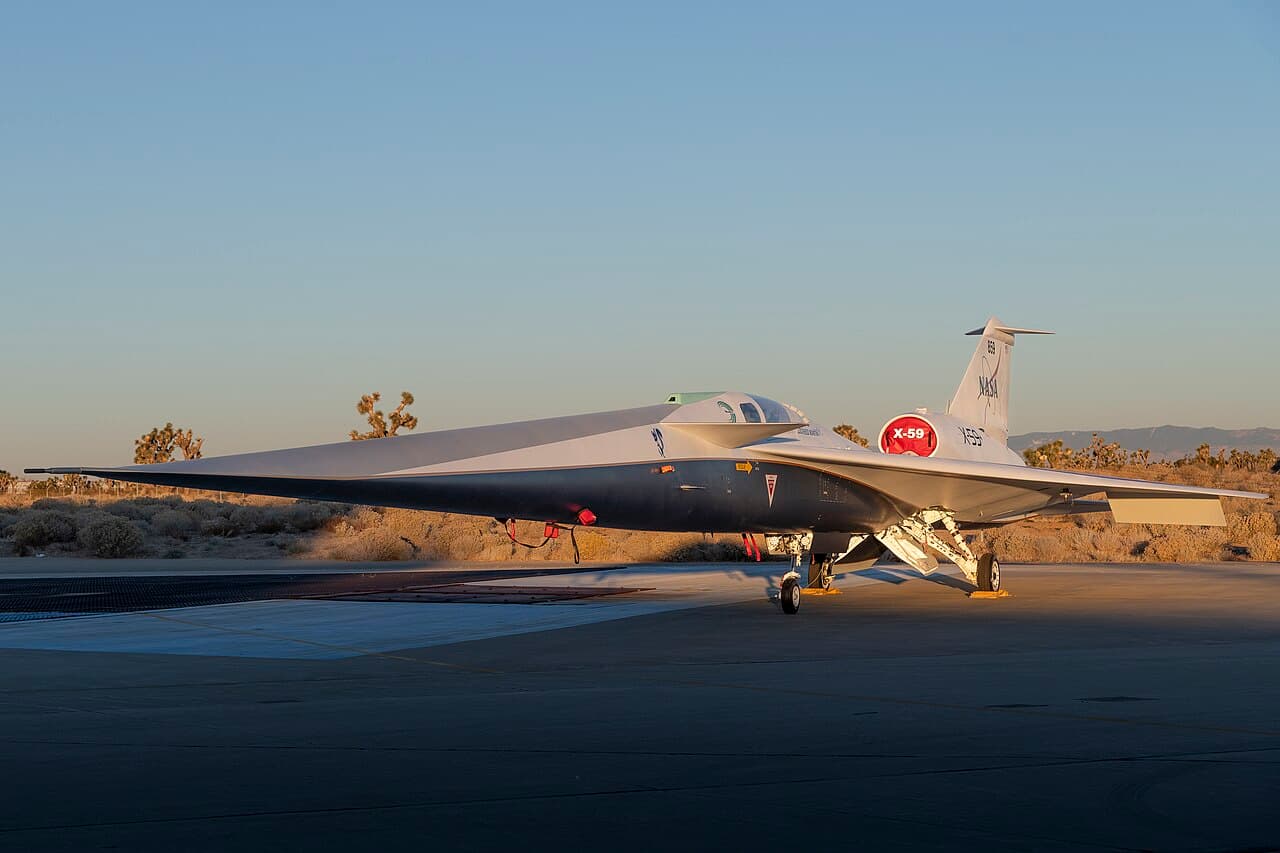
Image: NASA Headquarters / NASA/Steve Freeman · Public domain · via Wikimedia Commons
NASA's X-59 Quiet Supersonic Jet Reaches 55,000 Feet and Mach 1.4 in Testing
NASA's X-59 supersonic demonstrator achieves key speed and altitude milestones, paving way for noise impact community overflights to redefine sonic boom regulations.
The gist
NASA’s X-59 hits Mach 1.4 at 55,000ft, advancing toward public testing aimed at softening sonic boom restrictions.
NASA’s X-59 experimental aircraft reached a major flight milestone on 12 June 2026, climbing to 55,000 feet and accelerating to Mach 1.4. This achievement marks an important step in the aircraft’s envelope expansion testing phase, coming just six weeks after its initial maiden flight. NASA is focused on pushing the boundaries of quiet supersonic technology, aiming to demonstrate that supersonic overland flight can occur without disruptive noise impact.
The flight at 55,000 feet and Mach 1.4 was deliberately targeted to replicate the operating conditions under which the X-59 will perform its main mission: community overflights. These future flights will test how the aircraft’s unique sonic signature is perceived by people on the ground, addressing one of the most significant challenges for supersonic aviation: community noise disturbance caused by sonic booms.
NASA’s quiet supersonic demonstrator, developed with Lockheed Martin, incorporates design features specifically intended to minimize the loudness of its sonic boom. The resulting sound is projected to be a quiet thump, roughly comparable to the noise of a car door slamming shut. This contrasts starkly with the disruptive and window-shattering booms traditionally generated by supersonic aircraft, which led to a longstanding ban on supersonic flights over land.
The X-59’s community overflight program remains several months away, as NASA conducts further testing across varying altitudes and conditions to fully characterize the aircraft’s performance. An acoustic validation phase is also underway, during which researchers meticulously measure the supersonic acoustic signature to confirm the quiet thump is consistent and conforms to design expectations.
Following completion of the acoustic validation tests, NASA will begin the community overflight phase wherein the aircraft will fly over various populated areas. During these flights, surveys will be conducted to gather public feedback on the perception and acceptability of the sonic signature. This direct engagement with communities is critical to re-assessing the impact of supersonic flights on people living below flight paths.
The long-term goal of NASA’s X-59 program is to collect sufficient technical and public perception data to support a formal petition to the Federal Aviation Administration. NASA intends to urge the FAA to reconsider and potentially lift the decades-old ban on civilian supersonic flight overland. This regulatory barrier has constrained the broader development of commercial supersonic air travel despite advancements in aircraft design.
This program stands at the intersection of aerospace technology innovation and regulatory evolution. Earlier supersonic aircraft like Concorde achieved remarkable speeds but were limited by environmental noise regulations due to their loud sonic booms. The X-59 aims to break this paradigm by pioneering low-boom supersonic flight that communities can tolerate.
Lockheed Martin’s partnership with NASA has been instrumental in integrating the X-59’s unique configuration, which includes a long nose and shaping techniques designed to control shockwave formation. These design elements have been validated in wind tunnel and computational testing prior to flight trials, underpinning the recent success achieving supersonic cruise conditions.
As the X-59 completes the remaining flight test phases, the data gathered will provide a comprehensive picture of its sonic footprint under real operational conditions. The findings will be critical in shaping the future regulatory landscape and opening commercial possibilities that have eluded supersonic aircraft for over fifty years.
Read more
All Technology/eVTOL →
FAA Proposes Noise-Based Rules to Enable Supersonic Flight Over US Land
The agency has launched rulemaking aimed at allowing next-generation supersonic aircraft to operate over land under new noise standards.

Orlando International Airport to Build US's First eVTOL Vertistop with Flights Expected This Year
In an exciting move, the Greater Orlando Aviation Authority will proceed with approved plans to develop the United States first vertistop . Located on the grounds of Orlando International Airport (MCO), this is the first step in bringing electric vertical takeoff and landing to the Central Florida region.
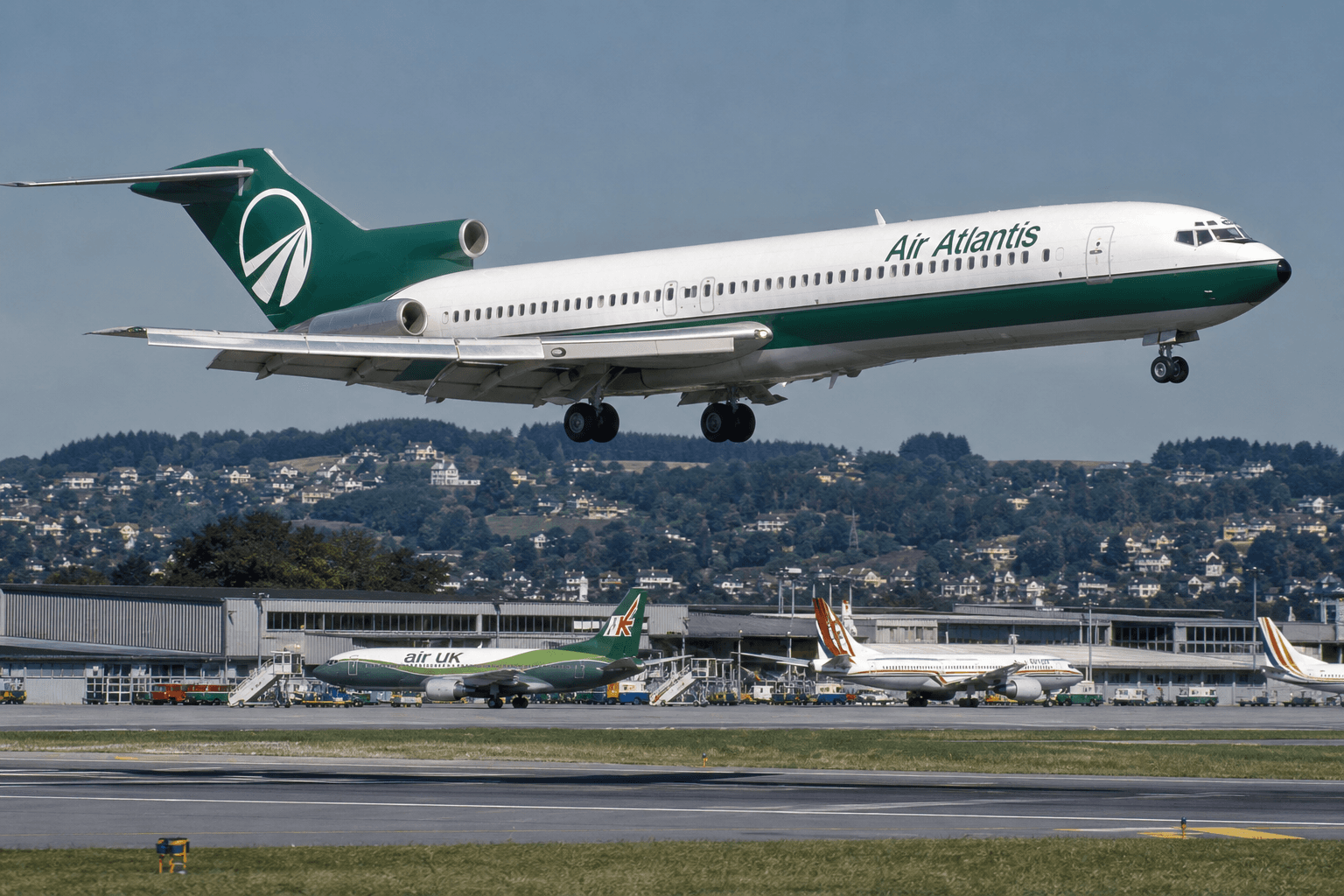
Air Atlantis, Portuguese Charter Airline, Shaped 1980s European Holiday Travel
For many plane spotters who frequented regional airports during the late 1980s and early 1990s, the sight of an Air Atlantis aircraft arriving from Portugal remains a fond memory. Wearing an attractive green-and-white livery and operating a fleet of Boeing 727s and 737s, the airline became a familiar visitor at airports across the UK and Europe during the package holiday boom. Although Air Atlantis existed for less than a decade, it played an important role in Portuguese aviation and helped support the rapid growth of tourism to the Algarve and Madeira before eventually being absorbed back into its parent company. The Birth of Air Atlantis Air Atlantis Boeing 707 at Birmingham. Photo: simon butler Air Atlantis was established in 1985 as a wholly owned subsidiary of Portugal’s flag carrier, TAP Air Portugal. During the 1980s, demand for leisure travel from northern Europe to Portugal was growing rapidly, particularly from the United Kingdom, Germany and Scandinavia. Rather than use its mainline fleet on charter operations, TAP created a dedicated airline that could focus entirely on the booming holiday market while allowing the parent airline to concentrate on scheduled international services. Based at Lisbon Airport, Air Atlantis began operations in 1986 and quickly became a major player in Portugal’s charter sector. Charter Flights Across Europe Air Atlantis 727-200. Photo: Rob Hodgkins The airline’s business centred on flying holidaymakers from across Europe to Portugal’s popular resort destinations. Flights linked cities throughout Britain, Ireland, Germany, France, Belgium, the Netherlands and Scandinavia with Lisbon, Faro, Funchal and Porto, carrying thousands of package holiday passengers every summer. British enthusiasts regularly saw Air Atlantis aircraft at airports including Manchester, Birmingham, Glasgow, Newcastle, East Midlands, Bristol, Bournemouth and many other regional airports. Their flights were often operated on behalf of major tour operators, meaning the airline became a familiar sight despite never operating scheduled services of its own. As well as leisure flights, Air Atlantis occasionally undertook ad hoc charter work and aircraft leasing for other airlines when demand required. The Air Atlantis Fleet Pedro Aragão, CC BY-SA 3.0 GFDL, via Wikimedia Commons Air Atlantis operated a fleet mostly in line with its parent, TAP Air Portugal, through whom it mostly procured its aircraft. In fact, the airline’s livery closely resembled that of the parent carrier through its use of white, green and red, reflecting the Portuguese flag. Air Atlantis began operations with Boeing 707-300, 727-100 and 737-200 aircraft in 1985. It later added Boeing 727-200 and 737-300 types as the fleet grew. In total, 19 aircraft were operated by Air Atlantis between 1985 and 1989. Perhaps the airline’s greatest attraction for enthusiasts was its fleet. The aircraft were configured in high-density seating layouts to maximise passenger capacity. Part of the Golden Age of Charter Flying Air Atlantis arrived at a time when charter airlines were flourishing across Europe. During the late 1980s, airports around the UK welcomed a fascinating variety of leisure carriers every summer. Britannia Airways, Dan-Air, Air Europe, Monarch, TEA, Spantax and many others regularly appeared alongside overseas operators such as Air Atlantis. For plane spotters, this meant regional airports often offered far greater variety than they do today, with unusual airlines and aircraft arriving from across Europe on weekly holiday flights. Why Did Air Atlantis Disappear? After Air Atlantis was closed down some of its fleet merged back into TAP Air Portugal. Photo: Aero Icarus By the early 1990s, the European airline market was changing rapidly. Charter and scheduled operations were becoming increasingly integrated, while deregulation created new opportunities for airlines to operate more flexibly. In 1993, TAP decided to wind up Air Atlantis and bring its charter activities back under the main airline. The fleet was gradually dispersed, with several aircraft finding new homes elsewhere around the world. Although the airline disappeared after only seven years, it left behind fond memories for enthusiasts who photographed its aircraft during the golden age of European package holidays. Do you remember seeing Air Atlantis at your local airport? Did you ever fly on the airline? Leave a comment below! For more articles on historic airlines and aircraft, remember to sign up for our free newsletter below! Title image: Maarten Visser

North Central Texas Council Launches $1M Fund for eVTOL Airport Chargers
The North Central Texas Council of Governments has opened a $1 million funding program for electric-aircraft charging equipment at public-use airports in the Dallas-Fort Worth region. Applications are due Aug. 7 at 5 p.m. CDT. The money was initially approved in September 2024 for a potential advanced-air-mobility demonstration connected to the 2026 World Cup. That plan did not proceed as originally envisioned. Arlington dropped expectations for carrying passengers during the tournament because aircraft certification and FAA regulations would not be completed in time, and NCTCOG later redirected the funding toward permanent charging infrastructure and airport readiness. The revised program also supports North Texas' participation in the larger eVTOL Integration Pilot Program ( eIPP ). The state’s participation in the initiative is led by the Texas Department of Transportation and is intended to develop infrastructure, routes and operating procedures for future electric-aircraft demonstrations and service. Airports in the council's 12-county planning area may seek awards of up to $200,000. The program does not require matching funds. Eligible expenses include an eVTOL charger and infrastructure directly required to install and operate it. Stand-alone electrical improvements that do not result in an installed charger are not eligible. The council said applications will be evaluated on airport planning documents, knowledge of advanced-air-mobility infrastructure, partnerships and implementation schedules. Proposed projects must also demonstrate how the equipment could support future aircraft operators, demonstrations or private investment.
The Daily Touch & Go
The day's best aviation news in your inbox. Free, no spam.