

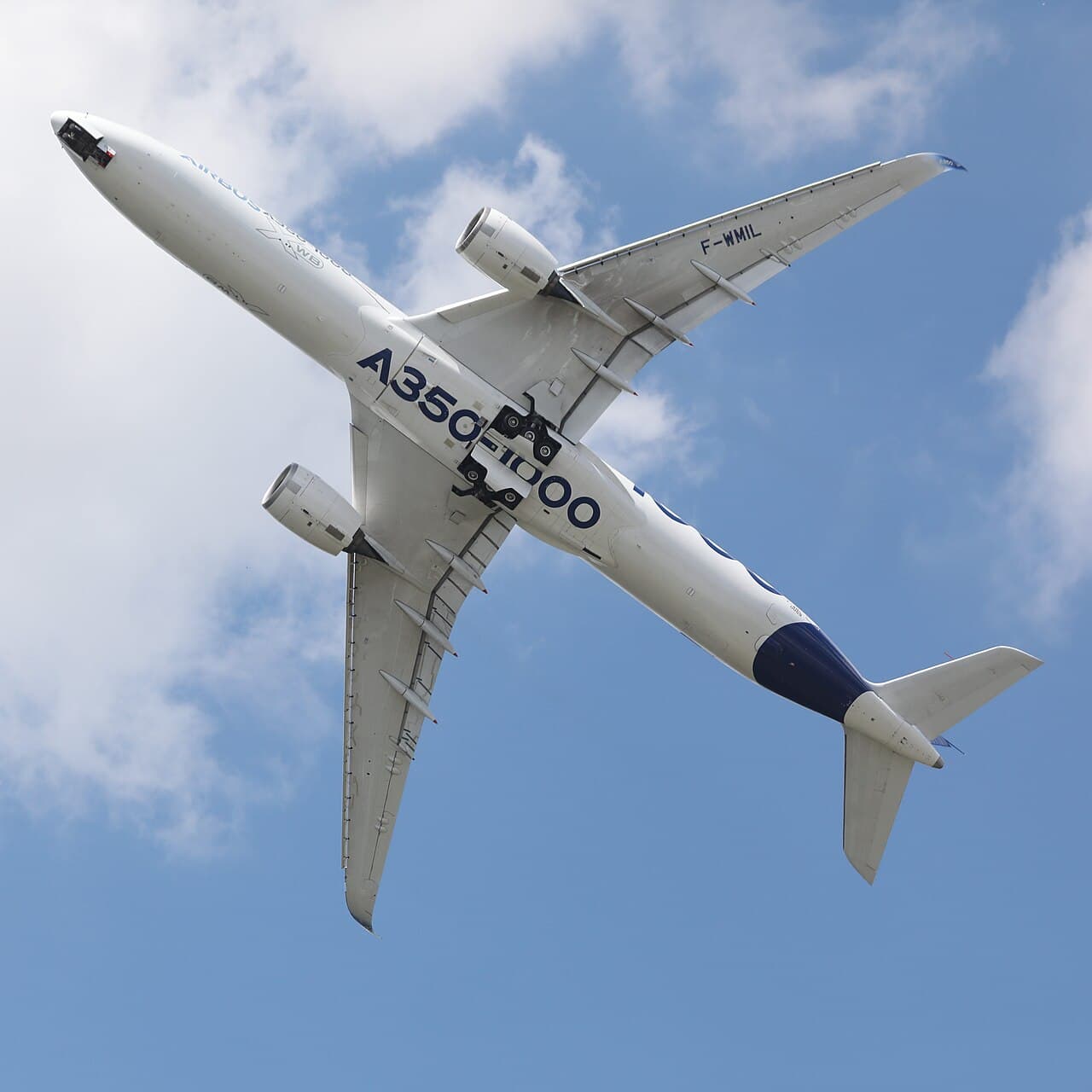
Image: New York-air · CC BY-SA 4.0 · via Wikimedia Commons
STARLUX Airlines Unveils AIRSORAYAMA Airbus A350-1000 at Phoenix Sky Harbor
STARLUX Airlines introduces the AIRSORAYAMA SILVER Airbus A350-1000 to North America with debut service to Phoenix Sky Harbor International Airport, showcasing innovative design and enhanced passenger experience.
The gist
STARLUX Airlines launches its AIRSORAYAMA Airbus A350-1000 in North America with a first landing at Phoenix Sky Harbor, blending art and aviation.
Continuing coverage
All Long-Haul Routes →- British Airways Ends 36 Long-Haul Routes From London Over Past Two Decades
- Alaska Airlines Debuts Boeing 787-9 Without Premium Economy Cabin Despite CEO's Admission
- SAS Evolves With New SkyTeam Alliance And Modern Airbus Fleet
- British Airways Leverages Airbus A380 to Maximize Capacity at Slot-Limited Heathrow
- Starlux Airlines adds striking silver-liveried A350-1000 to fleet
STARLUX Airlines marked a new chapter in its expansion by bringing the AIRSORAYAMA SILVER aircraft to the North American market on July 15, 2026. The Airbus A350-1000, co-created with renowned Japanese artist Hajime Sorayama, arrived at Phoenix Sky Harbor International Airport on Flight JX026. This event marked the STARLUX AIRSORAYAMA’s inaugural long-haul commercial service into the United States, cementing Phoenix as its first U.S. destination. A formal gate ceremony was held, attended by airline officials, local leadership, and members of the media to celebrate the aircraft's debut on American soil.
The AIRSORAYAMA project reflects a fusion of artistry and aerospace engineering. This series includes two distinguished Airbus A350-1000 aircraft – AIRSORAYAMA GOLD and AIRSORAYAMA SILVER – both distinguished by sleek, reflective surfaces and fluid designs inspired by Sorayama’s signature aesthetic. The design approach extends well into the cabin, which features curated amenities designed to provide passengers an immersive artistic and luxurious experience. The cabins are configured to serve four First Class suites, 40 Business Class seats, 36 Premium Economy seats, and 270 Economy seats, aiming to deliver a differentiated travel environment in every class.
Phoenix’s selection as the inaugural North American gateway for AIRSORAYAMA signals both strategic and economic intent. As one of the fastest-growing U.S. cities with increasing ties to Asian markets, Phoenix is becoming a notable hub for international travel and commerce. Mayor Kate Gallego emphasized that STARLUX’s introduction of the AIRSORAYAMA aircraft enhances Phoenix’s evolving profile as a global aviation crossroads, further bolstered by the airline’s successful half-year of operations in the city prior to the arrival of this flagship aircraft.
The debut event at Phoenix Sky Harbor featured multiple engagements, including presentations and media access to the aircraft. STARLUX representatives presented a commemorative aircraft model to Mayor Gallego, followed by guided tours of the newly unveiled cabin interiors, showcasing the airline’s dedication to design and passenger comfort. The tarmac access allowed for extensive photographic coverage, providing a rare glimpse of this unique collaboration between aviation and contemporary art.
Prominent figures from local aviation and business sectors participated in the ceremony, highlighting the broader significance of the arrival. Phoenix Sky Harbor Aviation Director Chad Makovsky, American Airlines’ Head of Partnerships Jeff Ogar, Alaska Airlines’ Managing Director of Partnerships & International Alex Judson, and STARLUX Chief Strategy Officer Simon Liu spoke about the momentous occasion. Their remarks focused on how the AIRSORAYAMA service deepens cross-cultural and commercial connections between the United States and Asia while promoting innovation in air travel experiences.
STARLUX Airlines plans to leverage the AIRSORAYAMA brand to broaden its global footprint, with scheduled flights from October 1, 2026 to Phoenix, Tokyo, and Prague. This network expansion positions the airline to further integrate its North American service with key international hubs, facilitating greater intercontinental connectivity and enhanced route diversity. The AIRSORAYAMA aircraft will be pivotal in showcasing STARLUX’s commitment to blending cutting-edge aviation technology with high-concept design.
Operationally, the AIRSORAYAMA’s Airbus A350-1000 platform is a modern widebody capable of efficient long-haul flights, combining advanced aerodynamics with a spacious cabin environment. The collaboration with Hajime Sorayama introduces a distinctive visual identity for the aircraft, setting it apart from conventional liveries and embracing a futuristic metallic motif. This approach extends STARLUX’s brand ethos, promising not only transportation but an artistic journey for passengers.
STARLUX’s investment in the AIRSORAYAMA concept exemplifies a new direction in airline differentiation focused on bespoke passenger experiences. By integrating art and technology, the airline aims to redefine luxury and comfort standards, appealing to discerning travelers seeking memorable flights. The move also signals a competitive strategy to establish a unique market position as STARLUX gains foothold in transpacific routes involving the rapidly growing Phoenix gateway.
While STARLUX has operated in Phoenix for six months prior to this introduction, the arrival of AIRSORAYAMA raises the profile of both the airline and the city’s airport as a nexus for innovative long-haul air services. Embedding the AIRSORAYAMA aircraft in its schedule highlights STARLUX’s confidence in Phoenix to support premium international routes and enhances the city’s attractiveness to global travelers and business interests.
Frequently asked questions
- What is the AIRSORAYAMA concept introduced by STARLUX Airlines?
- The AIRSORAYAMA concept involves two Airbus A350-1000 aircraft featuring designs by artist Hajime Sorayama with metallic textures and artistic cabin experiences, offering a unique luxury travel environment.
- Why was Phoenix Sky Harbor selected as the first North American destination for the AIRSORAYAMA aircraft?
- Phoenix is a fast-growing metropolitan area with increasing trade and travel connections to Asia, making it an ideal gateway for STARLUX Airlines to debut the AIRSORAYAMA aircraft in North America.
- What are the future route plans for STARLUX’s AIRSORAYAMA aircraft?
- Starting October 1, 2026, STARLUX plans scheduled AIRSORAYAMA flights connecting Phoenix, Tokyo, and Prague, expanding their global route network and intercontinental connectivity.
Read more
All Airports →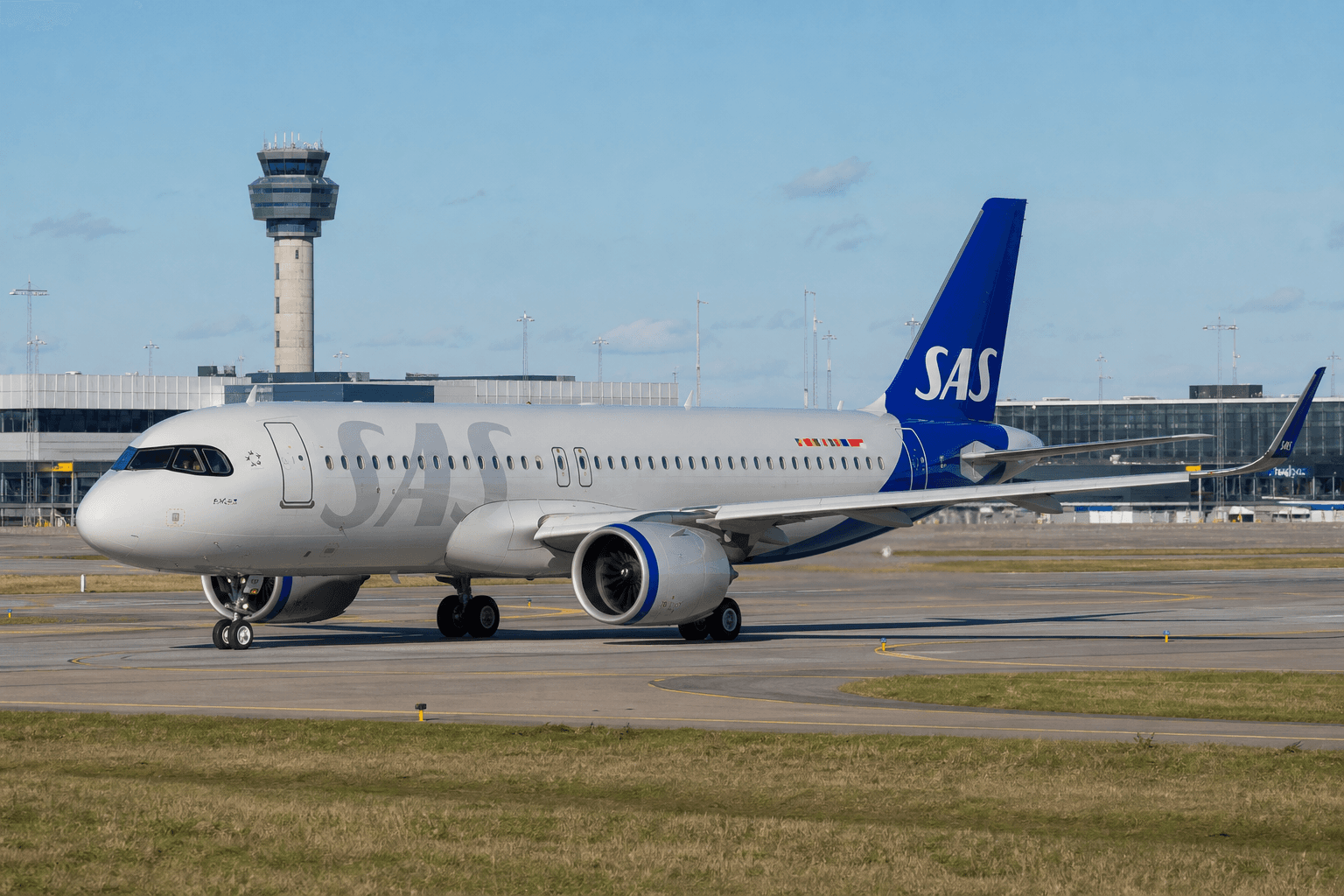
SAS Evolves With New SkyTeam Alliance And Modern Airbus Fleet
Scandinavian Airlines, better known simply as SAS , is the flag carrier of Denmark, Norway and Sweden. Founded shortly after the Second World War, it has grown into one of Europe’s longest-established airlines and remains one of the most recognisable carriers in Northern Europe. Following a major restructuring in the mid-2020s, SAS entered a new chapter in its history by joining the SkyTeam alliance and strengthening ties with Air France-KLM. Today the airline operates an almost all-Airbus jet fleet alongside regional turboprops, connecting Scandinavia with destinations across Europe, North America and Asia. Brief History of Scandinavian Airlines A historic photo of Bromma Airport. Credit SAS Museet. Scandinavian Airlines System (SAS) was officially founded on 1 August 1946 , when the national airlines of Denmark, Norway and Sweden combined their international operations into a single airline. The partnership allowed the three countries to compete more effectively on long-haul routes in the post-war era. During the 1950s and 1960s SAS became one of Europe’s most innovative airlines. It pioneered transpolar flights between Europe and North America via Greenland, helping reduce journey times, and later became one of the launch customers for the Douglas DC-8. The airline has operated many classic aircraft over the decades, including the Douglas DC-6, DC-7, DC-8, Caravelle, Douglas DC-9, Boeing 747, Boeing 767, McDonnell Douglas MD-80 and Boeing 737 Classic and Next Generation families. In more recent years SAS has become an almost entirely Airbus operator. Like many airlines, SAS faced severe financial difficulties during the COVID-19 pandemic. After entering Chapter 11 bankruptcy protection in the United States in 2022, the airline completed a major restructuring in 2024. This brought new investment from Air France-KLM, Castlelake, Lind Invest and the Danish government, while also ending SAS’ long membership of Star Alliance. On 1 September 2024 , SAS officially joined SkyTeam , marking one of the biggest alliance changes in recent aviation history. Current Bases and Operations Photo (c) SAS AB SAS operates from three primary Scandinavian hubs: Copenhagen (CPH) Stockholm Arlanda (ARN) Oslo Gardermoen (OSL) Among these, Copenhagen has become the airline’s principal international hub and continues to receive significant investment as SAS expands its long-haul network. The airline serves well over 100 destinations throughout Europe, together with intercontinental services to North America and Asia. Regional services are also operated through partner airlines and wet-leased aircraft, particularly within Sweden and Norway. Important and Notable Routes SAS has always been strongest on routes linking Scandinavia with the rest of Europe, but several long-haul services have become particularly significant. Among its busiest and best-known intercontinental routes are: Copenhagen – New York (JFK) Copenhagen – Chicago O’Hare Copenhagen – San Francisco Copenhagen – Seattle Copenhagen – Boston Oslo – New York Stockholm – Newark The airline also operates services to destinations including Tokyo and Shanghai, while Copenhagen remains the centre of almost all long-haul operations. Historically, SAS became famous for pioneering transpolar services over Greenland, establishing one of the fastest links between Europe and North America during the early jet age. Fleet Overview SAS A319 OY-KBT SAS has modernised its fleet considerably over the past decade and today operates one of Europe’s youngest Airbus fleets. Current Fleet (Last Update: July 2026) Aircraft Type In Service Airbus A319-100 4 Airbus A320neo 66 Airbus A321LR 3 Airbus A330-300 8 Airbus A350-900 4 ATR 72-600 6 Regional services are also operated by partner airlines using ATR 72s, CRJ900s and Embraer E195 aircraft under the SAS brand. Aircraft on Order 18 × Airbus A330-900neo (firm order) Additional long-haul aircraft remain under consideration as part of SAS’ fleet renewal programme. Airline Livery SAS introduced its current corporate identity in 2019 , replacing the classic dark blue cheatline that had been a familiar sight for decades. The new livery features a pale silver-grey fuselage with large dark blue SAS titles across the forward fuselage. The tail remains deep blue but now carries a simplified white SAS logo, while the engines are painted in matching blue. The overall design gives the airline a clean, modern Scandinavian appearance. However, enthusiasts should note that not every aircraft has yet been repainted . Several Airbus A320neo family aircraft continue to fly in the previous livery, making it possible to see both generations of SAS branding in service today. Special Liveries Unlike many airlines, SAS has generally preferred a consistent fleet appearance, although a handful of aircraft have carried promotional designs over the years. Occasionally, alliance branding and promotional decals also appear on individual aircraft. For example, this year Airbus A330 LN-RKR is wearing this special scheme marking the airline’s 80th anniversary. Airbus A319 OY-KBO is also in a special retro livery. Have you ever flown SAS? What do you think of the airline and its livery? Leave a comment below!
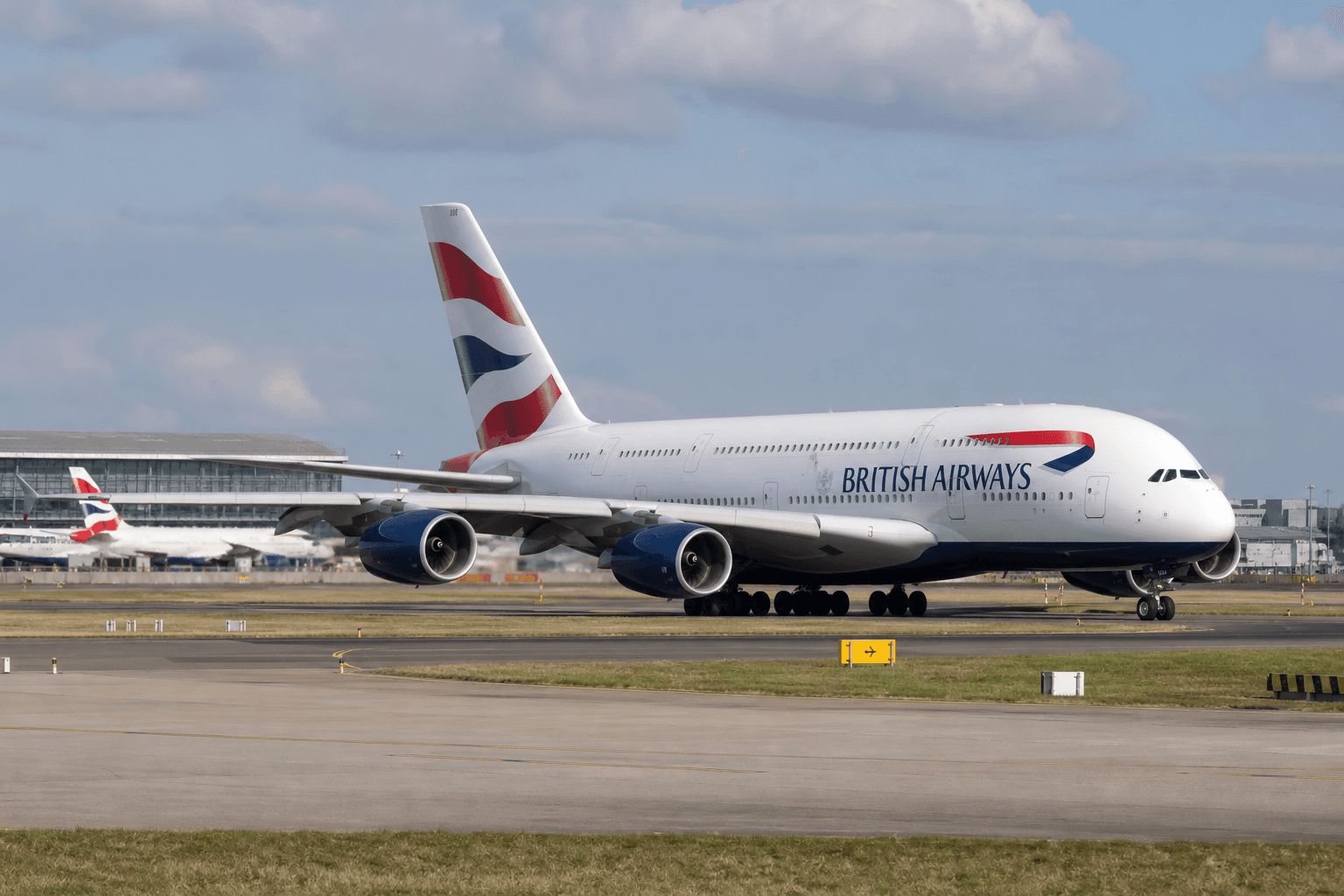
British Airways Leverages Airbus A380 to Maximize Capacity at Slot-Limited Heathrow
The Airbus A380 is the current icon of the British Airways fleet, serving as a critical tool in the airline's strategy at London Heathrow . In an era where many carriers have pivoted toward smaller, more fuel-efficient twin-engine jets, British Airways has doubled down on the world's largest airliner.
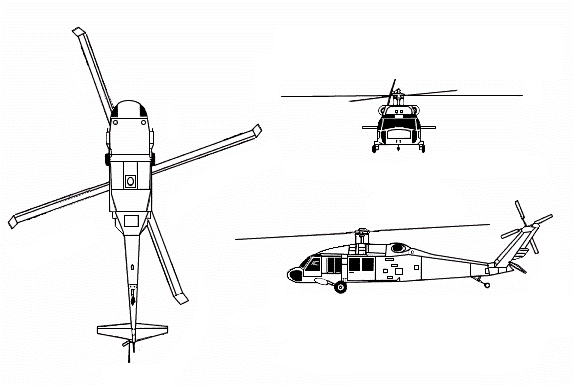
France combats Fontainebleau fires with Securite Civile helicopters and Czech Black Hawks
Authorities have deployed helicopters and CL-415 waterbombers to battle a Fontainebleau blaze, as assembly of the first European-built Firehawk begins. France's Securite Civile disaster relief agency continues to battle forest fires on multiple fronts, even halving its presence at the country's 14 July Bastille Day flypast to deploy airborne assets to a blaze currently raging to the south of Paris. Revealing the move in a post on X , the agency said a solitary helicopter joined the traditional display above the Champs-Elysees, while the "second was on duty over the Fontainebleau forest fire to support the rescue teams". Securite Civile operates a large fleet of Airbus Helicopters H145s – a mix of older variants and the newer five-bladed version – alongside 12 De Havilland Canada CL-415 water-bombers based at Nimes airport in southern France. Those fixed-wing assets have also been deployed to fight the Fontainebleau fire, scooping water from the river Seine near Chartrettes, a notable first. France is modernising its waterbomber fleet through the acquisition of new Canadair 515s. Paris recently doubled its commitment to the updated version of the legacy type, signing for two more examples in early June. 18h, les écopages continuent à Chartrettes en Seine-et-Marne #incendie #fontainebleau pic.twitter.com/oVbBMQjTEU — Antoine (@Ant01ne) July 13, 2026 Meanwhile, the Securite Civile has also leaned on firefighting assets from elsewhere in the EU. On 11 July, a Sikorsky UH-60 Black Hawk from the Czech Republic – deployed to France through the European Union's rescEU civil protection mechanism – carried out its first operation in the country, the Securite Civile says. Operating from Valence airport in southern France, two Black Hawks have been deployed on the operation, each equipped with a 3,540-litre (935USgal) Bambi Bucket and operated by Slovakia's Heli Company, a business in the Helicopter Alliance group . Both rotorcraft – OM-BHB and OM-BHK – are former US Army assets modified by Helicopter Alliance subsidiary Ace Aeronautics and owned by lessor SkyConnect Leasing . Prague has more firefighting helicopters on the way, having in November ordered three Sikorsky S-70 Firehawks through an agreement with Ceska letecka servisni (CLS) – another Helicopter Alliance company – and United Rotorcraft. Sikorsky’s Polish subsidiary PZL Mielec is currently assembling first Firehawk. Source: PZL Mielec An initial Firehawk from that order is now in final assembly at PZL Mielec – Sikorsky's Polish subsidiary – ahead of planned delivery in the fourth quarter of 2027. "The Czech Republic is not merely buying helicopters; it is pioneering Europe's first operational Firehawk capability," says Monika Kowalczykova, chief executive officer of CLS "Our partnership brings world‑class, multi‑mission aircraft to a region that faces increasingly severe wildfire threats, and it sets a benchmark that other European operators can follow." Each Firehawk is equipped with a 3,785 litre water tank, a retractable snorkel, twin engines and night‑vision capability.

Redbird Boosts Flight Simulator Realism with New Garmin G1000 NXi Avionics Upgrade
One of the best aspects of Redbird Flight Simulations ' aviation training devices (ATDs) is that with a change of the plexigas instrument panel and a swap out of the throttle quadrant you can be flying a different airplane. Those aircraft are about to become more realistic as Wednesday Redbird introduced an evolution of its flight deck software and hardware, bringing new high fidelity to the users of Garmin G1000 NXi avionics. Over the past 20 years there has been an increase in the use of simulation technology in the flight school environment. ATDs are cheaper to operate than aircraft, can be used in any weather, and serve as a better "classroom" because they can be paused with a push of a button when the learner falls behind the aircraft to allow instruction to happen in a less threatening environment. READ MORE: Redbird Partners With Avidyne to Make More Realistic Sims READ MORE: Redbird Appoints New CEO Redbird, one of the leaders in the field of simulation technology, has spent the past several years working on ways to increase the fidelity of its ATDs so they more accurately represent the aircraft they are meant to emulate. This enables more positive training for the learners as not only do they learn the procedures to fly the aircraft, but the ATD "flies" more like the real thing. "Flight training providers—from local flight schools to large, academy-style, Part 141 programs—continue to express a desire for highly realistic training devices that emulate exactly what their customers will experience in their aircraft fleet," said Redbird CEO Charlie Gregoire in a news release. "In our view, that means not only offering the look, feel, and functionality of specific aircraft cockpits but also the ability to represent and interchange between multiple aircraft configurations and avionics stacks in one device. The enhanced software and hardware options we are introducing today immediately deliver more training value without sacrificing a reconfigurable cockpit architecture that better serves flight schools that have multiple makes and models in their fleet." Redbird’s Enhanced G1000 panel [Credit: Redbird Flight Simulations] Founded in 2006, Redbird makes desk-style training devices and larger, more-immersive units, such as the cockpit-like SDX and the motion-enabled FMX. Redbird ATDs are being utilized in more than 50 countries at flight schools, colleges and universities, and K-12 programs as well as in the homes of individual pilots looking for a way to maintain proficiency away from the airport. The G1000 NXi software emulation and an accompanying "E001" instrument panel represent the first wave of upgrades. The NXi software, set to release on August 17, includes improved graphics, faster processing speeds, and enhanced operational features used for training with integrated flight decks and technically advanced aircraft (TAA), such as Synthetic Vision Technology (SVT), HSI mapping on the primary flight display, and airport environment tools like SafeTaxi. According to Redbird, the E001 enhanced aircraft panel will be available in early 2027. It will be the first installment in a new family of instrument panels with higher-fidelity hardware and embedded video displays. It features hardware for two G1000 GDU 1054Bs, a GMA1347 audio panel, and knobs to allow for three analog standby instruments. Redbird, based in Kyle, Texas, near Austin, noted the panel is more flexible and intelligent than previous versions, capable of querying the rest of the hardware in the training device to determine which aircraft configurations can be simulated accurately at a given time. Redbird also said the "roadmap" of the Enhanced Aircraft panels includes several configurations of popular Avidyne and Garmin avionics, including the IFD and GTN series—the same ones found in training aircraft on the ramp. "Everything we will be developing for the Enhanced Aircraft product line is modular and backward compatible with our existing install base, meaning customers with devices dating back to the original FMX 1 can update individual software and hardware components piecemeal," Gregoire said. "However, our product roadmap is focused on being able to offer complete, higher-fidelity cockpits for specific aircraft configurations." Redbird at AirVenture Redbird will be showcasing the G1000 NXi software and a prototype of the E001 instrument panel at booth No. 301 at EAA AirVenture Oshkosh on July 20-26, along with a prototype of an enhanced yoke for Cirrus SR20 and SR22 configurations and plans for enhanced throttles.
The Daily Touch & Go
The day's best aviation news in your inbox. Free, no spam.