

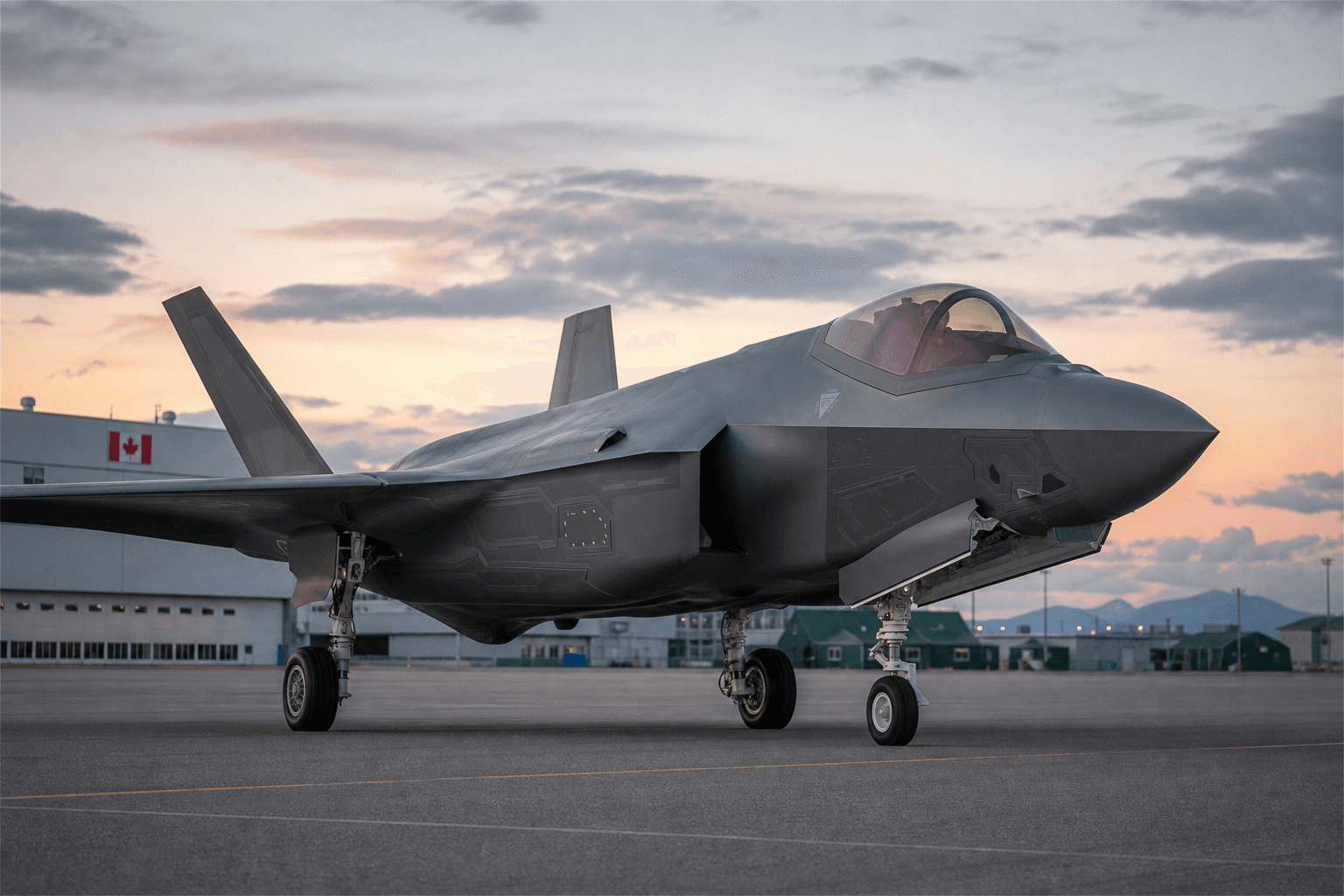
Illustration: The Touch & Go
Canada Quietly Advances F-35 Fighter Jet Payments Amid Public Debate on Purchase
While public discussions in Canada focus on whether to cancel or pursue the F-35 fighter order, the government has already funded 30 jets including initial deliveries and long-lead component payments.
The gist
Canada has discreetly funded payments for 30 F-35 jets, moving the procurement forward even as political debates on the fighter purchase continue.
Continuing coverage
All F-35 →- UK F-35s intercept Russian Tu-142 near Royal Navy carrier HMS Prince of Wales
- Trump signals lifting Turkey sanctions and reconsiders F-35 sales amid S-400 dispute
- UK Defence Investment Plan boosts Global Combat Air Programme and unmanned systems, trims older fleets
- Germany to Expand F-35 Fleet Amid FCAS Fighter Program Collapse
- Six F-35Bs Delivered Without Radars Amidst Upgrade Challenges, Program Director Reveals
Canada's future fighter jet procurement has been publicly mired in debate, with government officials weighing the purchase of Lockheed Martin's F-35 stealth jets against alternatives like Saab's Gripen. Despite ongoing reviews and political uncertainty surrounding costs, trade relations with the U.S., and defense dependence, Ottawa has been steadily advancing payments for these aircraft behind the scenes.
The procurement process shows that Canada initially ordered 16 F-35 jets, with deliveries slated to begin in late 2026. In parallel, the government has commenced payments for long-lead components related to another 14 jets, signaling a combined commitment to about 30 aircraft in various stages of production and funding. These actions maintain Canada's place in the global F-35 manufacturing schedule, ensuring production continuity despite public negotiations.
This progress reflects the complex nature of multi-decade defense programs, which differ vastly from typical government purchases. The F-35 production system spans a multinational supply chain with nearly 2,000 suppliers, requiring advanced purchase of specialized parts such as avionics, engine components, and radar systems to maintain the pace of assembly. Interruptions or delays in ordering can compromise production timelines and delivery slots across this tightly coordinated industrial network.
Canada's Future Fighter Capability Project originally envisioned acquiring 88 F-35s to replace the aging CF-18 fleet. While the base acquisition cost is currently pegged at around $14.1 billion USD ($19.8 billion CAD), fully factoring in life cycle expenses - including infrastructure, training, and sustainment - raises the total spend near $19.8 billion USD ($27.7 billion CAD). The program encompasses not only aircraft acquisition but also comprehensive modernization of pilot training and operational support extending into mid-century.
The Canadian government stresses that these incremental payments do not represent final confirmation of the complete 88-aircraft buy. Instead, they are intended to preserve manufacturing schedule positioning as ongoing political and strategic reviews continue. Prime Minister Mark Carney described these commitments as small financial measures designed to maintain flexibility amid broader policy assessments.
A significant dimension of the debate arises from tensions between Canada and the United States on trade and defense cooperation. Some policymakers and industry advocates express concern about becoming overly dependent on U.S. defense systems, driving interest in alternatives like Saab's Gripen, which promises greater domestic assembly and technology transfer.
Saab's Gripen E offers a lighter multirole fighter option capable of speeds up to Mach 2 and suitable for dispersed operations with rapid turnaround times. Industrial proposals highlight potential for 12,000 high-technology jobs in Canada through local assembly and supply arrangements. Supporters argue this alternative could help bolster Canada's aerospace sector and reduce reliance on American suppliers.
However, shifting from the F-35 to a different platform involves tradeoffs, including logistical complexity and potential disruptions to existing modernization plans. Maintaining the current procurement trajectory by securing production slots safeguards against delays in infrastructure upgrades, pilots' training, and fleet readiness, ensuring the Royal Canadian Air Force continues its transition without interruption.
Frequently asked questions
- How many F-35 aircraft has Canada already paid for?
- Canada has paid for an initial 16 F-35 aircraft and begun payments for long-lead components for another 14, totaling commitments for about 30 jets.
- Why is Canada making payments for F-35s amid ongoing political debate?
- Payments for long-lead components preserve Canada's manufacturing schedule and production slots, maintaining flexibility while policy reviews continue.
- What alternative fighter jet is Canada considering besides the F-35?
- Canada is considering Saab's Gripen E, which offers domestic assembly potential and lower operating costs as an alternative multirole fighter.
Read more
All Military/Defense →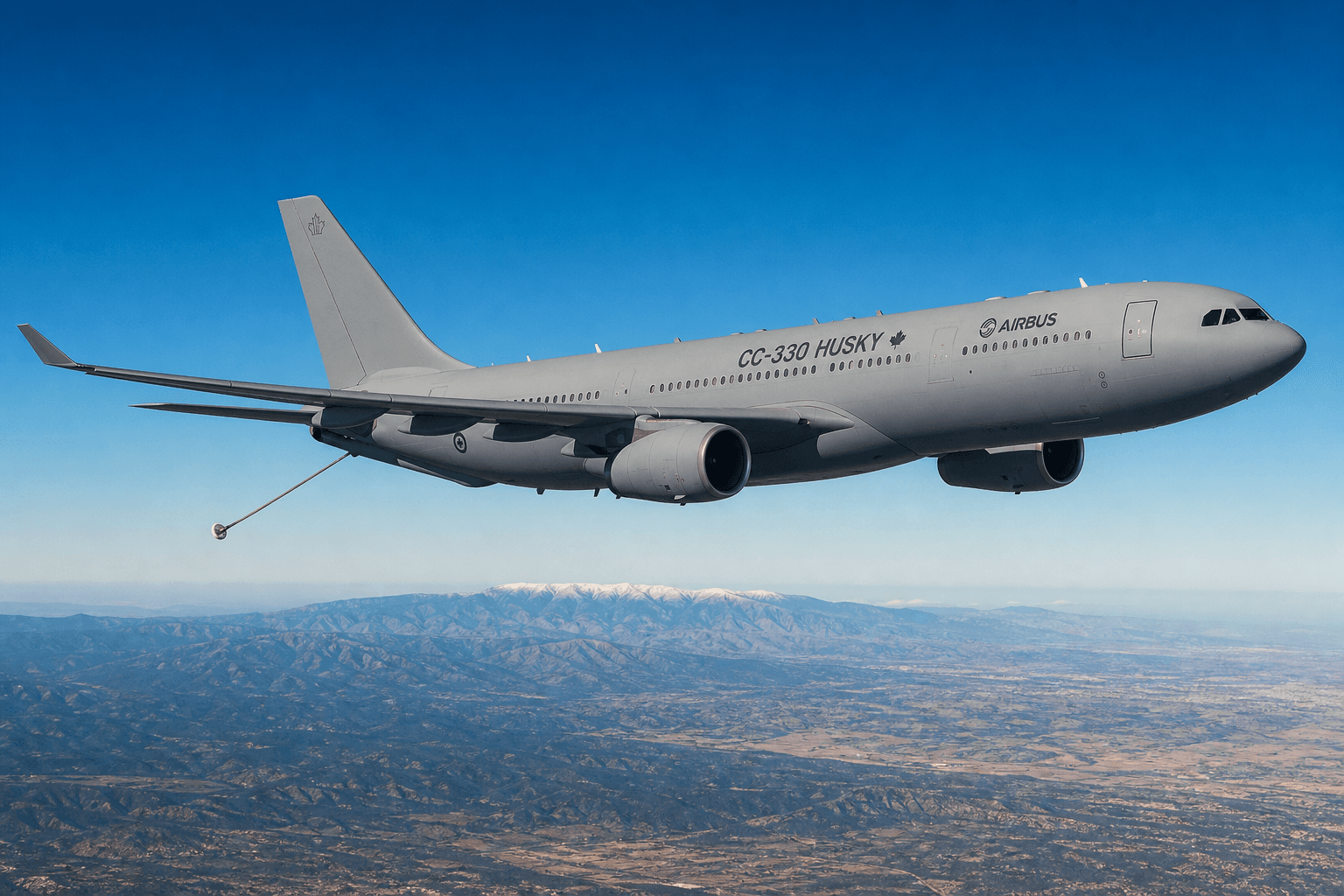
Canada's first newly built CC-330 Husky tanker completes maiden flight in Spain
Canada's first new-build CC-330 Husky tanker has completed its maiden flight from Airbus' facility in Getafe, Spain, marking a new milestone in the Royal Canadian Air Force's program to replace its aging CC-150 Polaris fleet. The aircraft flew on July 2, 2026, according to Airbus. It is expected to be delivered to Canada in 2027 after conversion and flight testing. The CC-330 Husky is Canada's designation for the Airbus A330 Multi Role Tanker Transport, a military tanker and transport aircraft based on the A330-200 airliner. The new-build aircraft is part of Canada's Strategic Tanker Transport Capability project, which will give the RCAF a fleet of nine CC-330 Huskies. The fleet will include four new Airbus A330 MRTTs and five used A330-200 aircraft converted to MRTT configuration. Canada has already received transport-configured CC-330 aircraft, but the latest flight marks the first flight of a new-build aircraft being prepared for the full tanker role. The Government of Canada says the CC-330 fleet will replace the CC-150 Polaris and support air-to-air refueling, military passenger and cargo airlift, medical evacuations and strategic transport for Government of Canada officials. The new fleet will give Canada additional tanker and long-range transport capacity for Canadian, NORAD, NATO and coalition missions. The first full MRTT-capable CC-330 delivery remains scheduled for 2027, according to the Government of Canada. Initial operational capability is planned for 2028-2029, with final operational capability expected in 2032-2033. The CC-330 program has moved through several milestones since Canada selected the A330 MRTT to replace the Polaris. Canada's first used A330-200 arrived in the country in August 2023 for acceptance work and use by the RCAF in the strategic airlift role. The first CC-330 entered service with the RCAF in November 2023, followed by a second aircraft in February 2024. Canada accepted its fifth and final used CC-330 in February 2025. In June 2025, Canada's first new CC-330, known as Husky 006, was flown from Airbus' facility in Toulouse, France, to Getafe, where it began conversion work to the multi-role tanker transport configuration. The Government of Canada awarded the main CC-330 acquisition contract to Airbus Defence and Space in June 2023. The Government of Canada awarded Airbus Defence and Space a CAD 3.6 billion contract in June 2023 for nine CC-330 aircraft, associated equipment, integrated logistics support elements, training simulators and sustainment. Canada also awarded three long-term in-service support contracts for the CC-330 fleet in 2026. Two contracts went to L3Harris MAS for maintenance and materiel support, while a third went to Airbus Defence and Space for original manufacturer support services. The Government of Canada lists the CC-330 as a twin-engine, long-range multi-role tanker transport aircraft with seating for more than 250 passengers and a range of 13,900 km with a 10-ton payload. The RCAF plans to operate the CC-330 fleet from main operating bases in eastern and western Canada. CFB Trenton will serve as the eastern main operating base, while Canada has been negotiating with Edmonton International Airport for a western main operating base.
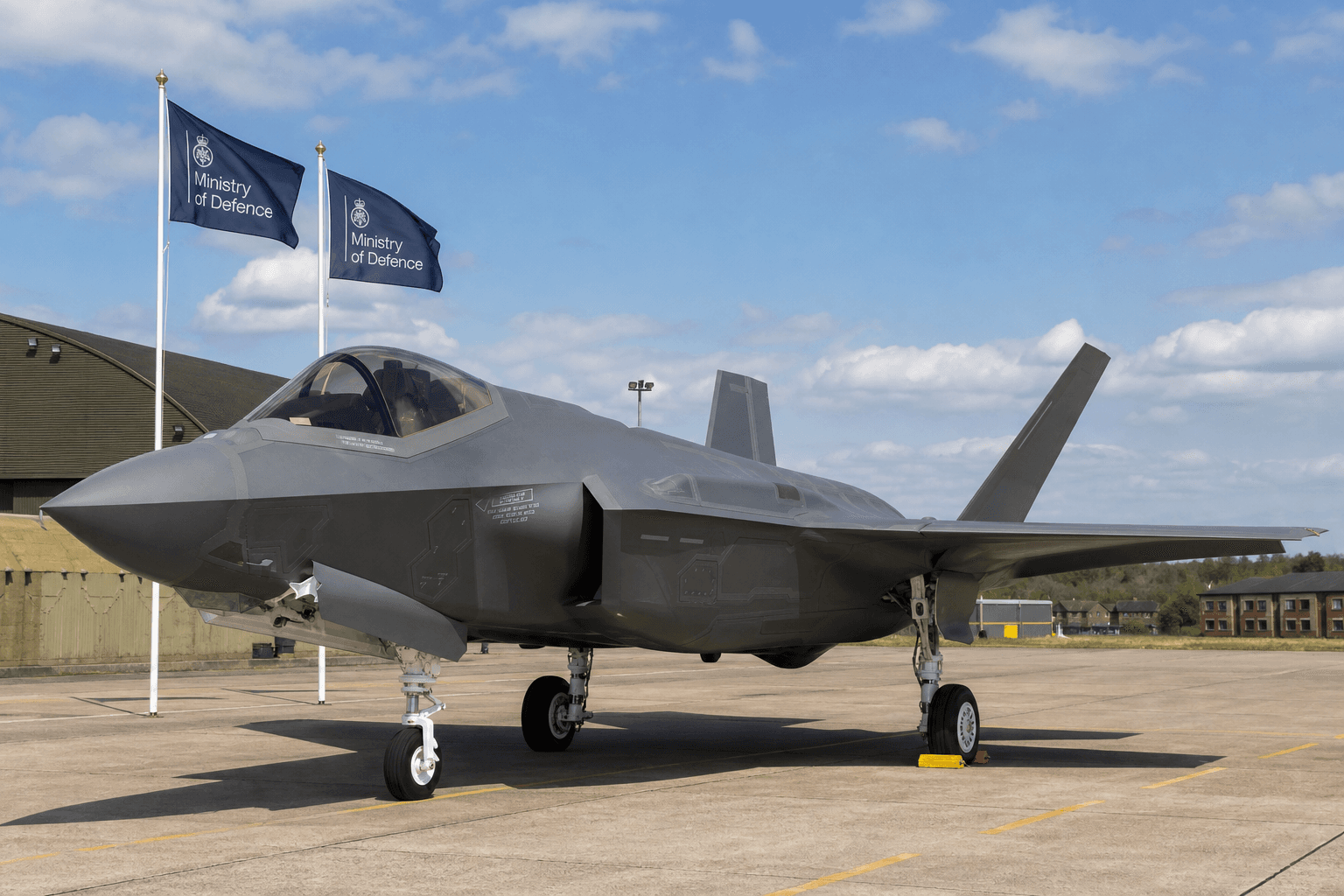
UK Defence Investment Plan boosts Global Combat Air Programme and unmanned systems, trims older fleets
Military expenditure rises, but MoD also announces “hard but necessary decisions”. The UK Ministry of Defence (MoD) has published its long-awaited Defence Investment Plan (DIP), committing fresh funding to the Global Combat Air Programme (GCAP) and confirming a previously announced plan to buy 12 Lockheed Martin F-35As, but also detailing a series of new platform…
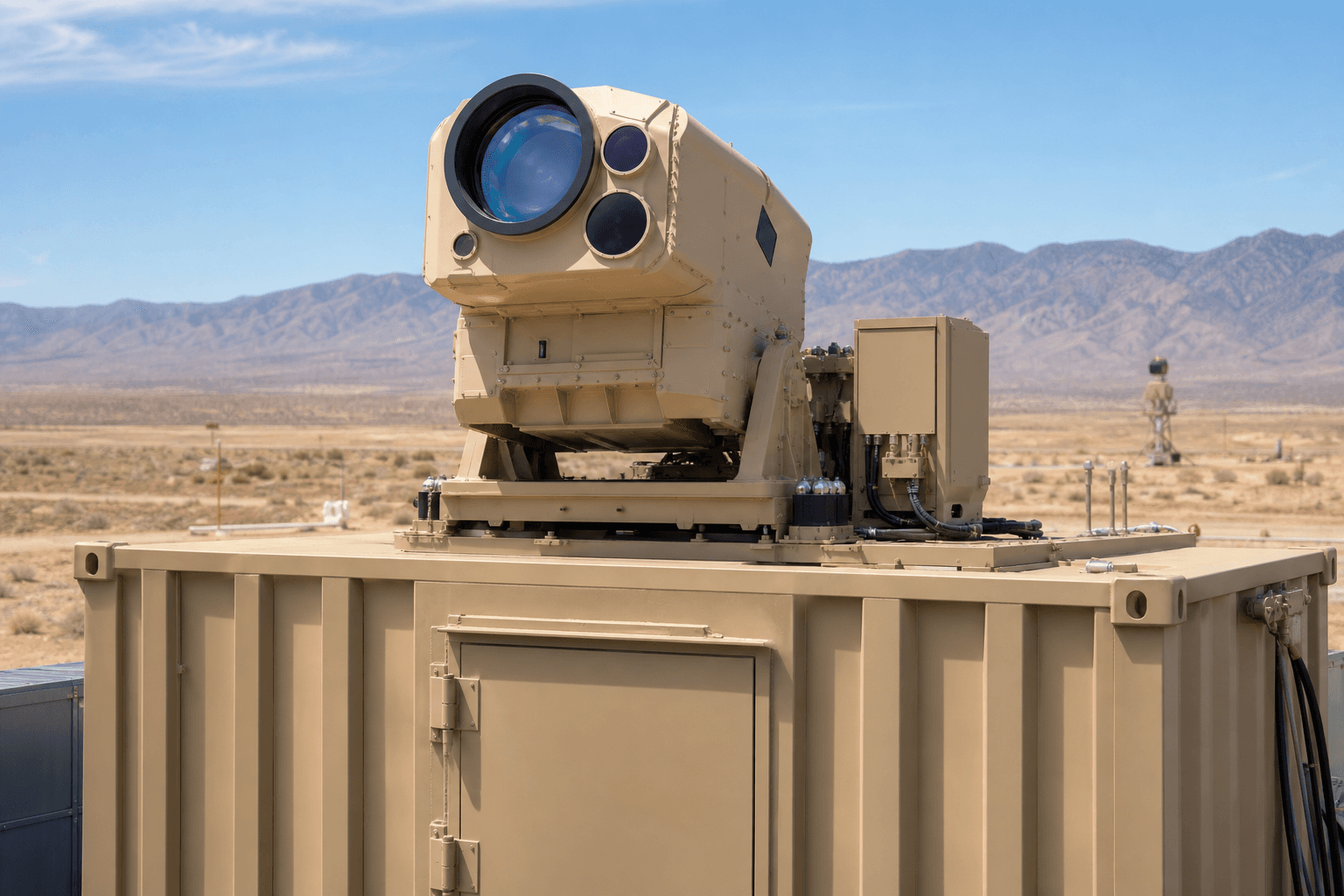
Pentagon Accelerates Fielding of High-Power Laser Weapons to Counter Drone and Missile Threats
For decades, military laser weapons promised revolutionary capability but rarely moved beyond laboratory testing and field demonstrations. That is beginning to change. The Pentagon's decision to award nLIGHT Defense and Lockheed Martin Aculight agreements worth an initial $86 million, with a combined program ceiling of $847 million, reflects an effort to turn high-energy laser prototypes into deployable weapons against drones and cruise missiles. The immediate goal is to field containerized systems beginning at about 150 kilowatts of power, then scale them into the 300- to 500-kilowatt range needed to tackle harder and faster targets. The sudden interest in laser weapons has less to do with realizing a science fiction dream than with the brutal economics of modern air defense. Militaries increasingly face inexpensive drones that can overwhelm defenses through sheer numbers. Shooting down a relatively cheap unmanned aircraft with a missile costing hundreds of thousands or millions of dollars may work tactically, but it becomes difficult to sustain during a prolonged attack. A laser changes that equation. Once the military has paid for the weapon, its power supply and cooling system, each engagement mainly consumes electricity. That gives laser weapons what defense officials call a "deep magazine": they can continue firing as long as the system can generate enough power and shed enough heat. Traditional air-defense systems cannot do that. Every missile launch removes one expensive interceptor from a finite supply that must be manufactured, transported, stored and reloaded. The comparison is not quite as simple as "a few dollars of electricity versus a multimillion-dollar missile." Laser systems remain expensive and require substantial support equipment. Still, their marginal cost per shot could make them valuable against the high-volume drone and missile attacks now shaping military planning. What does 150 kilowatts actually mean? Laser power ratings can sound abstract, but they are reasonably straightforward. A 150-kilowatt-class weapon is powerful enough to engage unmanned aircraft and other relatively vulnerable aerial targets when the system can maintain a focused beam on them. The next step, between 300 and 500 kilowatts, would give the weapon more energy to damage tougher targets in less time. The Pentagon sees that class as more suitable for cruise missile defense. Power alone does not determine whether a laser will actually work, however. The system must detect the target, track it precisely and hold the beam on one vulnerable point long enough to cause structural damage, ignite fuel, disable controls or destroy a critical component. The farther away the target is, the harder it is to shoot down. The beam must also remain tightly focused as it travels through the atmosphere. Air turbulence can distort it, while clouds, fog, smoke, dust and heavy moisture can absorb or scatter its energy. That means lasers will not replace missiles. They will add another layer to air defenses, giving commanders a cheaper option when conditions and target geometry allow it while preserving missiles for threats that lasers cannot reliably engage. The race for more power The Pentagon is not stopping at 500 kilowatts. Under the High Energy Laser Scaling Initiative, or HELSI, nLIGHT is working toward a one-megawatt-class laser. The company demonstrated a 300-kilowatt-class system during an earlier phase and later received additional contract options that increased its Phase 2 award from $86 million to $171 million. The three-year effort aims to produce a one-megawatt-class prototype. How powerful is a megawatt laser? One megawatt equals one million watts. Concentrating that energy into a controlled beam creates the potential to attack much more demanding targets. A quick physics refresher helps put that number in perspective. A watt measures how quickly energy is delivered, and one watt equals one joule per second. A joule, as many elementary physics students will know, is roughly the energy required to lift a medium-sized apple one meter off the ground. A one-megawatt laser delivers about one million joules every second, concentrated into a beam. If engineers can keep that beam tight and hold it on the target, surfaces heat, coatings burn, metals soften and structures fail quickly. At that power level, the question is no longer whether the laser is powerful. It is whether engineers can aim it, hold it in place and keep the weapon from cooking itself. A one-megawatt weapon is not simply a 300-kilowatt laser with the power turned up. Higher power creates more heat, places greater demands on electrical generation and makes beam quality increasingly difficult to maintain. Engineers must package the laser, optics, tracking equipment, power supply and cooling hardware into something military forces can move and operate outside a laboratory. nLIGHT uses an approach called coherent beam combining. Rather than building one enormous laser, the system combines multiple laser sources so they behave like a more powerful single beam. The company says it is trying to preserve beam quality while shrinking the full weapon into a transportable package. Its directed-energy systems are intended to support layered land and naval defenses against drones, rockets, artillery, mortars and missiles. nLIGHT wants to fit a ruggedized system into a standard shipping container while leaving room for precision long-range tracking and adaptive optics. That engineering challenge has defeated earlier laser programs. The US military has pursued directed-energy weapons for decades, including the Boeing YAL-1 Airborne Laser, a modified 747-400F fitted with a chemical laser intended to destroy ballistic missiles during their boost phase. The aircraft demonstrated the concept but proved too costly and operationally cumbersome to become a practical weapon. I attended a Boeing briefing in California on the YAL-1 program in early 2010. A general in an olive-drab uniform, his chest covered with brightly colored service ribbons, described the concept to a roomful of reporters. Smiling, he offered a gruesome illustration of what this kind of weapon could do. A laser aboard a US military aircraft, he said, could "melt the head off Saddam Hussein from three miles away." Saddam Hussein had already been dead for years, but the comment painted a vivid picture. I raised my hand and asked whether he worried that US adversaries would eventually acquire the same technology and use it against us. The general's smile faded. He shrugged. "Weapons proliferate," was all he said. Modern solid-state and fiber lasers avoid some of the problems associated with large chemical systems, but they still need enormous amounts of electrical power, precise beam control and effective cooling. The difference now is that weapons and military technology can proliferate at something closer to commercial speed. Cheap drones, loitering munitions and increasingly autonomous systems are spreading rapidly, forcing militaries to find defenses that do not always involve firing another explosive projectile. Jamming, spoofing, blinding sensors and damaging electronics have become part of the defensive mix. So have lasers. An unlikely defense company nLIGHT finds itself in an unusual position. For years, it was a mostly anonymous company building high-power fiber lasers for industrial applications. Think sheet-metal cutting for commercial heating and ventilation systems that eventually end up on the roof of an office building. Very few people would have identified nLIGHT as an emerging defense contractor, much less a potentially important one. The company's founder and longtime CEO, Scott Keeney, began his career as director of manufacturing at Pacific Coast Feather, a bedding company that produces pillows and comforters. That background hardly screams "future player in the military-industrial complex." Then the threats changed, and the Pentagon su

Socata TB30 Epsilon pilots meet French Air Force jet team during US tour
A spur-of-the-moment idea morphed into a one-of-a-kind get together between general aviation pilots flying Socata TB30 Epsilon piston-engine military trainers and their jet counterparts flying the blue-white-and-red livery of the French Air and Space Force during a stopover at Martin State Airport near Baltimore July 3.
The Daily Touch & Go
The day's best aviation news in your inbox. Free, no spam.