


Golden Dome Missile Defense System Achieves First Successful Directed-Energy Test
US Defense Secretary Pete Hegseth confirmed the Golden Dome shield executed a flawless first test using directed-energy technology against drones and cruise missiles.
The gist
Golden Dome’s initial test successfully employed directed energy to intercept multiple aerial threats, marking a key step in the new US missile defense program.
Continuing coverage
All Missile Defense →The United States has advanced its homeland missile defense efforts with the first milestone test of the Golden Dome system, which US Defense Secretary Pete Hegseth confirmed was a full mission success. Conducted under the Trump administration’s directive to protect the continental US from evolving aerial threats, the trial involved the use of cutting-edge directed-energy weapons to counteract incoming targets. Hegseth personally witnessed the exercise and reported that the Dynamic Defense Autonomous Defeat (DDAD) system flawlessly and autonomously detected, targeted, and neutralized numerous threats, including drones and cruise missiles.
Golden Dome for America is an ambitious layered missile defense shield designed to protect the nation from a broad spectrum of aerial incursions such as ballistic missiles, hypersonic weapons, cruise missiles, and drones. The program is being developed in phases by multiple entities within the US military apparatus, including US Northern Command, US Space Command, and the Missile Defense Agency. This collaborative approach aims to integrate sensors, command-and-control elements, various interceptors, and potentially space-based technology into a unified defense network.
The recent test centered on the effectiveness of directed-energy weapons, a category encompassing high-energy lasers and high-power microwave systems. These weapons offer a promising alternative to traditional missile interceptors by potentially providing a lower-cost, rapid-response means to engage small, fast, or numerous targets. Directed energy is particularly useful against drones, which have become prevalent battlefield threats that are often too numerous or inexpensive to counter efficiently with conventional interceptors.
Intercepting cruise missiles with directed energy presents a more complex challenge due to the missiles’ ability to fly at low altitudes, sustain high speeds, and perform evasive maneuvers. Successful engagement requires the weapon to sustain a damaging energy beam on the target long enough to cause destruction. Additionally, environmental factors such as clouds, fog, rain, smoke, and dust can degrade laser performance by scattering or absorbing the beam, which complicates reliability under real-world conditions.
Hegseth’s announcement highlighted that the Golden Dome’s DDAD system dynamically defeated every incoming threat during this test, effectively stopping drones and cruise missiles in their tracks. However, he did not divulge sensitive technical details such as the test location, the number or specific types of targets, or the exact systems employed. The success of this test demonstrates a breakthrough in autonomous targeting and engagement capabilities of directed-energy systems within a comprehensive missile defense framework.
President Donald Trump mandated the development of this next-generation missile defense shield in January 2025, underscoring the administration’s focus on defending America’s citizens and critical infrastructure against foreign aerial attacks. While Golden Dome is promoted as a major national defense priority, it also faces scrutiny regarding feasibility, costs, and the timeline required to operationalize its envisioned capabilities across all threat vectors.
Golden Dome’s encompassing vision is to erect a multi-layered protective barrier that fuses emerging technologies to counter increasingly sophisticated threats. It intends to amalgamate sensors and interceptors with command systems to create a responsive and adaptive defense posture. The successful directed-energy test represents a tangible step forward in demonstrating part of this system’s technological foundation, particularly in the autonomous defeat of low-signature aerial threats.
Though the recent achievement is encouraging, the Golden Dome program has not yet been validated as fully operational nor proven effective across its entire mandate. Directed-energy weapons remain at the cutting edge of military technology, with challenges to overcome in target acquisition, tracking, power generation, and environmental sensitivity. Nonetheless, this milestone shows progress in integrating these novel capabilities into a cohesive national defense system.
As Golden Dome continues its phased development, the integration and scalability of directed-energy systems alongside other missile defense components will be critical. The joint efforts of military commands and defense agencies underscore the complexity and ambition of the project. This initial test success serves as a benchmark for subsequent evaluations and an indicator of evolving US homeland defense strategy priorities.
Read more
All Military/Defense →
Ukrainian Drone Maker F-Drones Launches First US Production Line in Ohio
F-Drones is the first Ukrainian producer authorised by Kyiv to export its uncrewed weapons to the US military. For the first time, a Ukrainian manufacturer of military drones is establishing a production line in the United States. F-Drones specialises in assembling the small, first-person view (FPV) quadcopters that have become ubiquitous with the more than…

B-2 Spirit Bomber Equipped with Functional Crew Rest Facilities for Ultra-Long Missions
The Northrop B-2 Spirit is not designed for comfort; it is designed survive the first night of war. It is designed to be one of the first aircraft to kick in the proverbial door and carry out some of the operation's opening strikes. Unlike other bombers in service with the US, Russia, and China, it is able to penetrate enemy air defenses. To avoid the risk of being struck on the ground and to maximize surprise and uncertainty, these bombers often take off directly from their home base at Whiteman AFB, Missouri.
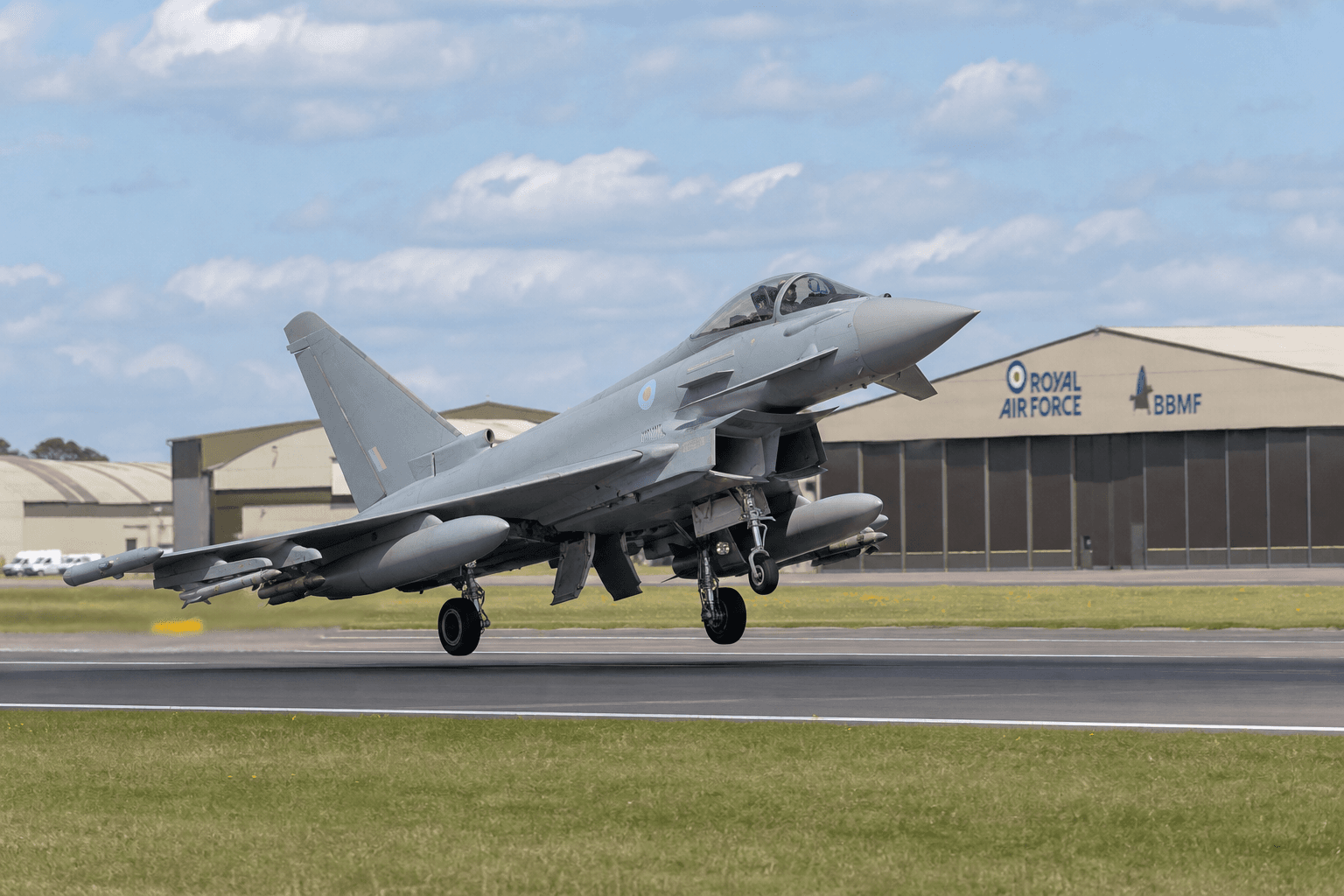
RAF Coningsby: UK's Premier Base for Typhoon Jets and Historic Battle of Britain Aircraft
Few military airfields in the UK are as rewarding for aviation enthusiasts as RAF Coningsby . Home to the Royal Air Force’s frontline Typhoon force and the world-famous Battle of Britain Memorial Flight, the Lincolnshire base offers a fascinating mix of modern combat aircraft and priceless Second World War classics. On almost any visit, there’s the chance to watch cutting-edge fighters carrying out training sorties before seeing an 80-year-old Spitfire or Lancaster taxi out for a commemorative flight. Located in the heart of what became known as ‘Bomber County’ , RAF Coningsby is surrounded by aviation history. Alongside nearby RAF Waddington, RAF Cranwell and the former bomber stations that once dotted Lincolnshire, it remains one of Britain’s premier aviation destinations and a must-visit location for military aircraft spotters. A Brief History of RAF Coningsby RAF Coningsby opened in 1940 during the Second World War as one of the many bomber stations built across Lincolnshire to support RAF Bomber Command. Initially home to Whitleys before receiving Avro Lancasters, the station became an important operational base from which crews flew missions over occupied Europe. Following the war, Coningsby entered the jet age, operating a succession of famous aircraft including the English Electric Canberra, Avro Vulcan and Panavia Tornado F3. Since 2005, it has become one of the principal operating bases for the Eurofighter Typhoon , cementing its role at the forefront of UK air defence. Today, while many of Lincolnshire’s famous wartime bomber stations have disappeared or become museums, Coningsby remains a fully operational RAF station, continuing the county’s proud aviation tradition while preserving its remarkable heritage through the Battle of Britain Memorial Flight . Aircraft and Squadrons RAF Coningsby is one of the Royal Air Force’s busiest fast-jet stations and serves as a major centre for Typhoon operations. The station is home to: No. 3 (Fighter) Squadron – Frontline Eurofighter Typhoon FGR4 unit. No. XI (Fighter) Squadron – Another operational Typhoon squadron responsible for UK air defence and overseas deployments. No. 29 Squadron – The RAF’s Operational Conversion Unit, responsible for training new Typhoon pilots before they join frontline squadrons. Coningsby also hosts the Battle of Britain Memorial Flight , whose hangars house the Flight’s priceless collection of historic aircraft. While these aircraft fly only on selected training and display sorties, spotting one alongside modern Typhoons is an unforgettable experience. Thanks to the station’s operational tempo, visitors can often expect multiple Typhoon departures and recoveries during weekdays, together with occasional visits from other RAF, NATO and international military aircraft. Visit the Battle of Britain Memorial Flight Visitor Centre No visit to RAF Coningsby is complete without spending time at the Battle of Britain Memorial Flight Visitor Centre . Situated just outside the station, the Visitor Centre offers guided tours of the BBMF hangars, where visitors can get remarkably close to the Flight’s legendary aircraft, including the Avro Lancaster , Supermarine Spitfires , Hawker Hurricanes and Douglas Dakota . It’s a rare opportunity to see these historic aircraft undergoing maintenance and learn about the engineering expertise required to keep them airworthy. If you’re planning a spotting trip to Coningsby, combining it with a BBMF tour makes for an outstanding day out. ( You can read our full guide to visiting the BBMF Visitor Centre here .) Plane Spotting at RAF Coningsby Whether you’re hoping to photograph Typhoons launching on Quick Reaction Alert training sorties, capture a Lancaster taxying past in the sunshine, or simply enjoy one of Britain’s most historic military airfields, RAF Coningsby rarely disappoints. Below, we’ve rounded up the best spotting locations around the airfield, together with advice on photography, runway usage and the best times to visit. Spotters Car Park Along Dogdyke Lane there is a car park situated at the end of runway 07 (postcode LN4 4TE). From here you can sit and watch or photograph movements on the runway (however 25 departures are a little high by this point). There's usually plenty of spotters around, and vans selling food and drink. BoBMF Layby A little further up Dogdyke Lane is a layby next to the fence which looks out onto the Battle of Britain Memorial Flight hangar and apron. It's great for seeing these aircraft coming and going, and you can also see Typhoons parked up beyond. Runway 25 The B1192 runs past the end of runway 25. To get there you can continue past spot 1, then turn left onto New York Road and left onto the B1192/Langrick Road, heading north. Just before the traffic lights at the end of the runway is some rough ground on the left, in a farmer's field. You can pull onto here and park (with a donations box for local charity). If aircraft are landing on 25 this is a great spot for photography. Discover 150 More Spotting Locations Across the UK and Ireland If you enjoy exploring airports like RAF Coningsby, our Airport Spotting Guides: UK & Ireland (2nd Edition) is the perfect companion. This comprehensive guide features 150 airports, military airfields and aviation museums across the UK and Ireland, with detailed spotting locations, photography advice, runway information, visitor facilities and practical tips to help you make the most of every visit. Whether you’re watching Typhoons at Coningsby, airliners at Heathrow, maritime patrol aircraft at Lossiemouth or classic warbirds at Duxford, it’s an essential reference for every aviation enthusiast. Available in print from our online shop and major booksellers, it’s the ideal resource for planning your next spotting adventure—and a book you’ll return to time and time again. Get Your Copy Here

Denmark Orders Two Boeing P-8 Poseidon Aircraft Alongside NATO MQ-4C Triton Drones
Two major announcements from the North Atlantic Treaty Organization came on Tuesday, July 7. First, four member nations of NATO have decided to procure up to five Northrop Grumman MQ-4C Triton advanced surveillance drones. Second, Denmark will complement its new drone with the purchase of two Boeing P-8A Poseidon maritime patrol aircraft.
The Daily Touch & Go
The day's best aviation news in your inbox. Free, no spam.