

Illustration: The Touch & Go
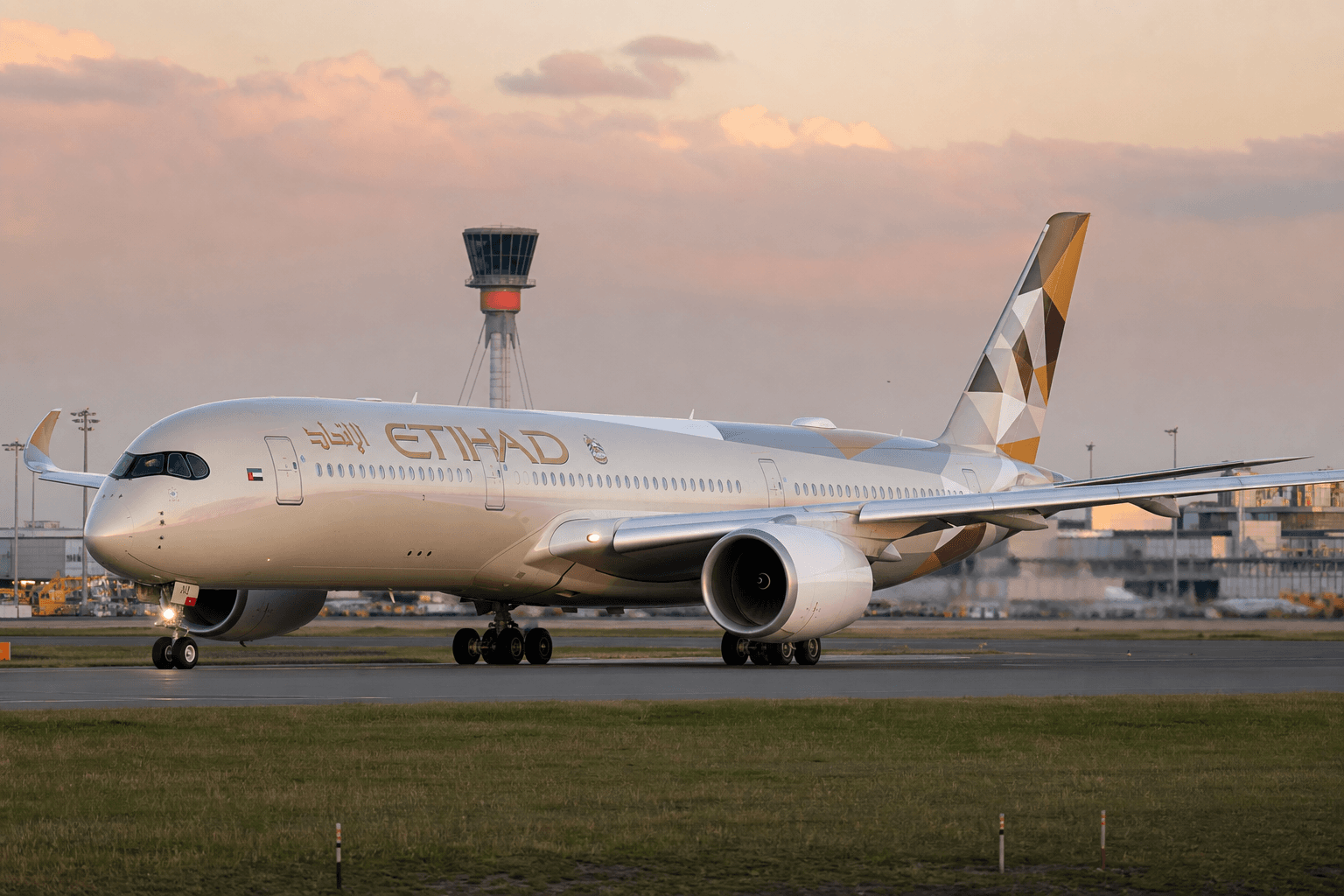
Etihad Airways' Airbus A350-1000 Business Class Tickets Start Around $2,000 in 2026
Etihad operates 12 Airbus A350-1000s featuring 44 business class seats; one-way fares vary by route from under $1,000 to over $6,000 with multiple destinations served worldwide.
The gist
Etihad’s A350-1000 business class fares range from $1,000 to $6,000 across key long- and mid-haul routes in 2026.
Continuing coverage
All Long-Haul Routes →- Air Canada launches new long-haul routes to Tenerife and Sapporo for 2026/27 winter
- Boeing 777-9 challenges Airbus A350-1000 dominance in long-haul widebody market
- IndiGo Halts Leased Widebody Flights, Awaits Airbus A350 to Restart Long-Haul Service
- IndiGo suspends London Heathrow and shifts Amsterdam to A321XLR as it awaits Airbus A350 widebodies
- Singapore Airlines to Drop 16 Long-Haul Routes in Network Reshuffle
Etihad Airways increasingly relies on its Airbus A350-1000 fleet to serve a diverse range of international routes, combining efficiency and passenger comfort. Currently operating 12 A350-1000 aircraft, Etihad plans to expand the fleet with 15 more units on order. Unlike many airlines that operate both A350-900 and A350-1000 variants, Etihad exclusively uses the larger A350-1000, configuring it to meet their specific route demands.
The airline configures its A350-1000s with a dense seating layout comprising 371 seats total, including 44 business class seats and 327 economy seats. This results in very low cost per seat but maintains a sizable premium cabin that caters well to high-profile routes such as Abu Dhabi to New York-JFK and Sydney. Notably, the 44-seat business class cabin is the second largest among Etihad’s fleet, surpassed only by the Airbus A380’s premium cabins.
Etihad’s business class product on the A350-1000 uses the Collins Aerospace Elevation seats, a reverse herringbone design with a sliding door, offering passengers direct aisle access. Each seat measures 21 inches wide and converts into a fully flat 79-inch bed. The cabin is arranged in 11 rows of four seats abreast and includes amenities like an 18.5-inch high-definition display and multiple charging options including USB-A, USB-C, and wireless charging. These seats differ from the airline’s custom Business Studios found on their A380s and Boeing 787s.
In economy, Etihad installs 327 Recaro CL3710 seats in a nine-abreast configuration. Each seat features a width of 17.6 inches and standard seat pitch of 31 inches, with a front economy section branded as Economy Space offering an expanded pitch of 35 inches across 45 seats. This setup balances capacity with competitive comfort for the airline’s medium and long-haul network.
The A350-1000 serves a mix of routes ranging from short-haul markets such as Delhi and Mumbai to ultra-long-haul services like Abu Dhabi to Atlanta, which at 6,621 nautical miles is the longest A350-1000 route in Etihad’s schedule. Business class fares vary widely by route, starting around $1,000 for one-way tickets on short-haul sectors like Mumbai and rising above $6,000 on premium routes such as Sydney. The Atlanta and New York flights generally start at about $4,700 to $4,800 in business class.
Mid-haul routes including Casablanca and Amsterdam see fares between $2,000 and $3,500, while flights to Seoul feature a notable price discrepancy, with one-way business class departing Abu Dhabi costing between $4,300 and $5,800, but return fares commonly drop below $2,000. Competitive pressures and market demand heavily influence these dynamic pricing patterns across Etihad’s A350 destinations.
Etihad also operates the A350-1000 on routes to Bangkok, Delhi, and Mumbai, where pricing ranges from below $1,000 to just over $2,000 one-way in business class. The use of the A350 with its favorable operating economics allows the airline to maintain consistent premium service and product standards across different markets, both highly competitive and long haul.
Regarding loyalty redemption, Etihad Guest miles are distance-based rather than revenue-based, with award prices linked to route length and fare class. Awards for business class segments typically require between 29,700 and 208,000 miles depending on the destination and member status tier. Upgrades from economy to business also vary from around 21,700 to over 86,000 miles. Etihad’s partnerships with 27 airlines enable miles to be redeemed across multiple carriers including American Airlines and Air Canada, enhancing flexibility in award bookings.
The deployment of Etihad’s A350-1000 fleet represents a careful balance of capacity, comfort, and cost efficiency across some of the airline’s most strategically important routes. The competitive fare structure, combined with a premium product offering, positions the airline to meet varied market demands while leveraging the A350’s strengths. With fleet expansions underway, Etihad’s A350s will continue to be central to its global network strategy.
Read more
All Airlines →
Top 5 Airlines Offering the Most Luxurious First Class Suites in 2026
The first class cabin is always seen as the ultimate in luxury with lavish features that many can only dream of. Business class has evolved into a more extensive product, with lie-flat beds and now private suites, and with more business class products than ever, first class has become more exclusive and somewhat rare on long-haul international flights.
Air Canada launches new long-haul routes to Tenerife and Sapporo for 2026/27 winter
Air Canada has been steadily expanding its international network in recent years. The airline has added several new destinations so far this year and increased its presence across leisure markets. It is continuing this expansion with more additions for the 2026/27 winter season .
LATAM Airlines posts $227 million Q2 profit amid strong premium demand
Resilient demand for premium seats and from loyalty programme members kept LATAM in the black. LATAM Airlines Group was able to pass to customers much of the increase in fuel prices in the second quarter thanks to strong travel demand, especially for premium seats and from member of its loyalty programme. The company reported an adjusted operating profit of $227 million for an adjusted operating margin of 5.4% during the three months ending in June. Its revenue increased 28% year on year to $4.2 billion, driven by an 18% year-on-year increase in revenue per available seat kilometre, allowing LATAM to recapture much of the additional $700 million fuel expense it paid in the period. LATAM’s second-quarter expenses jumped 39% year on year to $4.0 billion. "The combination of effective execution, commercial flexibility and the resilience of LATAM's diversified business model allowed the group to increase unit revenues this quarter [and] successfully mitigate a substantial portion of that [fuel] impact," said Ricardo Dourado, the chief financial officer of LATAM, during an earnings call on 5 August. Premium-seat sales and demand from loyalty programme members showed "greater resilience" than overall demand in the second quarter, he adds. LATAM is investing in new business-class suites and premium-economy seats for its widebody Boeing 787s. Installations began in 2025 and continue across the fleet. It is also expanding the number of premium-economy seats on its narrowbody fleet of Airbus A320-family aircraft and plans to introduce the seats on Embraer 195-E2s scheduled to enter service in November. LATAM initially plans to fly E195-E2s to four new destinations and on eight new routes in Brazil. The aircraft will allow it to expand and tailor capacity on existing routes to better match demand at various times of day, chief executive Roberto Alvo says. Looking ahead, LATAM reinstated its guidance despite what Alvo says remains a "highly dynamic" market. The company expects to grow capacity, measured in available seat kilometres, 8-9% in 2026 and forecasts a 2026 adjusted operating margin of 12-13%. LATAM is scheduled to take delivery of 15 A320neo-family aircraft, one 787-9 and 12 E195-E2s in the second half of 2026, its latest fleet plan shows. It forecasts adding 27 aircraft to its fleet in 2026, bringing its fleet to 410 aircraft at year-end. LATAM can retire older Airbus A319s if the demand environment weakens, Alvo says.
Airlines Abandon Middle Tier as Premium and Ultra-Budget Classes Dominate Market
Across the airline industry, it seems that the traditional middle tier of commercial air travel is on its way to the history books. It has always been common to see legacy carriers and low-cost airlines alike depend on a standardized main cabin product to generate steady baseline revenue. Today, that undifferentiated middle is rapidly disappearing as commercial aviation splits into two profitable extremes: high-yield premium cabins at one end and unbundled ultra-budget fares at the other.
The Daily Touch & Go
The day's best aviation news in your inbox. Free, no spam.