

Image: Esquilo · CC BY-SA 3.0 · via Wikimedia Commons
Large drone collides with LAPD helicopter over San Fernando Valley, forcing emergency landing
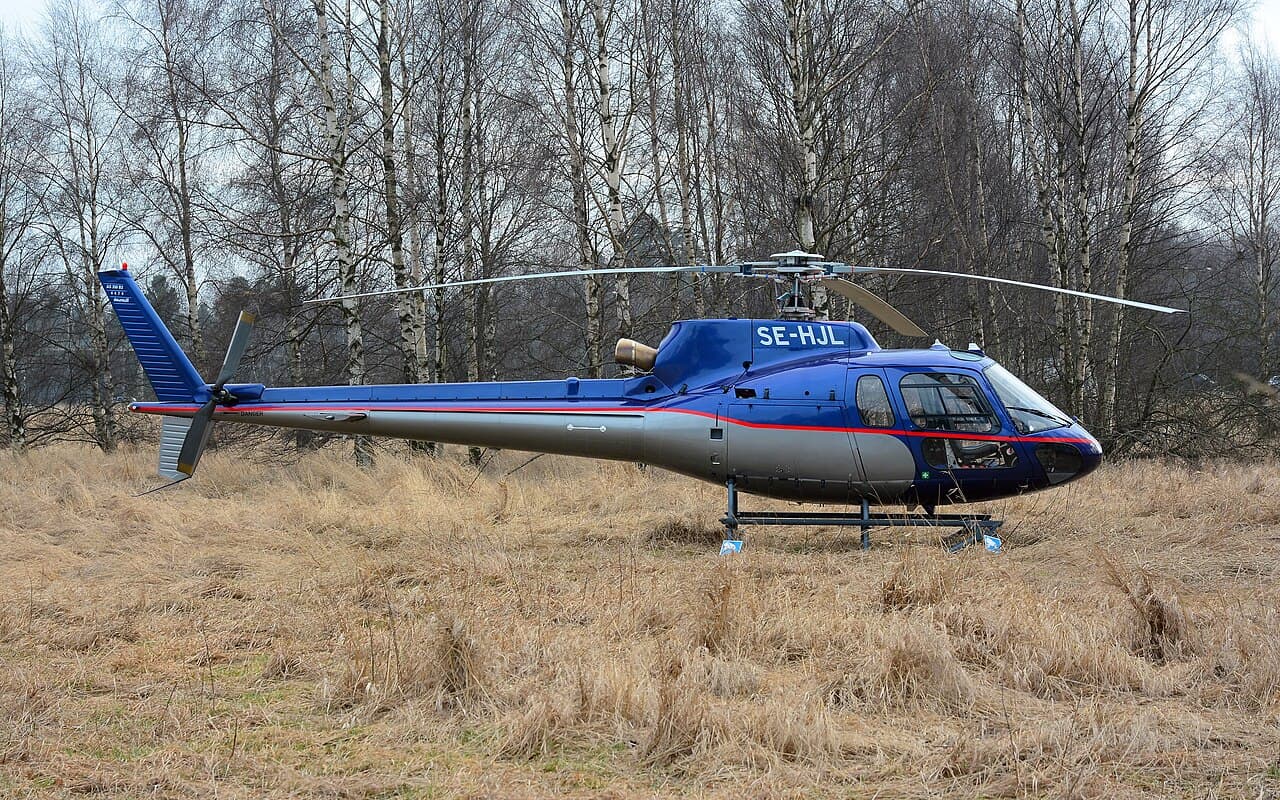
An LAPD Airbus AS350 patrolling a brush fire near Tarzana struck a large drone about three feet square, damaging its windshield; both officers on board were unharmed.
The gist
An LAPD helicopter was forced to land safely after colliding with a sizeable drone during a wildfire patrol in Los Angeles.
A serious midair collision occurred on July 7, 2026, between a Los Angeles Police Department Airbus AS350 helicopter and a large unmanned drone during a patrol mission over the San Fernando Valley. The incident took place shortly before 3 p.m. near the intersection of the 101 Freeway and Reseda Boulevard in the Tarzana neighborhood, forcing the police crew to conduct a precautionary landing at Van Nuys Airport. Fortunately, none of the two officers aboard the helicopter sustained injuries despite visible damage to the aircraft’s windshield.
The drone, described by authorities as approximately three feet by three feet in size, is considerably larger than typical recreational drones, raising concerns about its operation near critical airspace. While the exact make and model of the drone remain unidentified, the incident's timing coincided with firefighting efforts combating a brush fire near the Encino Reservoir. This has led investigators to speculate that the drone operator may have sought to capture video footage of the wildfire, though it remains unclear if the drone was intentionally flown dangerously close to the helicopter.
Following the collision, a joint investigation was launched by the Federal Aviation Administration and the FBI to determine the circumstances surrounding the event and identify the drone operator. The LAPD has emphasized the hazard unmanned aerial vehicles pose when operating near emergency response aircraft, especially during active firefighting missions where airspace coordination and safety are paramount.
Los Angeles Mayor Karen Bass condemned the actions leading to the collision and issued a stern warning to drone users. She labeled the interference with law enforcement and firefighting aviation as completely unacceptable and pledged rigorous enforcement. Bass stated that anyone found operating drones in a manner that jeopardizes public safety will face arrest and prosecution, underscoring the seriousness with which local authorities treat these incidents.
The FAA restricts drone flights to a maximum altitude of 400 feet and enforces strict limitations around airports and emergency scenes to prevent conflicts with manned aircraft. Despite these regulations, thousands of reports about drones operating near airplanes and helicopters are filed annually, although collisions remain relatively rare. This particular incident highlights ongoing challenges in enforcing safe drone usage, especially in congested urban areas with active emergency operations.
The helicopter pilot’s ability to conduct a safe landing after the collision was critical in preventing further harm. The damaged windshield signifies the significant impact a drone of this size can have on crewed aircraft, posing a tangible risk to aircrew safety and operational continuity. No images or video footage of the collision or the resulting damage have been made public as of July 13, 2026.
This event stands as one of several recent examples of drones interfering with emergency aviation activities in the United States, prompting aviation regulators and law enforcement agencies to intensify efforts to educate the public and enforce drone flight restrictions. The ongoing investigations will aim to identify the responsible individual and assess whether this was an intentional act or reckless negligence.
The case adds to a growing body of incidents emphasizing the need for heightened awareness among drone operators about the dangers and legal repercussions of flying near sensitive airspace. It also raises questions about technologies and policies that could improve detection and mitigation of drone incursions at critical times, especially around emergency response zones.
Frequently asked questions
- What type and size was the drone that collided with the LAPD helicopter?
- The drone was about three feet by three feet, significantly larger than typical hobbyist drones, though its exact make and model have not been identified.
- Were the officers aboard the LAPD helicopter injured in the collision?
- No injuries were reported; both officers on board the helicopter were unharmed despite damage to the cockpit windshield.
- What actions are being taken in response to the drone collision incident?
- Investigations by the FBI and FAA are ongoing to identify the drone operator and circumstances, while Los Angeles authorities have issued warnings and pledged prosecution of unsafe drone operations near emergency aircraft.
Read more
All Aviation Safety →
SpaceX Prepares Starship Flight 13 with Upgrades After Booster Flaw Fix
SpaceX announced it made several hardware and software modifications to its massive Starship rocket as it prepares for what could be the vehicle's most critical test flight yet. The launch provider said over the weekend it is targeting a 90-minute launch window that opens at 6:45 p.m. EDT on Thursday for Starship Flight 13, which is a precursor to more ambitious missions the company has planned for 2026. SpaceX said the mission will have "similar objectives" to Flight 12 in May, which was the first test of Starship's larger, more powerful Version 3 (V3) configuration. SpaceX has flown Starship variants since 2023, but the V3 is its first designed to be capable of commercial, orbital deployments of Starlink satellites. It is also the vehicle around which the company's human landing system (HLS)—a candidate to deliver astronauts to the moon on future NASA lunar missions—is based. The first of those missions is scheduled for early 2028, putting pressure on SpaceX to deliver a viable spacecraft. The company validated some of the V3 upgrades on Flight 12. But the rocket's Super Heavy booster failed to complete its flip and boostback burn as intended, causing it to land hard in the Gulf of Mexico and prompting the FAA to ground it . The FAA closed the SpaceX-led Flight 12 mishap investigation on Monday, clearing the way for Starship to return to action—and to form. The rocket completed five suborbital test flights in 2025, with the final two in August and October being the most successful. But the seven-month gap between Flights 11 and 12 was the longest drought since Starship debuted in 2023. With the V3 Starship, SpaceX in 2026 aims to complete its first mission to low-Earth orbit (LEO), achieve full reusability, and demonstrate docking and propellant transfer on orbit. The key to hitting those milestones will be returning to regular flight cadence. SpaceX has bet that stressing Starship to its limits—as it did on Flight 12 and other missions—will eliminate future hiccups, with the tradeoff being more frequent groundings. If SpaceX can launch Flight 13 this week, the less than two-month turnaround from the prior mission would be a significant improvement. At the same time, delays are stacking up. What Went Wrong? Starship Flight 12 was a mixed bag. On one hand, the rocket successfully reached orbit, deployed 20 "dummy" Starlink satellites, and splashed down within a predetermined zone in the Indian Ocean. On the other, the ship lost one of its six Raptor engines, and the Super Heavy booster did not behave as predicted. Due to the booster anomaly, the FAA activated a debris response area (DRA) that placed five aircraft in holding patterns and delayed six departures. The mission was critical as the debut of Starship V3, which is expected to be capable of larger Starlink deployments than SpaceX's Falcon 9 or Falcon Heavy rockets. Compared to the V2 spacecraft, it has lower mass but more thrust—enough to carry 100 metric tons of payload to LEO, according to CEO Elon Musk. Further enhancements to the ship will enable orbital docking and propellant transfer, which in the future could open up commercial or NASA lunar missions. For those trips, Starship would need to fuel up at an orbital propellant depot due to its massive size and the power required to get it to the moon. That is the Starship HLS' planned profile for NASA's Artemis IV lunar landing scheduled for 2028, should the space agency select it over Blue Origin's Blue Moon HLS. The FAA said Monday that it accepted SpaceX's assessment of the booster anomaly's two most probable root causes—"heat effects on propulsion system components during the ascent and erroneous engine alarm system settings." It said there were no reports of injury or property damage and approved four corrective actions. "SpaceX can proceed with Starship Flight 13 launch operations provided all safety and other licensing requirements are met," the agency said in a statement. SpaceX over the weekend provided further clarity. It said that during Flight 12 stage separation, "slight differences in engine startup" caused a 90-degree deviation to Super Heavy's planned flip maneuver, which is intended to save fuel during the booster's descent. The vehicle's engine startup sequence has been modified, SpaceX said, to more reliably flip in the right direction. After the flip, five of the booster's 33 Raptor engines failed to relight. That brought a premature end to its boostback burn and led to a harder-than-expected splashdown. SpaceX said that the Super Heavy for Flight 13 received hardware modifications that are intended to prevent a repeat, as well as upgrades to its engine alarm and abort systems. The company also addressed the loss of one of Starship's three vacuum-optimized Raptor engines, which it said occurred about 40 seconds after stage separation. Still, the Flight 12 Starship successfully completed a flip, burn, and splashdown in the Indian Ocean. What's Next? With Flight 13, SpaceX will look to recreate the successful aspects of Flight 12 without incurring anomalies. Super Heavy's core objective is the same—a successful launch, ascent, stage separation, boostback burn, and landing burn ahead of a soft splashdown. For Starship, SpaceX aims to relight one of the vehicle's Raptor engines in space, which it failed to do on Flight 12 due to the engine loss. If the ship makes it to atmospheric reentry, the company plans to push its heat shield to the limit, as it has done before. Previous missions have experimented with different angles of attack and tile materials. For a few, SpaceX stripped heat shield tiles in certain locations to expose Starship's underbelly to maximum stress. This time, it will attach tiles to various portions of the ship to evaluate different options for the integration of catch hardware. Unlike the company's Falcon 9, which is fitted with legs, Starship and Super Heavy are designed to be snared out of the air by a pair of giant metal chopsticks at the Starbase launch pad in Texas. SpaceX does not plan to catch either stage on Flight 13, but it has successfully caught and reflown two boosters. Another change to Flight 13 is Starship's payload. This time, the Starlink satellites will be real rather than dummy versions. The satellites, which are expected to burn up about 20 minutes after being deployed, will try to connect with SpaceX's larger Starlink constellation using solar arrays and antennas. Six of the satellites are equipped with cameras that are designed to scan Starship's heat shield and beam imagery from orbit to mission control in Texas. Some heat shield tiles were painted white to simulate missing hardware and test the system's accuracy. The idea is to assess the heat shield's health before committing resources to a catch attempt. Two of the 20 dummy Starlinks deployed on Flight 12 had the same modifications and successfully collected imagery . SpaceX will stream the mission live on its website and X account, starting about 30 minutes before liftoff. Watching closely will be thousands of space enthusiasts, as well as NASA and the company's commercial customers who are depending on Starship. More anomalies could impact SpaceX's future ambitions, including landing American astronauts on the moon. NASA in June awarded a lunar cargo mission to its main rival, Blue Origin, which is vying to be the HLS provider for the Artemis IV moon landing.
New Marine One Helicopters Cause Lawn Damage, FAA Reviews DC Crash Safety
New Sikorsky Marine One helicopters damage the White House lawn, the airports renamed for U.S. presidents, airline consolidation, DCA crash safety recommendations, controversy over ADS-B In regulations, Air France and Airbus manslaughter verdict, passengers sue Delta over turbulence injuries, a Ryanair window ruptures, and a seaplane makes a hard landing in New York's East River. Also, interviews from the Spurwink Farm fly-in. Aviation News Lockheed Martin Is Covering the Cost of Trump's White House Helipad President Trump said that Sikorsky, part of Lockheed Martin, would cover the cost of building a new helipad at the White House. Lockheed Martin confirmed the report. Sikorsky helicopters have been used to transport the president since the 1970s. The new VH-92A Patriot helicopter has propulsion exhaust vents located toward the rear of the airframe and pointed downward, unlike the VH-3D’s configuration. Also, with much more powerful engines, the VH-92A generates significantly more downwash than the VH-3D. The hot exhaust gets combined with the intense rotor downwash at touchdown, and the combined heat-and-airflow effect scorches the turf and can physically rip sod loose. Airline consolidation now rules the skies. Has it been good for passengers? Continental Airlines, Northwest Airlines, and US Airways are gone. Spirit Airlines is gone as well. Now, the Big Four U.S. airlines control roughly three-quarters of the U.S. market. Has this been good for the flying public? It depends on who you ask. Former governor Chris Sununu, now the head of Airlines for America, said at a Capitol Hill hearing, “We have more competition per route than ever before. When I go to buy a ticket, I have four, five, or six carriers going from Wichita to Dallas. So now they’re all competing on that exact same route." There are six airlines serving Wichita Dwight D. Eisenhower National Airport, but there’s only one that flies nonstop to Dallas. Past guest Ganesh Sitaraman, a professor at Vanderbilt Law School and the author of the book Why Flying Is Miserable and How to Fix It said, “From the airlines’ perspective, it makes sense. Bigger is better, and it’ll be more efficient for them, even if there’s a lot of drawbacks for communities and passengers.” A Florida airport is officially renamed for Trump. What does he stand to gain? FAA Details First Official Response to DC Crash Safety Recommendations After the January 2025 midair collision near Washington, D.C., that killed 67 people, the NTSB issued nearly three dozen recommendations. As is always the case, the FAA is not obligated to implement the NTSB’s recommendations. Earlier this year, the FAA said it had fully addressed seven of the recommendations and that it would evaluate the others, with further updates to come by May 31, 2027. The Air Current reported that the FAA indicated it is evaluating whether the number of arrivals permitted per hour at DCA is appropriate. This is a key metric that the NTSB said contributed to the airport’s congestion at the time of the crash. Also, any adjustments will be determined after an official analysis in 2027. This $50,000 Safety Fix Is Dividing the Aviation Industry and Washington This could be characterized as a conference-committee fight over how strong an ADS-B In mandate should be, not whether there will be one. ALPA and NTSB are on one side (ROTOR Act), and industry groups like A4A/AOPA/NBAA on the other (ALERT) side. Senate: ROTOR Act (Rotorcraft Operations Transparency and Oversight Reform Act) Would require all aircraft to be equipped with ADS-B In and repeal certain military exemptions from the technology requirements. Passed the Senate by unanimous consent in December, with strong support, including from ALPA. The House rejected it on February 24, 2026, falling one vote short of the two-thirds majority needed after the Defense Department raised national security concerns House: ALERT Act (Airspace Location and Enhanced Risk Transparency Act) House lawmakers revised the bill to explicitly include an ADS-B In mandate after the earlier version was criticized for failing to clearly require it. The updated version requires that aircraft carry both ADS-B In and ACAS X (Airborne Collision Avoidance System X), integrated so ADS-B In data feeds the alerting function. Opposition: ALPA doesn’t endorse it, arguing that ACAS Xa (the large-commercial-aircraft variant) isn’t yet commercialized, that no integration standards exist, and that the system suppresses alerts below 1,000 feet when situational awareness matters most. The NTSB also declined to support it, saying it falls short of requiring ADS-B In for all aircraft operating in airspace where ADS-B Out is already required, even though it allows compliance via portable receivers with line-of-sight limitations. Air France and Airbus found guilty of manslaughter over 2009 plane crash A Paris Appeals Court found Air France and Airbus “solely and entirely responsible” for the 2009 AF447 accident, which killed 228 people when it crashed into the Atlantic Ocean. The companies were cleared in April 2023 but were found guilty after an eight-week trial. Both Air France and Airbus have denied the charges and say they will appeal. In 2012, French investigators found a combination of technical failure involving ice in the pitot tubes and pilot confusion over faulty air-speed readings. Pilot training has since been modified, and pitot tube sensors have been replaced. 20 Sue Delta Over 2.5 Minutes of Terror on Flight Out of Utah A lawsuit has been filed against Delta Air Lines on behalf of 20 passengers of Delta Flight 56, claiming that pilots “recklessly flew” too close to thunderstorms, where severe turbulence caused multiple injuries. The turbulence lasted 2 1/2 minutes over Wyoming, and the flight was diverted to Minnesota. Twenty-five people were transported to local hospitals. The NTSB said the pilots were caught by surprise. In the lawsuit, the plaintiffs allege that the National Weather Service issued an advisory warning that turbulent conditions were present in the mountains east of Salt Lake City and that thunderstorms were present along portions of the flight path. Apparent engine fan blade failure preceded rupture of Ryanair 737 window The Air Current reports that the rupture of a Ryanair Boeing 737-800 window resulted from a fan blade failure on the right CFM56-7B engine. Fan blade failures are serious but rare. Aircraft engines are designed to contain fan blade failures and are tested during the certification process. The FAA issued airworthiness directives to mitigate the risk of fan blade failure through inspections and an engine inlet redesign to ensure containment. The FAA set a July 31, 2028, deadline for compliance. Small plane makes hard landing into New York's East River, officials say A Kodiak 100 seaplane with eight people on board made a hard landing in the East River between Brooklyn and Manhattan. There was "substantial damage" to the plane, but there were no injuries. The plane bounced three times, and the pilot subsequently told the passengers that a pontoon had broken. A pattern of progressive porpoise leading to structural failure appears in NTSB seaplane accident reports across various types, including Cessna 206 and 208 Caravan floatplanes, de Havilland Beavers, and Twin Otters on floats. A few East River/urban seaplane-specific factors that might be in play: Wake and chop from harbor traffic (ferries, tour boats) create a much less predictable water surface than open lake/bay operations. Confined approach corridors near Skyport limit go-around and abort options if the pilot senses a bad touchdown developing. The area has had at least one other recent seaplane mishap (a two-seater damaged by a wave three weeks prior), suggesting water-surface conditions have been a recurring operational challenge
Wisk Aero and NASA Demonstrate Ground Supervisor Managing Three Autonomous eVTOLs
Boeing's eVTOL (electric vertical takeoff and landing) air taxi unit Wisk Aero believes it has made a breakthrough in testing that it is conducting with NASA under a five-year Space Act agreement . Wisk said Wednesday that it simulated the simultaneous orchestration of three uncrewed aircraft, alongside regular air traffic, by a single ground-based supervisor. For autonomous models like Wisk's Generation 6 air taxi, the ability for one person to remotely oversee multiple aircraft is considered the unlock for operations at scale. However, with limited exceptions, the FAA does not permit operators to fly multiple small drones at once, let alone uncrewed aircraft that are designed to carry passengers. The Gen 6 lacks pilot controls but has four passenger seats. Wisk is the only American eVTOL developer that plans to integrate autonomy at launch. But others, including Joby Aviation, Archer Aviation, and Beta Technologies, view autonomous systems as critical to growing beyond a handful of daily operations. Wisk's Generation 6, a prototype of which made its first flight in December, is designed to coordinate with what the company calls multi-vehicle supervisors (MVSors). These personnel would oversee operations remotely and step in should the air taxi deviate from its predefined route. "This is an incredible milestone for Wisk as it's the first time we've successfully tested our 1:3 supervisor-to-aircraft ratio with NASA in a high-fidelity, high-workload environment that mirrors the complexity of the NAS," said Erick Corona, who heads system and operations integration for Wisk, in a statement. The company's Space Act agreement, awarded last year, is intended to study autonomous aircraft operations in the national airspace system (NAS) under IFR. Eventually, it is expected to combine actual flights with simulated airspace in NASA's Live Virtual Constructive (LVC) flight environment, which can layer live or historical NAS traffic over real-world aircraft. Goals of the collaboration include the development of standards for airspace and route design, aircraft and ground safety, and air traffic control (ATC) communications with uncrewed aircraft. Three For One Wisk said its Autonomy Lab in Mountain View, California, where the company studies human supervisors' interactions with the Gen 6's automated systems, was connected to ATC simulation laboratories at NASA's Ames Research Center in California's Silicon Valley. The partners used the NASA facilities, which can create full-scale, 360-degree simulations of the airport environment, to follow predetermined IFR routes between Moffett Federal Airfield (KNUQ) and San Martin Airport (E16) in California's San Francisco Bay Area. Wisk said its supervisors used the company's remote supervision system and autonomous systems to communicate with ATCs, who relied on existing tools and procedures. The researchers studied communication response times, task latency, situational awareness, and cognitive workload across both nominal and worst-case scenarios developed by NASA and Wisk. "Proving that a single ground-based supervisor can manage multiple flights safely and efficiently is paramount to making commercial air taxi operations scalable and affordable,” said Wisk’s Corona. Wisk said data and learnings from the simulation campaign could help to standardize communications and procedural frameworks designed to reduce ATC and pilot workload. It may also advance the company's vision for automated flight rules (AFR), a proposed policy framework that would define the role of its multi-vehicle supervisors. "AFR is designed to complement, not replace, VFR and IFR, and to be available to any properly equipped airspace user," Wisk wrote in a February blog post . "Whereas VFR and IFR rely on pilot visual awareness and ATC-provided services to keep aircraft safely separated, AFR will allow aircraft to use automation to perform conflict management functions." What's Next? Wisk's collaboration with NASA could produce tangible results. The space agency's UAS Traffic Management (UTM) project led directly to the FAA's development of the Low Altitude Authorization and Notification Capability (LAANC) for drone operations. The UTM team also devised the air traffic management framework that the FAA is using to facilitate drone operations in Dallas-Fort Worth. The city is the first to allow multiple operators to share airspace and fly beyond the visual line of sight (BVLOS) of personnel. Kurt Swieringa, deputy manager for technology for NASA's Air Traffic Management Exploration (ATM-X) project, told FLYING last year that his unit was shaping a version of the Airborne Collision Avoidance System (ACAS) that can accommodate uncrewed aircraft. NASA researchers have tested digitized communications between ATC and the flight deck and conducted many remotely piloted flights. They have also studied air taxi noise, traffic, ride quality, and crash scenarios. The space agency shares these findings with the FAA to inform new regulations that could unlock commercial service for Wisk, Joby, Archer, Beta, and more. Unlike competitors, Wisk's Gen 6 will be autonomous from the get-go and could benefit the most from NASA's work. "I think there's a hurdle of integrating an eVTOL into the airspace, and then there's the autonomous piece," said Cindy Comer, Wisk's vice president of SMS, safety, and quality, in a Q&A that appeared in the March 2026 issue of FLYING . "How do we best engage with air traffic control so that we don't increase their workload, but they're aware and engaged in our flights as much as they need to be?" Per Comer, the Gen 6 uses a combination of computers, predictive hardware and software, radar, sensors, and ground links to detect and avoid other aircraft on its own. Many of its systems are present on transport-category aircraft such as the Boeing 737 or Airbus A350. Wisk is even providing autonomous systems for future variants of Archer's Midnight air taxi, and Comer left the door open when asked if the company could sell them to other rivals. Should they adopt Wisk's autonomy, those competitors could rely on the same multi-vehicle supervisor framework that it and NASA are studying. Of course, the partners will eventually need to validate the strategy with real flying. Wisk's first Gen 6 prototype was joined by a second in May . Though it did not fly them during the recent NASA campaign, Wisk hopes to debut the prototypes publicly by the end of the FAA's eVTOL Integration Pilot Program (eIPP). The multiyear program will see Wisk work with the Texas Department of Transportation toward high-frequency Gen 6 flights. Dan Dalton, Wisk's vice president of commercialization and airline development, told FLYING in March that the FAA during the eIPP may even permit passenger carrying operations for revenue. The eIPP kicked off last week with organ delivery flights completed by Beta's all-electric Alia CX300. Activities under the multiyear program are expected to grow increasingly complex.
NBAA Honors Doug Carr for 28 Years Driving Safety and Security in Business Aviation
NBAA Senior Vice President for Safety, Security, Sustainability and International Operations Doug Carr recently announced his decision to retire from NBAA at the end of August after 28 years of outstanding service to NBAA and the entire business aviation community.
The Daily Touch & Go
The day's best aviation news in your inbox. Free, no spam.