

Illustration: The Touch & Go
Turkish Airlines Operates 11-Hour One-Stop Flights Using Boeing 737 MAX on African Routes
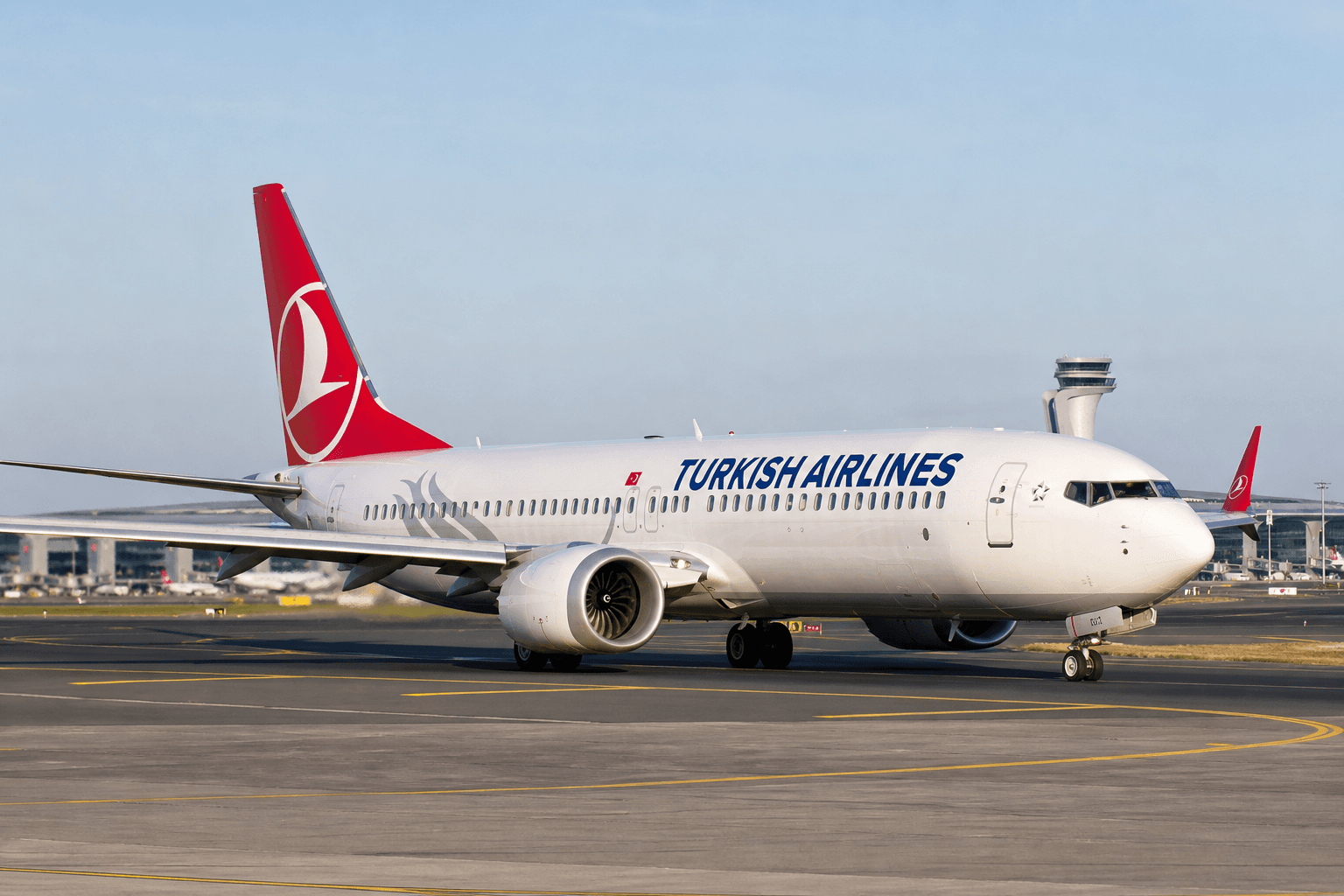
Turkish Airlines deploys Boeing 737 MAX 8 aircraft on long one-stop flights reaching up to 11 hours and 20 minutes, primarily serving African destinations from Istanbul Airport.
The gist
Turkish Airlines runs 11-hour-plus 737 MAX 8 flights with strategic one-stop routings across Africa, expanding reach efficiently.
Continuing coverage
All Boeing 737 Max →- Somon Air debuts Boeing 737 MAX with first aircraft delivery from DAE lease
- Aerolineas Argentinas to modernize fleet with new A330neos, updated business class, and Wi-Fi
- Why Allegiant Air Operated Boeing 757s to Reach Hawaii and Beyond
- Alaska Airlines Launches New Daily Boise-Honolulu and Weekly Spokane-Honolulu Boeing 737 Routes
- United Airlines Expands Airbus A321neo Orders Amid Boeing 737 MAX 10 Delays
Turkish Airlines has incorporated Boeing 737 MAX aircraft into extended routes, with some flights reaching durations of over 11 hours. Although the MAX fleet comprises only about 6% of Turkish Airlines' total aircraft count—specifically 20 Boeing 737 MAX 8s and five MAX 9s out of 409 total aircraft—the airline uses these narrowbodies on notable long-range one-stop services from its Istanbul Airport (IST) hub. Between July and December 2026, Turkish Airlines will operate these MAX aircraft to as many as 83 countries, illustrating their strategic deployment beyond short-haul ranges typical of narrowbody aircraft.
The majority of Turkish Airlines’ longer-stage 737 MAX services are conducted by the MAX 8 variant, configured with 151 seats. This variant dominates the carrier’s schedule to African destinations when all aircraft types are considered. Turkish Airlines has embraced one-stop routings to expand its footprint in Africa. For example, many of the longest MAX flights are not nonstop but involve a single intermediate airport, enabling the carrier to serve distant markets like Lusaka, Zambia, with operational efficiency and competitive scheduling.
OAG schedule data reveals that the longest single MAX operation by Turkish Airlines is a 11-hour and 20-minute flight from Lusaka’s Kenneth Kaunda International Airport (LUN) back to Istanbul, routed via Dar es Salaam Airport (DAR) in Tanzania. This return flight, scheduled to resume in October 2026 coinciding with the airline’s shift to winter schedules, flies three times weekly. The itinerary includes an overnight departure from Lusaka and an early morning arrival in Dar es Salaam for the connecting segment to IST. This routing reflects the carrier’s use of Tanzania as a key regional hub for such multi-leg MAX flights.
Other notable long MAX flights include a 10 hour and 30 minute service from Istanbul to Conakry, Guinea, via Ouagadougou in Burkina Faso, and routes to Freetown, Sierra Leone; Point-Noire, Republic of Congo; and Banjul, The Gambia, all featuring one-stop operations of around 10 hours or more. Frequencies vary from multiple weekly to just a few times per week, demonstrating the niche yet significant role these routes serve. The MAX 8’s balance of range, payload, and seat capacity—helping to maintain operational economics on longer narrowbody sectors—is central to Turkish Airlines’ network strategy in Africa.
The carrier’s African network requiring one-stop MAX flights extends to various secondary and tertiary cities where nonstop service is not viable. Routes such as IST to Niamey, Niger via N’Djamena, Chad, or IST to Banjul with a stop in Nouakchott, Mauritania, illustrate how the airline leverages intermediate stops to connect underserved markets. This flexible routing approach permits Turkish Airlines to maintain a strong market share and presence throughout the continent while optimizing aircraft utilization and maintaining relatively low operating costs per flight compared to deploying widebody aircraft on those routes.
The Tanzanian city of Kilimanjaro also features prominently in Turkish Airlines’ use of the 737 MAX 8. Since 2012, the airport has been connected with IST, initially served on Boeing 737-900ER jets. With the MAX 8 now operating two to three daily rotations via different routings involving Zanzibar (ZNZ), service to this tourism gateway underscores the aircraft’s ability to handle medium-to-long sectors with multiple stops. Scheduled block times for these rotations can approach 10 hours during certain periods, underlining the endurance of the aircraft in a regional hub-and-spoke role.
Booking data to April 2026 indicates European countries such as Germany, the UK, and Italy are major market sources for passengers flying to Lusaka, with London being the top city destination, reflecting historical and economic ties. Despite this, Turkish Airlines ranked only seventh among indirect carriers in these city pairs, suggesting opportunity for growth using its hub strategy facilitated by the MAX 8’s range and efficiency.
Turkish Airlines’ strategic use of the 737 MAX 8 in one-stop operations across Africa illustrates a tailored approach to network development, deploying their smaller narrowbodies on routes requiring strategic routing rather than nonstop capability. This plays an important role in maximizing frequencies, maintaining presence in challenging markets, and optimizing fleet utilization without dedicating widebody types to less dense long-distance sectors. As flight schedules adjust seasonally, Turkish Airlines is set to maintain or grow these long MAX 8 operations, securing an efficient connection between Turkey and Africa’s diverse and geographically spread markets.
Read more
All Airlines →
Top 5 Airlines Offering the Most Luxurious First Class Suites in 2026
The first class cabin is always seen as the ultimate in luxury with lavish features that many can only dream of. Business class has evolved into a more extensive product, with lie-flat beds and now private suites, and with more business class products than ever, first class has become more exclusive and somewhat rare on long-haul international flights.
Boeing 777-300ER Revolutionized Long-Haul Air Travel with Twin-Engine Efficiency
The 777 succeeded Boeing's first widebody twinjet, the 767 , and showed the world just how great the platform could be for both the economics of the notoriously volatile flying business and the satisfaction of flyers. The success of the 777 series directly contributed to the end of its larger quadjet predecessor, the 747.
Air Canada launches new long-haul routes to Tenerife and Sapporo for 2026/27 winter
Air Canada has been steadily expanding its international network in recent years. The airline has added several new destinations so far this year and increased its presence across leisure markets. It is continuing this expansion with more additions for the 2026/27 winter season .
Airbus Surpasses 1,000 Net Orders in 2026 Following Strong July Demand
Airframer nearly halfway to delivery target after handing over 67 aircraft in July. Airbus's net orders for this year have surpassed 1,000 after the airframer added more than 200 to its total during July. It has confirmed China Eastern Airlines' order for 25 A330-900s and Hainan Airlines' agreement for 40 A320neo-family aircraft in the airframer's latest backlog figures. It has listed the Hainan deal as comprising 13 A321neos and 27 A320neos. Airbus's July backlog records the SMBC Aviation Capital order for 65 A321neos and 35 A320neos unveiled at the Farnborough air show . Orders from Saudi Arabian carriers Riyadh Air, for six A350-1000s, and Flynas for five A330-900s and 20 A321neos – both revealed during the show – have also been listed. Airbus's figures for the month show two agreements from undisclosed customers, one for six A321neos, and the other for a single A320neo and A319neo – the first for an A319neo since March 2024. Net orders to the end of July, as a result, reached 1,024. Airbus has also delivered 418 aircraft this year, including 32 A350s, 10 A330s and 326 A320neo-family aircraft, alongside 50 A220s. This total is just under half of the planned full-year target of 870.
The Daily Touch & Go
The day's best aviation news in your inbox. Free, no spam.