

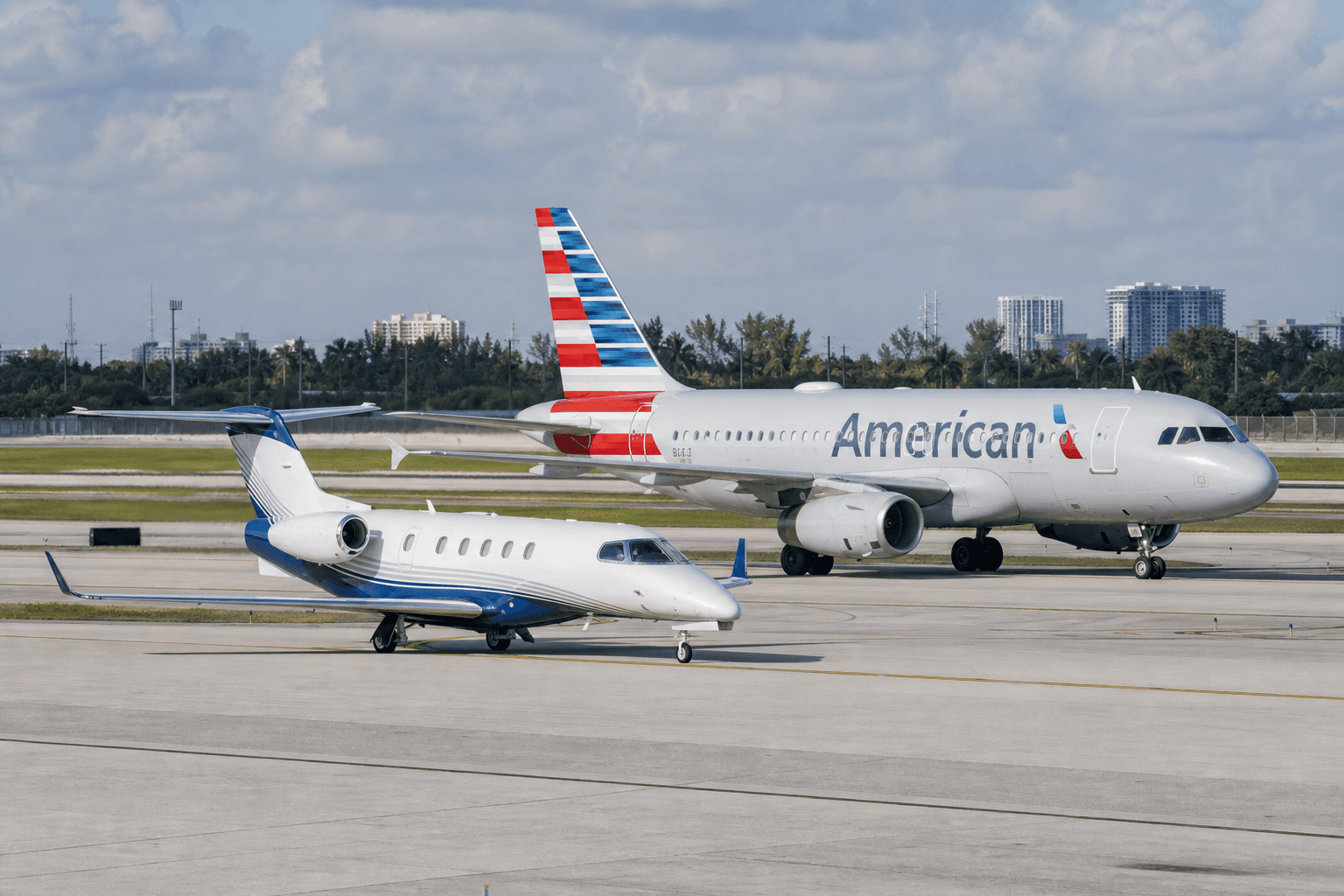
Illustration: The Touch & Go
FAA opens probe into Miami runway near-miss involving American Airlines A319 and Phenom 300
The FAA is investigating a close call on a Miami runway where an American Airlines Airbus A319 rejected takeoff to avoid a potential collision with a Embraer Phenom 300 executive jet.
The gist
FAA probes runway near-miss at Miami involving American A319 and Phenom 300 to ensure safety and prevent future incidents.
Continuing coverage
All Faa →- FAA Opposes Cleveland's Plan to Close Burke Lakefront Airport; Congressional Override Lacks Support
- BETA Begins Three-Week Electric Aircraft Test Flights in Southeast Texas
- FAA assigns AT&T central role in $2 billion air traffic network overhaul
- FAA and Ohio Senators Firmly Oppose Closure of Burke Lakefront Airport
- FAA Seeks Billions More to Fund CAP Automation Amid Growing Industry Competition
The Federal Aviation Administration (FAA) has launched a formal investigation following a near-collision incident at Miami International Airport involving an American Airlines Airbus A319 and an Embraer Phenom 300 business jet. The incident reportedly occurred when the A319 rejected its takeoff, narrowly avoiding the smaller aircraft on the runway.
According to initial information, the American Airlines A319 was preparing to depart when pilots observed the Phenom 300 in a position that created a potential conflict on the active runway. Exercising caution, the A319 crew aborted the takeoff to prevent a runway incursion or collision.
Miami International is a major hub handling a mix of commercial and private aviation traffic, making runway incursion risks a constant concern. The presence of both a commercial narrow-body airliner and a light business jet in close proximity underscores the complexity of managing diverse aircraft operations in busy airport environments.
The FAA's inquiry will focus on determining the operational and communication factors that led to the close proximity event. This will involve examination of air traffic control procedures, pilot actions, and airport surface movement monitoring systems to establish causation and recommend safety enhancements.
This investigation highlights ongoing challenges in runway safety management amid increasing air traffic volumes. Ensuring robust protocols and real-time situational awareness is critical to preventing such near-miss events and promoting secure airport operations.
Stakeholders including airlines, airport authorities, and regulatory agencies will be closely monitoring the FAA's findings. The outcome could prompt revisions to surface movement policies and highlight needs for technological upgrades at Miami International and similar airports.
Read more
All Aviation Safety →
FAA Seeks Billions More to Fund CAP Automation Amid Growing Industry Competition
As competition for the FAA's common automation platform (CAP) contract heats up, the agency still lacks the funds required to develop the technology, which is envisioned to combine its En Route Automation Modernization (ERAM) and Standard Terminal Automation Replacement System (STARS) platforms. Thales becomes the latest company to pitch a CAP solution to the FAA. On Wednesday, it announced TopSky-America, a cloud-based, AI-powered platform that it said is tailored for the FAA to enhance information sharing, decision making, and situational awareness for air traffic controllers (ATCs). The idea is to reduce controller workload by combining data from ERAM, which manages high-altitude flights, and STARS, which coordinates arrivals and departures in towers and terminal route approach control (TRACON) facilities, in a single digital interface. STARS also provides sequencing and issues weather updates and conflict alerts. The CAP is billed as a core pillar of the Transportation Department's (DOT) Brand New Air Traffic Control System (BNATCS) effort. Without funding, though, it is unclear how the FAA plans to support the CAP's development and deployment. Congress last year allocated $12.5 billion toward BNATCS, while the DOT has requested a total of $31.5 billion to fund its more expensive components. The Modern Skies Coalition, led by the Aircraft Owners and Pilots Association (AOPA), in July called on Congress to allocate another $20 billion toward the effort. It estimated that the CAP alone would cost $10 billion. Transportation Secretary Sean Duffy has previously asked for the additional $20 billion but in recent months has signalled that the agency would settle for less. Duffy on Tuesday said the DOT "would love $20 [billion], but we'll take $10 [billion]." The secretary clarified that $10 billion would cover certain software upgrades planned under BNATCS. A "second $10 billion," he said, would be required for the "actual bricks and mortar" of new ATC facilities, such as TRACONs. Duffy did not mention the CAP in his remarks Monday, and the FAA's internal estimate of its cost is unclear. Thales said Thursday that it supports the "FAA's call for additional congressional funding." Competition Heats Up Thales described TopSky-America as an advanced ATC automation system "built specifically for the U.S. National Airspace System [NAS]." The platform is a version of the company's popular TopSky-ATC offering. But Thales emphasized that it is "customized for the unique requirements" of and designed "exclusively" for U.S. airspace. "These capabilities will deliver greater predictability for air carriers and the traveling public, improve operational performance, and help reduce workload on the controller workforce—while continuing to uphold the highest standards of safety," the company said in its announcement. TopSky-America is not the only CAP candidate. RTX's Collins Aerospace is pitching a version of its AutoTrac platform for the FAA contract, FlightGlobal reported in March. Collins was previously selected for BNATCS to provide hundreds of new ATC radars , while parent RTX is the FAA's prime STARS contractor. Leidos, which maintains the ERAM system, also has a CAP solution . The Air Current in April reported that Thales, Collins, Leidos, Australia's Frequentis, and Spain's Indra—the FAA's other BNATCS radar contractor—are the five companies shortlisted for the CAP contract. Thales' path to winning the contract could involve highlighting the success of its TopSky-ATC, which it estimates manages 40 percent of air traffic globally. The company in July announced agreements to modernize the air traffic management systems of Singapore and Mongolia. It also produces primary and secondary ATC surveillance radars and is developing capabilities for the management of uncrewed aircraft systems (UAS) traffic. Also working in the French company's favor is a commitment to design TopSky-America software upgrades in the U.S., a nod to the DOT's desire for domestic companies to lead the ATC modernization effort. "One of the focuses in modernization was to onshore production of critical infrastructure," FAA Administrator Bryan Bedford said Tuesday. "We have brought those jobs back to the United States, which is a key focus of [Secretary Duffy] and [President Donald Trump]." Thales has about 5,000 U.S. employees and said producing the platform domestically will create hundreds of new jobs. Ultimately, the contract award could come down to a battle among the shortlisted companies. Thales earlier this year lost out on the FAA's contract for Strategic Management of Airspace, Routes, and Trajectories (SMART)—an AI-powered, predictive air traffic management software —after being shortlisted for that award. Bedford said Tuesday that Thales, Palantir, and Air Space Intelligence (ASI), which ultimately won the contract, each created digital twins of the NAS for evaluation. Duffy described the exercise as a "competition" and said ASI produced the "best product, the best tool that we thought would help us best manage the airspace." "We want the best companies building our software," Duffy said. "And what's different is we're not just picking a contractor to work for us. We're actually going through a competition to see who actually can deliver on behalf of the FAA."

FAA Unveils Advanced Surface Movement Radar at Newark to Boost Airport Safety
The Federal Aviation Administration installed a new surface movement radar at Newark Liberty International Airport, as part of its effort to modernize the nation's aging air traffic control infrastructure. Transportation Secretary Sean Duffy and FAA Administrator Bryan Bedford unveiled the new Surface Movement Radar Model 4 (SMR-4) on Tuesday, saying the system will give controllers a clearer picture of aircraft and vehicle movements on the airport surface, particularly during darkness or low-visibility conditions. The radar replaces equipment that had been in service for roughly three decades. According to the FAA, Newark is the fifth airport to receive the new technology as part of a broader deployment that will place 53 surface movement radar systems at 44 of the nation's busiest airports. The rollout is expected to be completed by 2028. Unlike conventional airport surveillance systems, the SMR-4 is designed to provide controllers with improved situational awareness during poor weather, when visual observation from the control tower may be limited. Officials said the upgraded radar offers greater reliability while helping reduce the risk of runway incursions and ground collisions. "Newark sees well-over a thousand flights per day, and the new Surface Movement Radar will help controllers keep those flights safe at this major U.S. hub," said FAA Administrator Bryan Bedford . "This is just the latest step in the FAA's work to modernize our skies for the Golden Age of Travel." The announcement comes as the FAA continues facing scrutiny over infrastructure reliability following several high-profile equipment outages and recent runway safety incidents. Officials say modernizing surveillance and communications systems is intended to improve both operational efficiency and safety as air traffic demand continues to grow. Meanwhile, the agency reported a decline in runway incursions during the current fiscal year, a trend officials say reflects a combination of new technology, operational improvements, and ongoing safety initiatives.

New Surface Movement Radar Enhances Safety at Newark Liberty International
U.S. Transportation Secretary Sean P. Duffy and Federal Aviation Administrator Bryan Bedford unveiled a brand-new Surface Movement Radar at Newark Liberty International Airport (EWR) on August 11, 2026. ezstandalone.cmd.push(function () { ezstandalone.showAds(119); }); This upgrade replaces the airport’s 30-year-old system. It marks another step by the Trump Administration to modernize one of America’s busiest airports and improve safety. The new Surface Movement Radar Model 4 (SMR-4) helps air traffic controllers track aircraft and vehicles on runways and taxiways. It works in all weather and visibility conditions. ezstandalone.cmd.push(function () { ezstandalone.showAds(127); }); EWR’s unit is the fifth of its kind installed nationwide so far. The radar aims to prevent runway incursions and give controllers better situational awareness. Delivering Safety Improvements “Since the start of this administration, we have been working towards building a modern system that will serve America’s skies for generations,” said Secretary Duffy . ezstandalone.cmd.push(function () { ezstandalone.showAds(128); }); “From replacing Newark’s ancient copper wire to investing $30 million into new infrastructure and bringing new radar online, we are delivering real safety and efficiency enhancements at one of our nation’s busiest airports.” FAA Administrator Bryan Bedford added, “Newark sees well-over a thousand flights per day, and the new Surface Movement Radar will help controllers keep those flights safe at this major U.S. hub. This is just the latest step in the FAA’s work to modernize our skies for the Golden Age of Travel.” ezstandalone.cmd.push(function () { ezstandalone.showAds(129); }); Photo Credit: United Airlines $30 Million in Upgrades Coming Over the next three years, EWR will receive $30 million from President Trump’s Working Families Tax Cuts for critical improvements. Officials have already replaced 90% of the airport’s copper wiring with high-speed fiber. This change boosts communication reliability. The airport is also switching from paper flight strips to electronic ones. By the end of summer 2027, EWR will install several more tools. These include new electronic information displays for better controller awareness. New voice switches will improve communication with pilots and other facilities. A new long-range radar will give controllers a more reliable way to track aircraft positions. ezstandalone.cmd.push(function () { ezstandalone.showAds(130); }); Progress After Past Delays In summer 2025, Newark ranked among the worst airports in America for delays. Upgrades have subsequently arrived. Teams deployed a software patch to fix glitches and prevent outages. They expedited new fiber installation to replace aging copper. Runway construction finished ahead of schedule. Officials also rebalanced flight volumes to match available controller staffing. These steps have paid off. Newark now ranks as a leading Northeast airport for on-time flights. Nationwide Modernization Efforts The work at EWR fits into a broader push. The FAA is now upgrading the national air traffic control system at a rapid pace. In the past year, the agency has replaced 60% of all copper wires. ezstandalone.cmd.push(function () { ezstandalone.showAds(131); }); It converted 363 radio sites across the country. Teams installed 96 new Surface Awareness Initiative systems. Nineteen towers switched to electronic flight strips. Controllers now use 151 IP voice switches at control towers. These changes support safer and more efficient air travel. Newark’s new radar shows how targeted investments can deliver results at a high-volume hub. Passengers can expect continued improvements as the administration advances its modernization goals. The focus remains on practical upgrades that enhance safety and reduce delays for the traveling public. ezstandalone.cmd.push(function () { ezstandalone.showAds(132); });
Alaska Airlines Flight Returns to Gate After Passenger Threats in Miami
Alaska Airlines flight 305 returned to the gate in Miami after flight attendants reported passenger threats, including one customer allegedly threatening to take over the aircraft. The pilots stopped departure, placed the cockpit under lockdown protocol, requested law enforcement, and returned to gate E6 while the incident continued to develop.
The Daily Touch & Go
The day's best aviation news in your inbox. Free, no spam.