

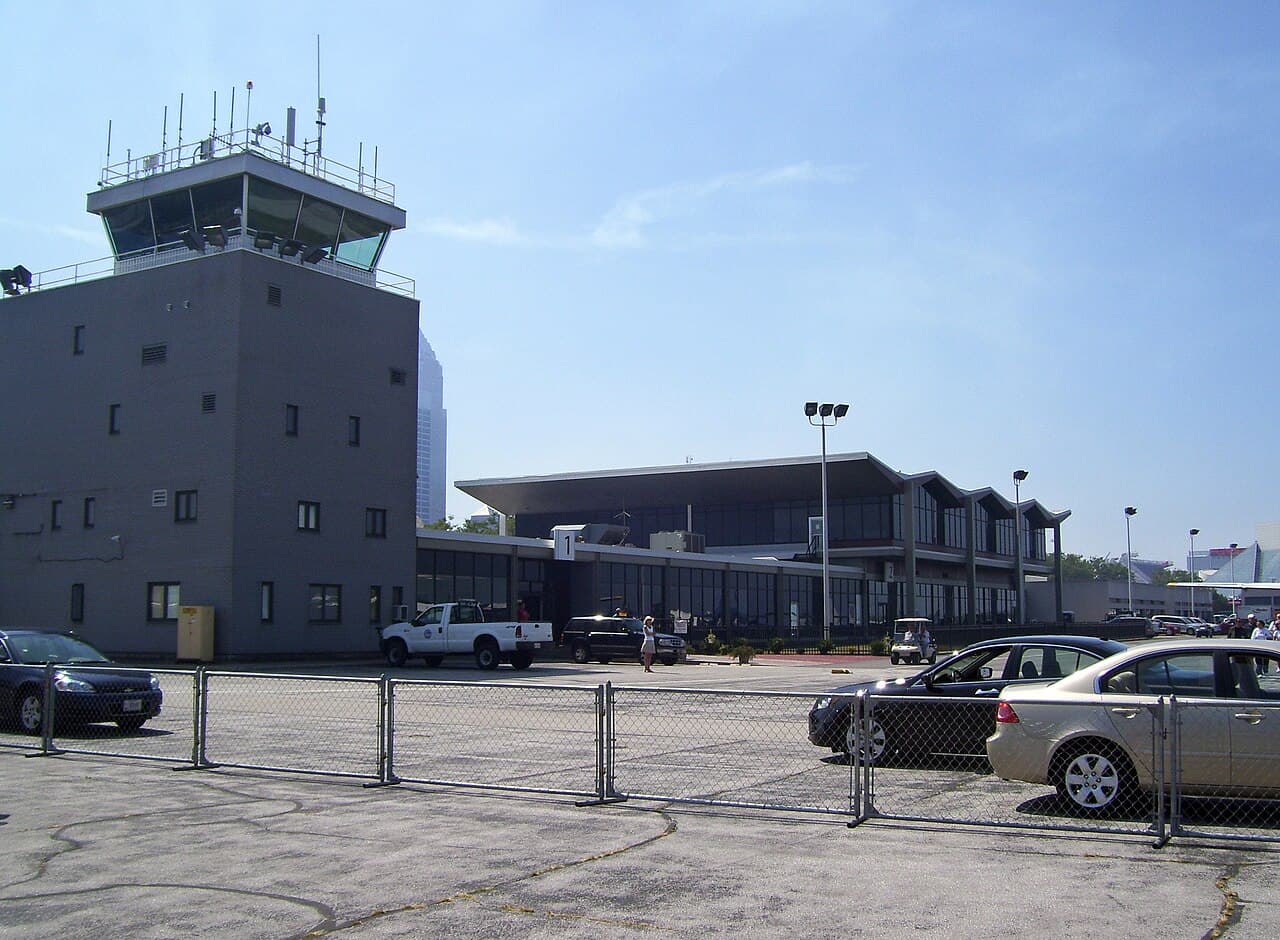
Image: Mr.Z-man · CC BY-SA 3.0 · via Wikimedia Commons
FAA Opposes Cleveland's Plan to Close Burke Lakefront Airport; Congressional Override Lacks Support
FAA Administrator Bryan Bedford publicly opposed closing Burke Lakefront Airport citing future air traffic growth, with local senators rejecting bypassing federal review.
The gist
FAA opposes closing Cleveland’s Burke Lakefront Airport as senators back using traditional review instead of a congressional override.
Continuing coverage
All Faa →- BETA Begins Three-Week Electric Aircraft Test Flights in Southeast Texas
- FAA assigns AT&T central role in $2 billion air traffic network overhaul
- FAA and Ohio Senators Firmly Oppose Closure of Burke Lakefront Airport
- FAA Seeks Billions More to Fund CAP Automation Amid Growing Industry Competition
- FAA Rules Texas Airport Violated Federal Rules by Selling Land for Nearby Housing Development
The Federal Aviation Administration (FAA) under Administrator Bryan Bedford has voiced clear opposition to Cleveland’s efforts to close Burke Lakefront Airport, emphasizing the strategic importance of maintaining airport infrastructure amid projected growth in air traffic and emerging aviation technologies. Bedford explicitly rejected the city’s closure proposal during an interview with News 5 Cleveland, stating the FAA’s stance is generally against shutting down existing airport assets. Instead, the focus should be on how to reopen or expand aviation facilities to accommodate future demands, including drone operations and electric vertical takeoff and landing (eVTOL) aircraft.
Burke Lakefront Airport, primarily serving business aviation, general aviation, flight training schools, and medical helicopter services, has been the focal point of Cleveland’s redevelopment plans for its lakefront area. The city argues that the airport is underutilized and has operated at a multimillion-dollar deficit for over twenty years. Cleveland’s vision includes repurposing the airport’s real estate for parks, recreation, trails, and other urban developments, reflecting a broader push to enhance public access and urban revitalization along the lakefront.
Despite the city’s long-standing financial concerns about Burke, FAA Administrator Bedford and the agency highlight the increasing need to preserve existing airport capacity considering anticipated rises in air traffic volumes. This encompasses not only traditional fixed-wing aircraft but also innovations in air mobility such as drones and eVTOLs, which could require expanded or maintained airport infrastructure. The FAA’s opposition signals the agency’s prioritization of national airspace capacity and readiness over local redevelopment ambitions.
Cleveland’s mayor, Justin Bibb, has sought to explore two pathways to close the airport: through the FAA’s standard closure review process or by securing congressional intervention to sidestep federal regulatory hurdles. However, this latter option appears unlikely to gain traction after Ohio Senators Bernie Moreno and Jon Husted publicly expressed their reluctance to support congressional efforts that would override the FAA’s established procedures. Both senators have recommended adhering to the conventional federal review framework.
Underlying the city’s closure attempt are federal and state grant obligations tied to Burke. These agreements require the city to continue airport operations until at least 2039 or risk having to repay grants. The acceptance of further federal grants could extend these operational obligations. This grant framework acts as a significant barrier to unilateral closure and redevelopment without federal involvement and compliance with aviation laws.
The local community, including general aviation advocates such as Kyle Lewis, AOPA’s Great Lakes Regional Manager, has actively engaged with stakeholders to negotiate a balanced approach. Lewis noted that dialogue with city and federal officials has aimed at finding an unbiased path forward that accounts for diverse interests and concerns. The consensus among these groups is that the city should cooperate with the FAA to develop a comprehensive airport master plan rather than pursue drastic closure measures.
Burke Lakefront Airport represents a valuable asset within Cleveland’s aviation infrastructure portfolio. Though financially challenged, the airport’s role in supporting business and emergency medical aviation as well as flight training underscores its operational significance. The FAA’s position reflects its statutory mission to safeguard and optimize the national air transportation system, weighing local redevelopment against broader aeronautical needs.
The political dynamics surrounding Burke’s proposed closure illustrate the complexity of balancing urban development goals with federal aviation policy and community aviation interests. Cleveland’s negotiations with the FAA and federal legislators reveal the intertwined legal, financial, and political factors shaping the airport’s future. With the congressional override option off the table, Cleveland must now engage in the FAA’s formal closure evaluation, a process that typically involves detailed impact assessments and community input.
Moving forward, the fate of Burke will depend on realistic assessments of aviation demand projections, the airport’s fiscal sustainability, and its strategic value within the region’s transportation ecosystem. The FAA’s opposition and the senators’ stance effectively place a procedural and policy framework around any future decisions. This ensures that airport closure considerations are carefully weighed against airspace management imperatives and federal grant obligations for decades to come.
Frequently asked questions
- Why does the FAA oppose closing Burke Lakefront Airport?
- The FAA opposes closing Burke because it values maintaining existing airport capacity amid anticipated growth in air traffic, including new technologies like drones and eVTOL aircraft.
- What is Cleveland’s rationale for closing Burke Lakefront Airport?
- Cleveland cites underuse of the airport and a multimillion-dollar deficit over two decades, planning to redevelop the land for parks, trails, and recreational facilities.
- Why will Congress likely not override the FAA to close Burke?
- Ohio’s senators have made clear they will not support bypassing the FAA’s traditional review process, favoring adherence to federal procedures over a congressional shortcut.
Read more
All Regulatory →
FAA Rules Texas Airport Violated Federal Rules by Selling Land for Nearby Housing Development
The FAA has found the sponsor of Pearland Regional Airport —a privately owned, public-use airport near Houston—in violation of four federal grant assurances after it sold airport property to a developer that is building hundreds of homes immediately adjacent to the airport.

New Radar at Newark Debuts as DOT Seeks $10B More for Air Traffic Control Upgrades
U.S. Transportation Secretary Sean Duffy and FAA Administrator Bryan Bedford on Monday inaugurated a new surface movement radar (SMR) at Newark Liberty International Airport (KEWR). But the officials are seeking at least $10 billion more for further air traffic control (ATC) upgrades. Duffy has previously requested $19 billion in addition to the $12.5 billion allocated by Congress to the effort in 2025. In July, the Modern Skies Coalition, a group of aviation stakeholders led by the Aircraft Owners and Pilots Association (AOPA), called on Congress to allocate another $20 billion. On Monday, though, Duffy said the Transportation Department (DOT) "would love $20 [billion], but we'll take $10 [billion]." "Hopefully, by the end of this year we'll get it," he told a crowd of reporters at the airport's remote control tower. Duffy and Bedford reiterated that the multibillion-dollar ATC modernization effort should be complete by the end of 2028. The former said that the effort is "actually saving money" that has allowed DOT to begin developing Strategic Management of Airspace, Routes, and Trajectories (SMART)—an AI-powered software that could predict airspace conditions months in advance. The DOT plans to begin testing a "portion" of SMART in September and fully deploy the system by the spring, Duffy said. The goal is for it to come online with infrastructure upgrades such as the new surface movement radar at Newark Airport. Duffy said the $10 billion that he requested Monday will cover the software's development. But he said a "second $10 billion" would be required for building the "actual bricks and mortar" for new ATC towers and facilities, such as terminal radar approach control (TRACON) sites. "[President Donald Trump] has leaned in and has been a great advocate for getting us the money," Duffy said. "He wants updates on how we're doing and how quickly we can go." Bedford was also adamant about securing additional funding. In tandem with infrastructure upgrades and controller hiring, he said SMART will be indispensable in meeting future demand on the National Airspace System (NAS). He said the FAA projects the annual number of passengers flying through the NAS will double from 1 to 2 billion over the next two decades. "We have to have a modern, cloud-based, cybersecure, infinite data capacity system, with modern software," Bedford said. However, it is unclear if $10 billion will be enough to cover that. In July, the Modern Skies Coalition estimated that a new common automation platform (CAP)—designed to combine en route and terminal data—would alone cost $10 billion. ATC Modernization Continues Apace Duffy said the new SMR at Newark Airport replaces a system that is about 30 years old. Bedford said replacement parts are no longer made for the old system. The SMR tracks vehicles on airport runways, taxiways, and ramps and is designed to give controllers better visibility of the ground and aircraft on final approach. "If they can't see out of the tower and see what's happening on the tarmac, they can actually use this radar to actually see on the screens where everything is," Duffy said. Added Kathryn Garcia, executive director of the Port Authority of New York and New Jersey, "this technology will help the controllers who operate this airspace manage their work more efficiently." Bedford said the SMR, built by Saab in upstate New York, was the fifth of 53 planned deployments to the nation's 44 busiest airports. Four more, he said, are deployed at three other sites. Garcia said new SMRs will also be installed at LaGuardia Airport (KLGA) and John F. Kennedy International Airport (KJFK) in 2027 or '28. Duffy said radar outages at Newark last year were influential in Congress' decision to allocate the initial $12.5 billion for ATC upgrades. Two 90-second outages left controllers without radar and communications, prompting several to take mental health leave. The DOT replaced copper wiring that carried telecommunications data from a facility on Long Island, New York, to the Philadelphia TRACON—where ATCs oversee Newark airspace—to help prevent future outages. Bedford on Monday said the airport has seen a "great recovery of reliable operations" since last year but that there is "more to do for sure." That work continues apace. For example, Duffy said that about 60 percent of copper telecommunications wiring has been upgraded to newer systems. That figure was about 50 percent in April. Out of 220 planned surface awareness initiative (SAI) installations, Duffy said that 96 are complete versus 54 in April. Of more than 1,500 radio site conversions, 363 are complete compared to about 250 in April. In addition, Duffy said the agency has installed 151 out of 450 new voice switches and converted from paper to electronic flight strips at 19 of 89 planned towers. He said the effort spans all 50 states and is "one of the largest projects in America right now." At the same time, Bedford said the FAA has hired 4,000 new controllers since the ATC modernization push began. About 1,000 of them are "close to being certified," about 1,500 are training at facilities, and another 600 are at the FAA Academy in Oklahoma City. "It's no secret that the FAA is understaffed at its critical terminal facilities and towers," Bedford said. "So we are moving with urgency to clog the staffing gaps." Getting SMARTer Duffy and Bedford praised the speed of the modernization effort thus far. But Bedford said the program will "not be successful" unless SMART is rolled out in tandem. Duffy said the DOT will "slow-roll different aspects" of SMART rather than introduce the whole system at once. He said the agency has demonstrated it to Congress and plans to do so for Trump. "If there's paths through the weather that we can safely take, we can deploy those for our airlines and increase the through capacity," Duffy said. The secretary said the idea of SMART is not to "outsource" airspace management to AI but rather to give controllers another tool in their toolkit. "We can't control the weather, but we can control the decisions that we make to keep airspace open, or only close airspace when we absolutely have to," said Bedford. "The primary mission of the air traffic organization is to keep things separated. None of that's changing…It's going to create more safe capacity to stop the traffic jams on the airports and get flights moving." FLYING readers can track progress on ATC modernization using the FAA's Modern Skies portal .

Controllers' high sick rates worsened Northeast flight disruptions amid thunderstorms
Nearly 11,000 flights were delayed or canceled Friday as thunderstorms hammered the Northeast and air traffic control staffing problems made recovery harder. Transportation Secretary Sean Duffy blamed controllers calling out sick, but FAA advisories throughout the day suggest weather was the primary driver, with staffing constraints becoming a compounding problem rather than the whole story.

FAA prioritizes certifying Boeing 737 MAX 7 and MAX 10 before 777-9 amid extensive delays
Boeing currently has three aircraft models that have been stuck in certification hell for years: the 737 MAX 7, the MAX 10, and the 777-9. All three of these were supposed to be certified between 2019 and 2020 when initially launched, but over six years later, Boeing has not delivered a single example to an airline. Certification and entry-into-service for all three have been continuously delayed, but earlier in 2026, Boeing provided a more concise timeline. The 737 MAX 7 and MAX 10 will be certified by the end of the 2026 summer season, while the 777-9 will come in 2027.
The Daily Touch & Go
The day's best aviation news in your inbox. Free, no spam.