

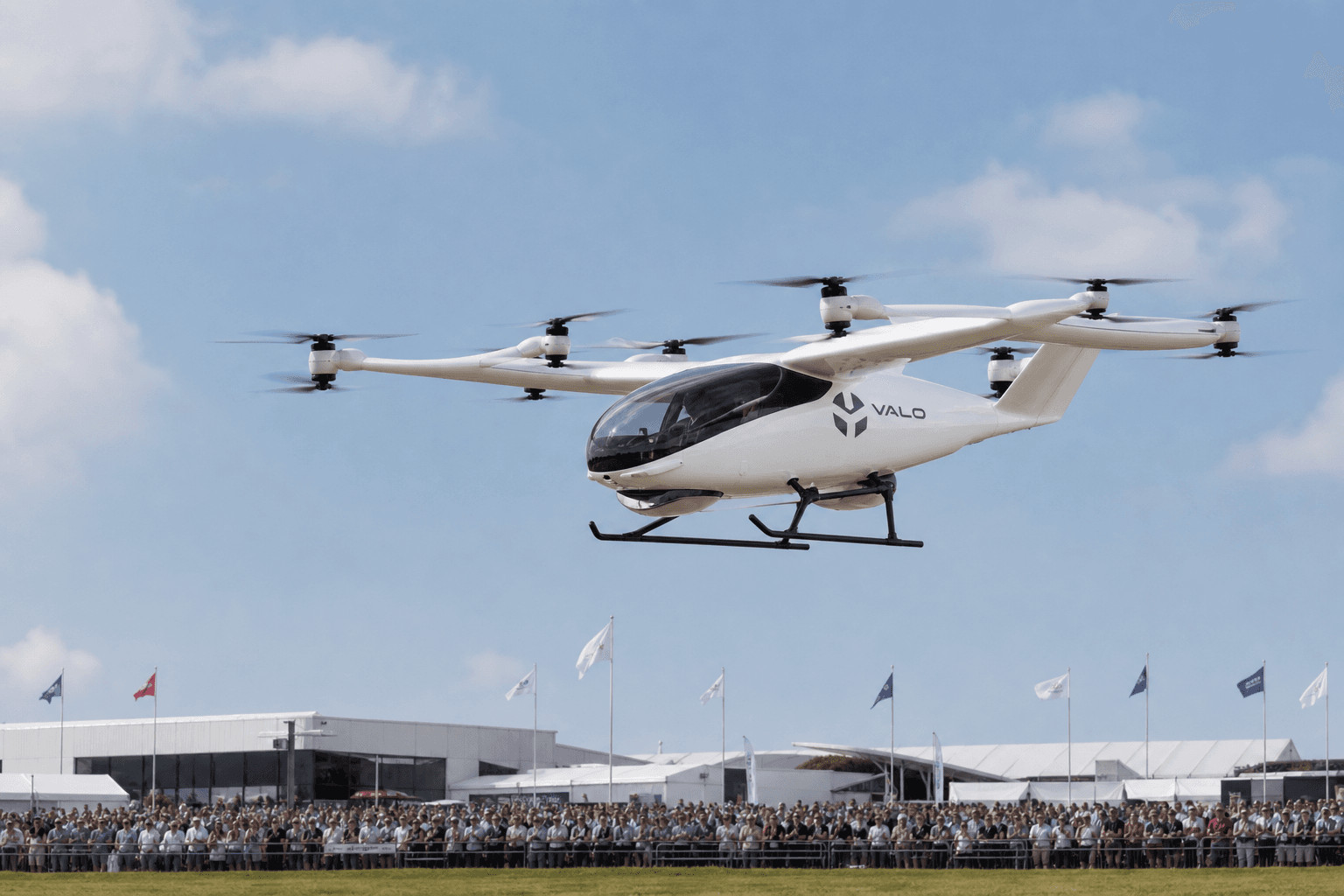
Illustration: The Touch & Go
Vertical Aerospace to Perform First Public eVTOL Flights at Farnborough Airshow 2026
UK's Vertical Aerospace will fly its electric VTOL aircraft publicly at Farnborough 2026, showcasing its Valo model amid progress toward certification and commercialization.
The gist
Vertical Aerospace will debut its Valo eVTOL with public demonstration flights at Farnborough 2026, marking a key step toward commercial electric flight.
Continuing coverage
All Advanced Air Mobility →- North Central Texas Council Launches $1M Fund for eVTOL Airport Chargers
- Electra Achieves FAA Certification Basis Using Desired Path for EL9 eVTOL
- CoachAir CEO Details Digital Infrastructure Vital for Advancing Advanced Air Mobility
- FAA Launches $8.3M Advanced Air Mobility Test Range in Oklahoma City
- DOT and FAA launch $8.3M Oklahoma facility to advance eVTOL research and integration
Vertical Aerospace, a prominent player in UK electric aviation, is set to make history by conducting the first public flights of an electric vertical take-off and landing (eVTOL) aircraft at the Farnborough International Airshow 2026. The company plans to demonstrate its full-scale prototype aircraft, Valo, during the airshow week from July 20 to 24 in a landmark moment for electric aviation in the UK. This debut underlines Vertical Aerospace’s momentum toward certification and eventual commercial operation of their eVTOL technology.
Over the past year, Vertical Aerospace has achieved significant milestones. The company launched its commercial eVTOL aircraft, named Valo, and successfully completed piloted transition flights that moved the design closer to operational readiness. Financially, it has strengthened its foundation and broadened its global technology partnerships, working with sponsors like Honeywell Aerospace, Aciturri, Evolito, and Hyundai WIA. Parallel advances have also been made in their hybrid-electric defense programs and certification efforts.
Farnborough 2026 will feature two primary highlights from Vertical Aerospace. The public can witness live demonstration flights of the piloted Valo prototype. Additionally, a full-scale commercial model of Valo will be on display at the exhibition, allowing attendees to closely inspect the design and meet the development team. This hands-on presence emphasizes Vertical’s readiness to transition from prototype testing to market entry.
The company has recently expanded its operational scope following the UK Civil Aviation Authority’s broadened Permit to Fly, authorizing Vertical to conduct flights beyond its Cotswold Airport base. Test pilots have flown Valo to various locations including RAF Brize Norton and Farnborough Airport itself, gaining vital experience across differing environments that support certification goals. Scheduled demonstration flights at Farnborough will operate weather and regulatory permitting.
Vertical Aerospace is leveraging a robust ecosystem of over 1,500 conditional pre-orders from international customers across four continents. Partners include American Airlines, Avolon, Bristow, GOL, and Japan Airlines, confirming notable market interest. Moreover, a newly announced strategic collaboration with Near Earth Autonomy aims to integrate advanced autonomous flight systems into Valo, broadening the aircraft’s potential for defense and commercial missions.
Leadership at Vertical Aerospace, including CEO Stuart Simpson, will participate in several key panels during the event. Discussions with stakeholders from the UK Civil Aviation Authority, Bristow Group, NATS, and the Department for Transport will focus on the UK’s role in advanced air mobility and strategies to convert developmental lead into durable commercial success. Other industry leaders including CEOs from BETA, JOBY, and Archer Aviation will join for market sector insights.
The company’s roadmap for the coming months signals critical progress toward certification and industrialization. Vertical Aerospace aims to complete its Critical Design Review (CDR) by late 2026, setting the certifiable design baseline. Early production assembly facilities will open in Q3 2026, accompanied by an expansion of the Vertical Energy Centre in Q4. Its hybrid-electric program anticipates selecting a long-term turbogenerator supplier within 2026, with hybrid flight testing planned for 2027.
These initiatives fiscally and technically position Vertical Aerospace at the forefront of the emerging advanced air mobility sector. With a combination of public demonstrations, strategic partnerships, and a growing customer pipeline, Vertical Aerospace's presence at Farnborough heralds a concrete step toward bringing sustainable electric flight into commercial reality.
Frequently asked questions
- What is significant about Vertical Aerospace's participation in the Farnborough International Airshow 2026?
- Vertical Aerospace will conduct the first-ever public electric VTOL demonstration flights at Farnborough, marking a historic milestone for electric aviation at a major airshow.
- What progress has Vertical Aerospace made toward certifying its Valo eVTOL aircraft?
- The company has completed piloted transition flights, expanded its permit to fly beyond its home base, and plans to complete its Critical Design Review by the end of 2026, advancing toward certification.
- Who are some of the key partners and customers involved with Vertical Aerospace's Valo program?
- Key partners include Honeywell Aerospace, Aciturri, and Near Earth Autonomy, while major customers with pre-orders include American Airlines, Avolon, Bristow, GOL, and Japan Airlines.
Read more
All Military/Defense →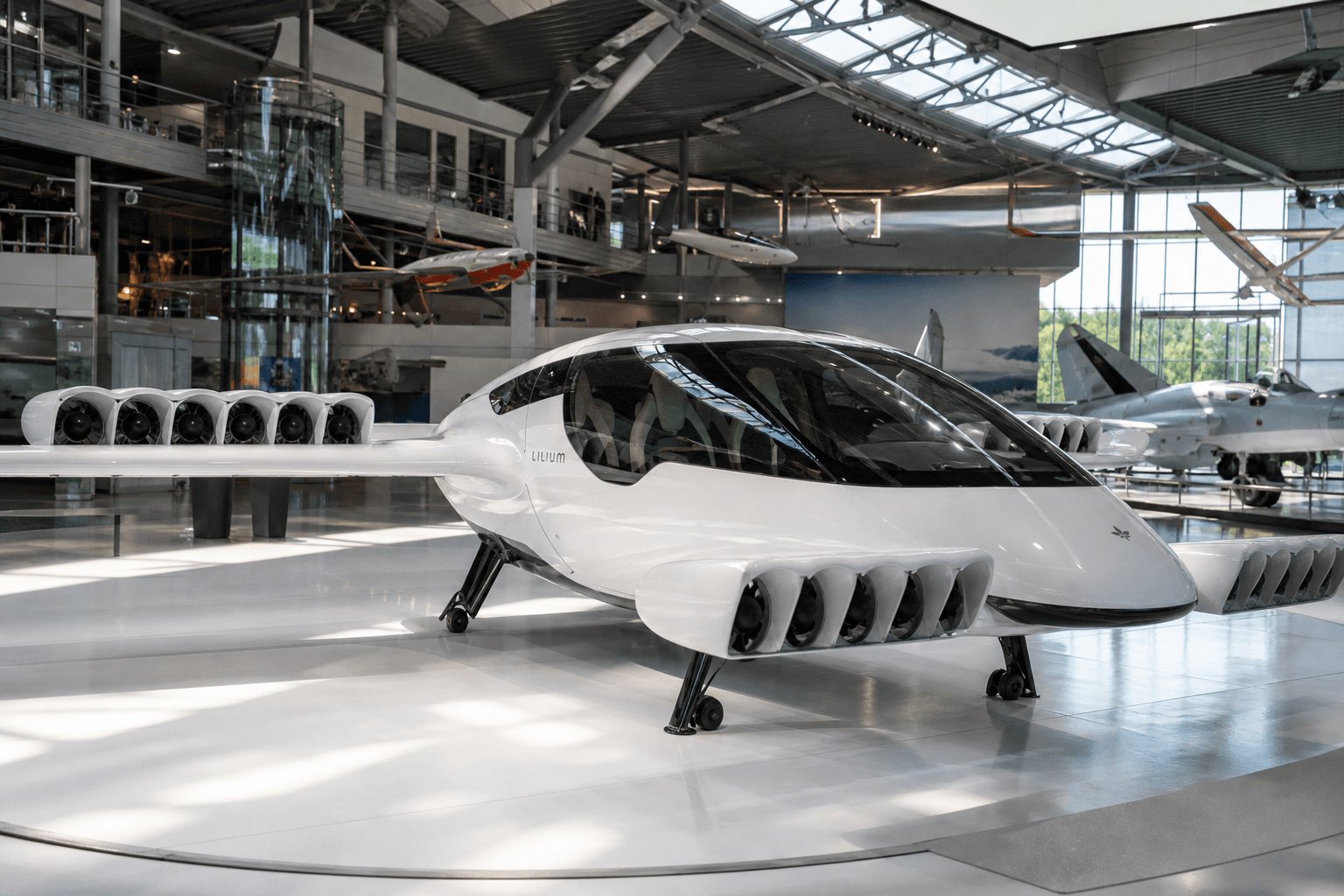
Historic Lilium Phoenix eVTOL prototypes preserved in German aviation museums
The lighter side of Flight International . Museum pieces With a growing list of advanced air mobility ventures giving up the ghost well before their experimental designs reach the market, history risks losing a physical record of their visions. However, thanks to the efforts of Robert Gardemin, the original test aircraft of one of the electric vertical take-off and landing (eVTOL) sector's pioneers have been saved. German developer Lilium filed for insolvency in October 2024. With no buyer found for the company's assets, Gardemin launched a successful crowdfunding campaign to raise €10,000 ($11,600) to rescue the so-called Phoenix scaled prototypes, which he describes as representing "years of dedicated work by over 1,000 people and one of the most ambitious electric aviation programmes ever developed in Germany". The uncrewed test aircraft had been heading for the scrapheap after completing early flight testing in Spain, with one – Phoenix 2 – notching almost 200 flight hours. According to an update from Gardemin on LinkedIn, the prototypes have been transferred to the Deutsches Technikmuseum in Berlin and Luftfahrtmuseum Wernigerode in Saxony Anhalt, where they will be reassembled for display, ensuring that "an important chapter in the emergence of eVTOL technology is not erased but made accessible to the public for generations to come". Joyce’s choices Alan Joyce was a working class lad from Dublin, the son of a cleaner and a factory worker, who through a love of numbers – mathematics, then management science – found himself working for and then running airlines, including, at the age of 42, Qantas. Now, almost three years after he quit as chief executive of the Australian flag-carrier, Joyce has penned a memoir, Riding the Jet Stream . He says he had two motivations – one professional, one personal. He needed to "set the record straight" about his 15-year stint at Qantas, including the grounding of the fleet in 2011, the industrial battles, and steering the business through the pandemic. Former Qantas CEO shares his experiences. Source: BillyPix "I wanted to tell it as it actually unfolded, in the room, under pressure, with every decision carrying enormous consequences for tens of thousands of people," he explains. The other was "more personal", he says. "I wanted to encourage young leaders to learn from my successes and failures, because I think that's where the real lessons sit." He also writes about what it was like to be "one of the few openly gay CEOs in corporate Australia" and how he used his platform for "something bigger than the bottom line, including the campaign for marriage equality". Riding the Jet Stream is available from Hardie Grant Books. Chipmunk at 80 Published to commemorate the 80th anniversary of the de Havilland Canada DHC-1’s first flight, Chipmunk at 80 includes “first-hand stories from pilots, engineers and custodians”, along with over 200 photographs, including rare archive shots. Written by Ben Griffiths and Ian Black, Volume 1 is a fitting tribute to an iconic type much loved by generations of military pilots, air cadets and total aviation people everywhere. Available to order now via chipmunkat80.carrd.co for £37.99. Bristol where-port A confused Doug Brown references a recent picture from The Sun newspaper, illustrating a story about Bristol airport's ambition to introduce long-haul flights. "I couldn't work out why Lulsgate had big X marks on the runway, and a massive displaced threshold I don't remember from landing my Hamble Cherokee there, until I spotted the Brabazon hangars to the right of the shot," he says. The picture was of a Bristol airport, but not the Bristol airport, BRS in Lulsgate Bottom. Instead, it was the former Filton airfield, famous birthplace of Concorde and now largely a housing estate, with the main Brabazon hangar repurposed to a music arena. Yuckspeak We can also coordinate any speaking moments with members of the leadership team = We can arrange an interview. Copa mechanism We are warned to avoid mangling metaphors, but surely there is an exception for Copa Airlines boss Pedro Heilbron's splendid summation of the Panamanian carrier's risk strategy: "We never roll the dice without a parachute." From yuckspeak to tales of yore, send your offcuts to murdo.morrison@flightglobal.com From the archive 1926 Gentleman’s way The Chairman, in thanking Mr. Upson for his talk, said that, having tested most of the methods of getting up into the air, he considered the airship the only gentleman’s way of travelling. His own experience in English airships was that one sat in comfort, there was no noise, one rang a bell for anything one wanted to eat or drink, one gazed quietly out on the scenery, and one could talk. Most of all, however, he would like to know from Mr. Upson when this airship was going to be finished. They had all talked about airships for such a long time, and what he wanted was to see the airship in the air. Mr. Upson said he was very sorry that the one question as to when the airship would be finished was the one that he was afraid he was unable to answer. 1951 ‘The Big Show’ Every evening, Pierre Clostermann recorded the story of his life with the R.A.F., and by the end of the war his jottings filled three large notebooks. They have now been published as "The Big Show", so that “Free Frenchmen might be reminded of their own hopes and loyalties” in those darker years and so that the tales of their sons’ deeds might give some consolation to the families of his fallen friends. Not one of these pages can be passed over lightly. The breathless concentration as the judder of a Spitfire’s cannon answers the anxious thumb at the gun-button, heart-beats quickening at the telephone’s urgent tinkle, the proud yet pitiful show of bravado as the lone pilot returns without his comrades – all those undying moments of a fighter pilot’s life are here. 1976 Amateur aerobatics There is no legislation to prevent an untutored pilot from attempting aerobatics, or to prevent an unqualified tutor from doing aerobatic coaching. This is a curious anomaly. A pilot may not take a passenger at night without being suitably trained and tested, yet he can legally roll his unsuspecting victim upside-down with no formal training at all. It is questionable as to which is more hazardous. Aviation legislation can be meticulous on seemingly petty points – it is only recently that the CAA has proposed making shoulder harnesses mandatory for the front seats of light aircraft – but appears sometimes to turn a blind eye to others. So there is little to prevent a pilot from picking up a few tips from an aerobatic pundit and then going up to try some manoeuvre himself. 2001 After the attacks With the backlog of passengers stranded by the events of 11 September now cleared, the slump in passenger confidence will leave the airlines having to fly, in some cases, near-empty aircraft. With little hope of securing finance from investors, the only solution is a direct injection of Federal cash. Assuming there are no more terrorist attacks, passengers may return, slowly. But airlines will have to cope with the cost of implementing new security measures. Israeli airline El Al is arguably the safest to fly on, but the cost of implementing El Al-style security measures, from pressurised, double armoured doors to the flightdeck, to individually interviewing each passenger, would be crippling. That is why the USA must step in and fund new security measures directly.
Australia's Top End hosts 19 nations and 100 aircraft for Exercise Pitch Black 26
Australia's Northern Territory will serve as a hub of international air power from July 20 to August 7, 2026, as 19 partner nations take part in Exercise Pitch Black 26, a three-week air combat training exercise. The exercise officially launched on July 16, 2026, when Royal Australian Air Force (RAAF) Air Commodore Matthew McCormack, who is commanding this year's edition, joined detachment commanders from participating countries at RAAF Base Darwin. In total, the exercise has brought 100 aircraft and 2,500 personnel from around the world into RAAF Bases Darwin and Tindal, turning both installations into temporary centers of multinational air operations. As #PitchBlack26 heats up, we're shining a spotlight on the combat support teams who keep the mission moving. No. 23 Squadron at RAAF Base Amberley is supporting international tanker aircraft and ensuring safe, efficient airfield operations pic.twitter.com/06Q5MF0z0l — Royal Australian Air Force (@AusAirForce) July 17, 2026 Why the Northern Territory is an ideal training ground #image_title The location is far from incidental. Northern Australia is home to one of the largest military training areas in the world, offering vast, largely unrestricted airspace that few other regions can match. This degree of space matters for an exercise built around modern fighter aircraft, many of which need significant room to operate at full capability. McCormack pointed to that airspace directly, noting that some of the world's most advanced fighters require exactly the kind of operating room that the Top End provides. As #PitchBlack26 heats up, we're shining a spotlight on the combat support teams who keep the mission moving. No. 23 Squadron at RAAF Base Amberley is supporting international tanker aircraft and ensuring safe, efficient airfield operations pic.twitter.com/06Q5MF0z0l — Royal Australian Air Force (@AusAirForce) July 17, 2026 What Exercise Pitch Black training involves At its core, Pitch Black is built around large-force employment missions, exercises that bring together fighter aircraft, intelligence, surveillance, and reconnaissance platforms, air mobility assets, and command-and-control elements in scenarios meant to mirror real-world combat conditions. McCormack described the exercise as war fighter-focused, designed to expose both Australian aviators and their international counterparts to complex, high-end air combat scenarios. The goal, he said, is to sharpen decision-making and tactical skill while preparing participating forces to operate effectively in contested environments. Building relationships that extend beyond the flightline While the flying is the centerpiece, McCormack suggested the exercise carries value that extends well beyond the aircraft themselves. With so many nations training side by side, Pitch Black gives participants a chance to understand how other air forces operate, something that he feels would pay dividends if those same nations should ever need to work together in real conflict. That collaboration isn't limited to pilots. Aircrew, mission planners, engineers and support personnel from across the participating nations are all working together throughout the exercise, building the kind of professional familiarity that underpins effective coalition operations when it matters most. Staged every two years, Pitch Black has become one of the Royal Australian Air Force's signature international exercises, combining demanding air combat training with a rare opportunity for allied air forces to train, coordinate and build trust together at scale. RELATED Royal Australian Air Force announces Exercise Pitch Black for July-August 2026

Australia begins hunt for next-gen lead-in fighter trainer to replace Hawk 127s
The Australian government will explore several financing models to fill trainer requirement. Canberra has reached out to airframers as it explores possibilities to replace the Royal Australian Air Force's (RAAF’s) fleet of BAE Systems Hawk 127 advanced jet trainers. Designated Project Air 6002, the lead-in fighter training system (LIFTS) effort calls for a new aircraft that will train pilots for types such as the Boeing F/A-18F Super Hornet fighter, EA-18G Growler electronic attack jet, and the Lockheed Martin F-35A, according to an Australian government tender document. The requirement also is referred to as FLIF, for future lead-in fighter. The new aircraft will be required to enter service in the 2030s and help pilots develop skills ranging from general and instrument flying to air combat manoeuvres and integrating with other combat assets. "The system must have a sufficiently flexible architecture such that future capabilities can be introduced as future training requirements emerge," says the document. The aircraft could be acquired under several financial models including leasing, Foreign Military Sales, international cooperation, public private partnership, or working with foreign partners. The document does not list the number of aircraft to be obtained, or specifics about when the new type will attain initial and final operational capability. Cirium, an aviation analytics company, indicates that the RAAF operates 33 Hawk Mk-127s with an average age of 25.4 years. In April, the Australian Department of Defence's 2026 Integrated Investment Program document reiterated the need to replace the Hawks among other modernisation efforts. The replacement effort is likely to attract interest from companies such Boeing, Korea Aerospace Industries, and Leonardo.
Strait of Hormuz Tensions Push Airline Stocks Down as Fuel Costs Rise
Global Aviation Round-Up from Aircraft Value Intelligence (AVN) File photo Editor's Note: To watch a video report that concisely examines the themes of this article, click here . Geopolitical flashpoints have a way of upending the market’s priorities. Investors may spend weeks focused on inflation, interest rates, or corporate earnings, only to have an overseas conflict suddenly dominate trading. On Wall Street, the phenomenon is known as "headline risk." The latest example is unfolding in the Middle East. Renewed friction between the United States and Iran is putting the Strait of Hormuz back in the spotlight, injecting fresh uncertainty into global financial markets. One sector particularly hard hit is aviation. Last week at the NATO summit in Ankara, Turkey, President Trump declared that the Iran cease fire was "over." Subsequently, on July 13, Trump announced that the U.S. would be "taking over" the Strait of Hormuz and reinstating its naval blockade on Iran. The result has been a jittery stock market. Major indexes have swung sharply as traders react to each new development out of the Middle East, and some of the market’s biggest losers have been airline stocks. The connection isn’t hard to understand. The Strait of Hormuz is one of the world’s most important oil transit routes, carrying roughly one-fifth of global petroleum supplies. Whenever shipping through the narrow waterway appears threatened, oil traders immediately begin pricing in the possibility of supply disruptions. Even if those disruptions never materialize, crude prices can spike simply because the risk has increased. That’s bad news for an industry that runs on fuel. For most airlines, jet fuel ranks just behind labor as the largest operating expense. Fuel costs can account for 20% to 30% of an airline’s budget, so even a modest jump in oil prices can quickly eat into profit margins. Unlike energy companies, airlines don’t enjoy a windfall when oil climbs. In fact, they’re often caught flat-footed. Seats may have been sold months in advance at fixed prices, leaving carriers little choice but to absorb higher fuel bills until they can gradually adjust fares. That’s why airline stocks often sell off almost automatically whenever oil starts climbing on geopolitical fears. There’s another problem that doesn’t get as much attention: flight operations themselves. Carriers serving Europe, Asia, and the Middle East sometimes have to reroute aircraft to avoid conflict zones or closed airspace. Those detours burn more fuel, lengthen flight times, complicate crew scheduling, and raise operating costs. On a busy international network, those expenses can add up quickly. Taken together, higher fuel bills and longer routes create an unwelcome squeeze on profitability. Investors know the pattern well. When geopolitical risk rises, money tends to flow out of economically sensitive industries and into sectors viewed as safer. Airlines, cruise operators, hotels, and other travel-related businesses often come under pressure, while energy producers and defensive sectors such as utilities or healthcare attract fresh buying. That shift isn’t always a reflection of company fundamentals. It’s often a response to uncertainty itself, and Wall Street hates uncertainty. Past Is Prologue History offers plenty of examples. During the Gulf War, after the September 11 terrorist attacks, and during previous confrontations involving Iran, airline shares generally lagged the broader market. Once oil prices retreated and tensions eased, many carriers recovered. But investors who held through the volatility had to endure some rough stretches along the way. This latest episode has followed a familiar script. Reports of military escalation have pushed crude prices higher and weighed on airline shares. Headlines hinting at diplomatic progress have sparked equally swift rebounds. Those reversals have become almost routine, producing the kind of volatile trading sessions that can leave investors wondering whether they’re watching markets or ping-pong. Indeed, the almost predictable reaction of financial markets to news out of the Middle East has sparked concerns about insider trading. None of that necessarily changes the industry’s long-term outlook. U.S. airlines are generally in stronger financial shape than they were before the pandemic, and demand for both leisure and business travel has remained surprisingly resilient. Travelers have continued booking vacations and business trips despite higher ticket prices, giving carriers some pricing power that didn’t exist a decade ago. Still, there’s a limit to how much cost inflation airlines can pass along. If crude oil remains elevated for an extended period, analysts will almost certainly begin trimming earnings forecasts. Carriers with extensive international operations or limited fuel-hedging programs could face the greatest pressure. Aircraft manufacturers are affected as well. Notably, Airbus recently lowered its forecast for global aircraft demand over the next 20 years, citing the economic effects of the Iran conflict, trade tensions, and a softer-than-expected post-pandemic recovery. The broader market faces a similar dilemma. Higher energy prices can reignite inflation just as central banks have been looking for room to ease monetary policy. If oil stays expensive, policymakers may find themselves reluctant to cut interest rates, even if economic growth begins to cool. Liquidity is the lifeblood of equity markets; investors turn bearish when the monetary spigot tightens. For now, every development involving Iran, U.S. military policy, or commercial shipping through the Strait of Hormuz is likely to keep traders on edge. For airlines and the OEMs that serve them with aircraft, the flight path will probably remain bumpy for a while. John Persinos is the editor-in-chief of Aircraft Value Intelligence . Previously, John covered global financial markets as the editorial director of Investing Daily .
The Daily Touch & Go
The day's best aviation news in your inbox. Free, no spam.