

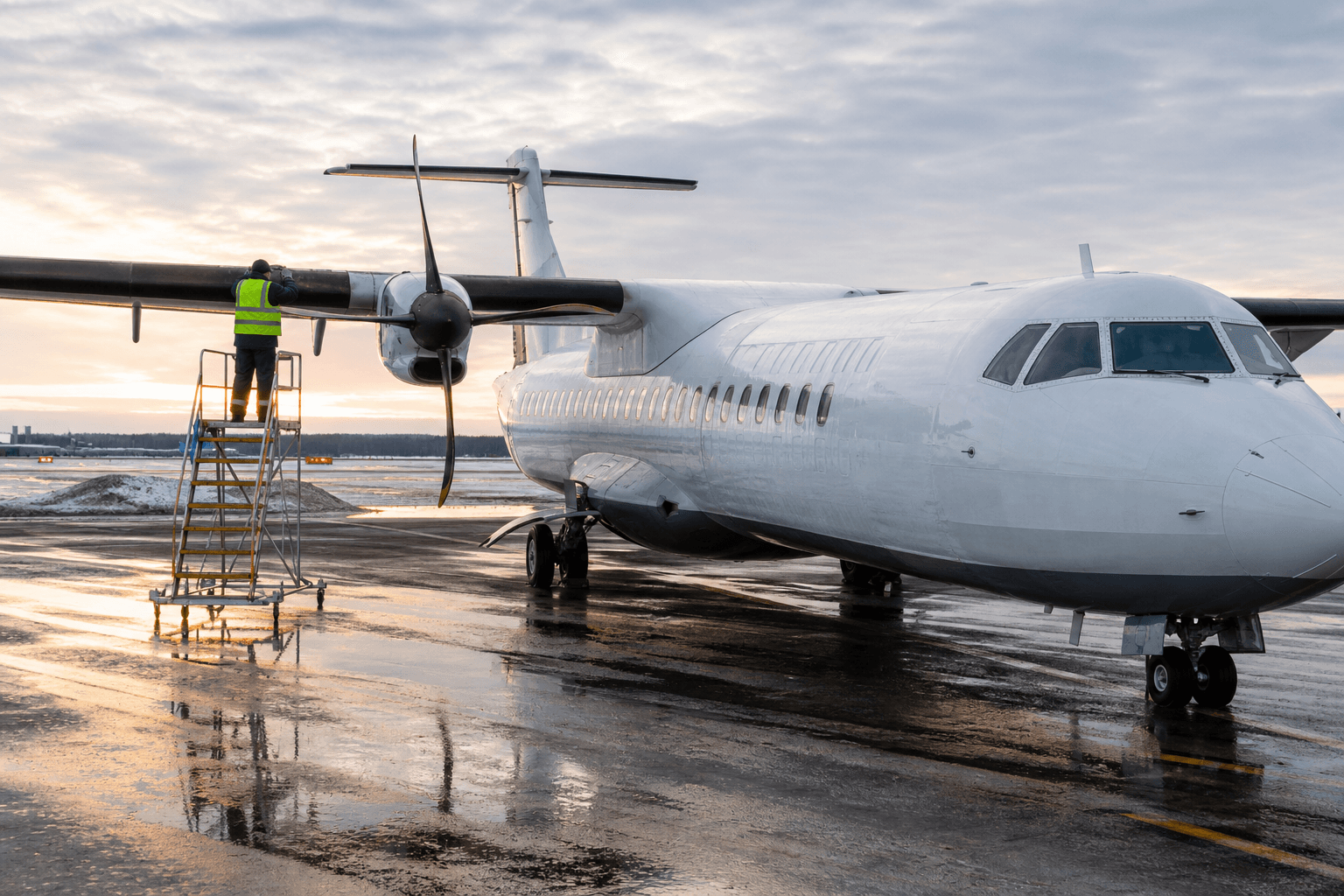
AI-generated illustration
EASA Shortens ATR 42/72 De-Icing Valve Check Intervals After Voepass Flight 2283 Findings
Airworthiness Directive 2026-0219 cuts repetitive functional-check intervals for pneumatic de-icing pressure regulator and shut-off valves to between 160 and 210 flight hours, depending on aircraft configuration.
The gist
EASA now requires ATR 42/72 operators to check de-icing PRSOVs every 160 to 210 flight hours to catch hidden valve failures before icing encounters.
Continuing coverage
All Easa →- Ascendance Rolls Out First Full-Scale Atea Hybrid-Electric VTOL After Eight Years of Development
- Gulf Carriers Extend Saudi Suspensions as Houthi Drones and Missiles Target the Kingdom
- Airbus Banks on 250 Year-End Handovers as A350 Directive, Cathay Order and Buyback Land at Once
- EASA Orders More Frequent ATR 42 and ATR 72 De-Icing Valve Tests to Guard Against Loss of Control
The European Union Aviation Safety Agency has ordered more frequent inspections of the pneumatic de-icing systems on ATR 42 and ATR 72 turboprops, tightening the schedule for functional checks of the valves that feed air to the wing and tail de-icing boots. Airworthiness Directive 2026-0219, dated November 16, 2026, takes effect on November 30, 2026. It targets pressure regulator and shut-off valves, known as PRSOVs, which EASA said can fail in a way that goes unnoticed during normal operations. The directive supersedes AD 2025-0011, which the agency issued on January 10, 2025.
The new requirements follow further technical analysis by ATR and its component supplier, which found that more frequent checks were needed to keep the required safety margins. EASA described the hazard as a dormant failure: a valve can develop a fault that does not show up on routine flights. If that fault is not found and fixed, and the aircraft then flies into icing conditions, the reduced performance of the ice-protection system could lead to a loss of control, the agency said.
ATR 42 and ATR 72 aircraft use inflatable rubber boots along the leading edges of the wings and horizontal stabilisers. Pressurised air cycles the boots, expanding and contracting them to crack off ice that builds up on those surfaces. Ice disturbs airflow, adds drag, cuts lift and raises stall speed, even in small amounts. The PRSOVs regulate and control the pneumatic supply that drives each de-icing cycle, so a faulty valve can leave the boots ineffective when crews need them.
The directive sorts the fleet into three groups. Group 1, the ATR 42-200, -300 and -320, must have PRSOV functional checks every 190 flight hours. Group 2, covering specified ATR 42-400/-500 and ATR 72 aircraft without ATR modification 06076 installed in production or the matching service bulletin embodied in service, moves to 210 flight hours. Group 3, the specified ATR 42-400/-500 and ATR 72 aircraft that do carry modification 06076 or the service bulletin, faces the shortest interval at 160 flight hours.
Those figures are not immediate deadlines on their own. Under the compliance table, the applicable threshold is whichever comes later between the interval since the last functional check and a transitional allowance of 100 flight hours after the directive takes effect. That is capped at maximum limits of 650, 700 and 1,050 flight hours since the previous check for Groups 1, 2 and 3 respectively. Operators therefore need to read the full table against each aircraft's records and modification status.
When a check turns up any discrepancy, operators must complete corrective actions before the aircraft's next flight, following ATR's Airworthiness Operators Message 2024/12, Issue 6. If the published instructions do not fix the problem, the operator must contact ATR for approved corrective instructions and complete that work before the aircraft flies again. EASA said the directive has no terminating action, so the repetitive checks will continue indefinitely.
The work falls on airline engineering departments, Continuing Airworthiness Management Organisations, Part-145 maintenance shops and aircraft lessors. They will need to revise maintenance programmes, track accumulated flight hours by tail number, confirm whether each aircraft has modification 06076, schedule additional maintenance slots and document every check and fix.
The tighter schedule comes in the wake of the investigation into Voepass Flight 2283, an ATR 72-500 that crashed in Vinhedo, São Paulo State, on August 9, 2024, while flying from Cascavel to São Paulo's Guarulhos International Airport. All 62 people aboard were killed. Brazil's Centre for Research and Prevention of Aeronautical Accidents, CENIPA, published its final findings in July 2026, citing severe icing, repeated failures in the aircraft's de-icing system, crew actions and organisational safety deficiencies among the contributing factors. Investigators also raised concerns about how recurring technical defects were managed and how effective maintenance oversight had been.
Originally reported by FL360aero
Read more
All Regulatory →
FAA Orders Checks on 300 Boeing 737NGs Over Thrust Split Monitor Spoiler Data Flaw
An emergency airworthiness directive requires repeated tests of digital flight control systems on older 737NGs whose autothrottle safety monitor may fail to activate.

DOT Inspector General Opens New Audit of FAA Manufacturing Oversight as Six Boeing Fixes Remain Open
The Transportation Department watchdog will examine how the FAA polices manufacturers and their US and foreign suppliers, while six of 16 recommendations from a 2024 Boeing audit are still unresolved.
FAA Urges Pilots to Call Out Runway Number Before Crossing After 2023 JFK Near-Collision
New voluntary guidance under InFO 26016 asks airline, charter and fractional crews to read the runway number off airport signs aloud before crossing, a step the NTSB found missing at JFK.

Modern Skies Coalition Launches ACT NOW Ad Campaign Pressing Congress for ATC Modernization Money
A coalition of more than 50 aviation groups began a national ad push a week after a nearly five-hour nationwide ground stop, as DOT seeks another $50.1 billion for infrastructure.
The Daily Touch & Go
The day's best aviation news in your inbox. Free, no spam.