

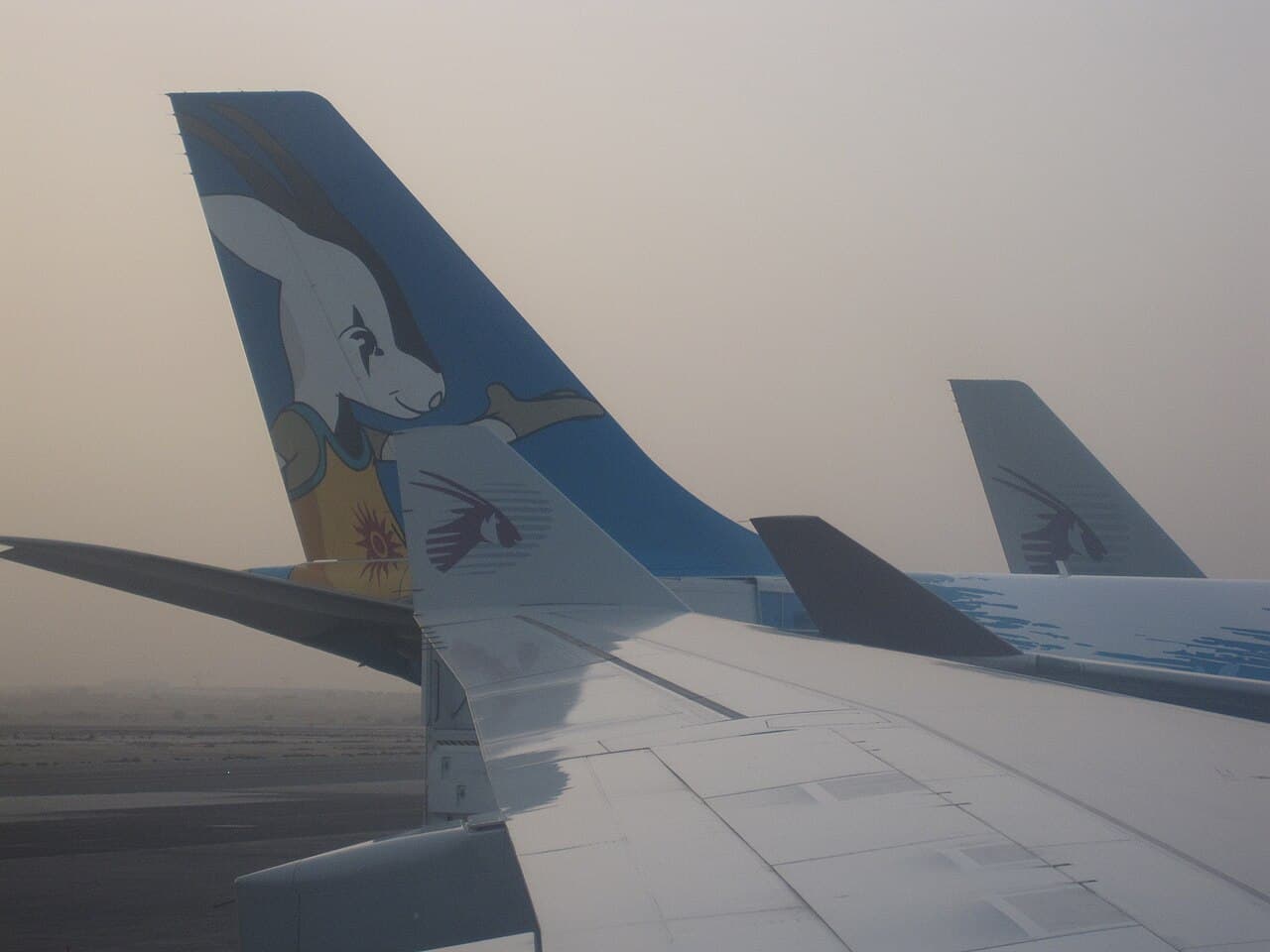
Image: Ciphers · Public domain · via Wikimedia Commons
Qatar Airways Shifts New Zealand Flights From Adelaide to Melbourne Starting December
Starting December 9, Qatar Airways will reroute its Doha to Auckland service via Melbourne, ending its stopover in Adelaide and adding a new Melbourne-Auckland leg.
The gist
Qatar Airways will fly Doha to Auckland through Melbourne instead of Adelaide from December 9, debuting a new Melbourne-Auckland service with its Boeing 777-300ER.
Continuing coverage
All Route Network →- Aer Lingus cuts three US routes and trims fleet amid rising transatlantic rivalry
- British Airways Ends 36 Long-Haul Routes From London Over Past Two Decades
- British Airways Launches 11 Ultra-Long Boeing 787 Routes Including Sydney and Melbourne
- Delta Air Lines Posts $1.6 Billion Q2 Profit on Strong Revenue Growth Despite Rising Fuel Costs
- Singapore Airlines Operates 11 Boeing 737 MAX Routes Up to Nearly 7 Hours
Effective December 9, Qatar Airways is changing the routing of its Doha to Auckland service by replacing its Adelaide stopover with a Melbourne stopover. This shift will mark the airline's first direct service between Melbourne Airport (MEL) and Auckland Airport (AKL), creating a new trans-Tasman route in its network. Separately, the Doha-Adelaide (DOH-ADL) leg will revert to a standalone operation and no longer be connected through to Auckland.
The service will utilize Qatar's 354-seat Boeing 777-300ER aircraft configured without first class but equipped with the carrier's Qsuites business class product and Starlink Wi-Fi for all passengers. This is the same aircraft currently deployed on the Doha-Adelaide-Auckland route, as well as on Qatar's existing Doha-Melbourne route operated in partnership with Virgin Australia, which leases 777-300ER aircraft from Qatar Airways. The airline is expanding to three daily flights on the Doha-Melbourne route later this year, indicating stronger focus on Melbourne as a regional hub.
Looking at the schedule from December 9, the flight will depart Doha at 1:50 AM local time and reach Melbourne at 10:20 PM the same day. The onward connection departs Melbourne at 1:20 AM to Auckland, arriving at 6:50 AM. The return legs see the flight leave Auckland at 1:15 PM, arrive in Melbourne at 3:10 PM, then depart Melbourne at 5:10 PM to Doha, with an 11:25 PM arrival. This timing aims to maximize connectivity primarily with Europe, as Qatar Airways notes significant inbound arrivals around midnight and outbound departures around 1:00 AM at Doha's Hamad International Airport.
This new routing contrasts significantly with the former Doha-Adelaide-Auckland schedule, which had a later Doha departure around 7:30 PM and a lengthy layover in Auckland before returning to Doha. The new Melbourne stopover offers a shorter transit and direct Melbourne-Auckland connectivity, allowing Qatar Airways to enter the highly trafficked Melbourne-Auckland market for the first time.
The Melbourne to Auckland route is one of the largest trans-Tasman passenger flow markets, with approximately 715,000 round-trip passengers traveling exclusively between these cities in the prior year to May 2026. Only Sydney to Auckland sees more traffic in this category. Starting December 10, Qatar Airways will compete directly with established carriers Qantas and Virgin Australia on this route, though its midnight departure from Melbourne may deter some passengers despite competitive fares and a high-quality service offering including its acclaimed business class.
In the December to February period, four airlines will operate on the Melbourne-Auckland route, including Qatar Airways, Qantas, Virgin Australia, and Air New Zealand. The market typically observes about 12 daily flights between the two cities, with up to three on widebody aircraft such as the Boeing 777-300ER and Boeing 787-9. Qatar joins at a time when the competitive environment for trans-Tasman services remains intense, offering travelers more choices in terms of aircraft and service levels.
In the broader context of non-Australian and non-New Zealand carriers flying across the Tasman Sea, Qatar Airways' expansion complements existing operations by Emirates (Sydney to Christchurch daily with an A380) and China Airlines (Brisbane to Auckland five times weekly with an A350-900). Furthermore, Starlux Airlines plans to begin Taipei-Auckland flights via Sydney with an A330-900 four or five times weekly starting in 2027, adding to the diversity of operator options for travelers in this region.
Frequently asked questions
- When will Qatar Airways start flying from Doha to Auckland via Melbourne?
- Qatar Airways will initiate its new Doha to Auckland route via Melbourne on December 9, 2026.
- What aircraft will Qatar Airways use on the new Melbourne-Auckland stopover service?
- The airline will operate the route using its 354-seat Boeing 777-300ER configured without first class, featuring Qsuites and onboard Starlink Wi-Fi.
- How does Qatar Airways’ new Melbourne-Auckland flight times compare to the previous Adelaide stopover?
- The new routing features earlier departures from Doha and shorter layovers, with a late night departure from Melbourne at 1:20 AM, replacing the previous Adelaide stopover which involved later Doha departures and longer ground times in Auckland.
Read more
All Airlines →
EasyJet's Q3 profit crashes 70% amid soaring fuel costs and takeover uncertainty
UK carrier's latest quarterly earnings took a hit from elevated fuel costs and reduced demand. EasyJet's fiscal third-quarter operating profit fell by more than two-thirds after the Iran war led to a £105 million ($140 million) increase in its fuel costs and weaker customer demand. The UK low-cost carrier, which is awaiting confirmation of a proposed £5.7 billion takeover by US investment firm Apollo Management, says the quarter ended 30 June was marred by a reduction in demand as concern over jet fuel supplies hit consumer confidence. However, it points to a "strong" late booking trend and says its seats are 68% sold for the fourth quarter. EasyJet has reported a £104 million operating profit for the period – down from a £293 million profit in the third quarter last year – and a profit before tax of £85 million, representing a 70% year-on-year drop. Its holidays division posted an £84 million pre-tax profit, which is £2 million lower than the same period last year. Group revenue was up 2% while passenger revenue dipped 1%. Capacity during the quarter was 3% higher than the corresponding period last year, but reduced passenger numbers resulted in a 1.3 percentage point fall in load factor to 88.9%. EasyJet expects full-year ASK capacity growth of 6% for fiscal 2026, and says capacity growth will "normalise" in the first half of fiscal 2027. "We have continued to manage the impact of the Middle East conflict, and its effect on fuel prices and booking trends, during the quarter," says EasyJet chief executive Kenton Jarvis. "As consumer confidence increases, we are seeing the load factor gap close for peak summer and an extension of the booking curve." Fuel costs on the unhedged portion of the carrier's fuel were a "headwind" in the third quarter, increasing its bill by £105 million year-on-year. EasyJet is 79% hedged at $786 per metric tonne going into the fourth quarter, but its fuel costs remain "uncertain due to price volatility". It is 62% hedged at $754/MT in the first half of fiscal 2027. Every $100/MT movement in price equates to about £17 million in extra fuel costs, says the carrier. As Airbus A319 retirements "accelerate", the carrier says upgauging will deliver about £250 million of incremental annual cost efficiencies across fiscal 2028 and 2029. Management changes The airline also discloses in its 23 July trading update that chief operating officer David Morgan is retiring from his role, "to return to flying as an EasyJet pilot". He will be succeeded by current chief commercial officer Sophie Dekkers. EasyJet has appointed former Norwegian chief commercial officer Daniel Skjeldam as Dekkers' replacement, effective 1 September. The carrier makes no mention of Apollo's proposed bid in its trading update. The US investment firm has until 7 August to make a firm bid for the airline or walk away. EasyJet has said it is "minded" to recommend Apollo's proposal to shareholders, should it turn into a firm offer. Apollo's proposal trumped an earlier proposed bid by Castlelake, which has, so far, not put forward a higher offer.
Airlines Shift Fleet Design to Expand Premium Cabins, Shrinking Economy Seating
For years, the airline industry has promoted premium cabins as an optional upgrade for travelers seeking extra comfort, additional space, or a more refined experience. Business class, premium economy, and other enhanced seating products were traditionally viewed as extras rather than the foundation of an airline's commercial strategy, while standard economy class remained the core product that filled most aircraft and generated the majority of passenger traffic across domestic and international networks.
USAir's journey from a regional carrier to a cornerstone of American Airlines
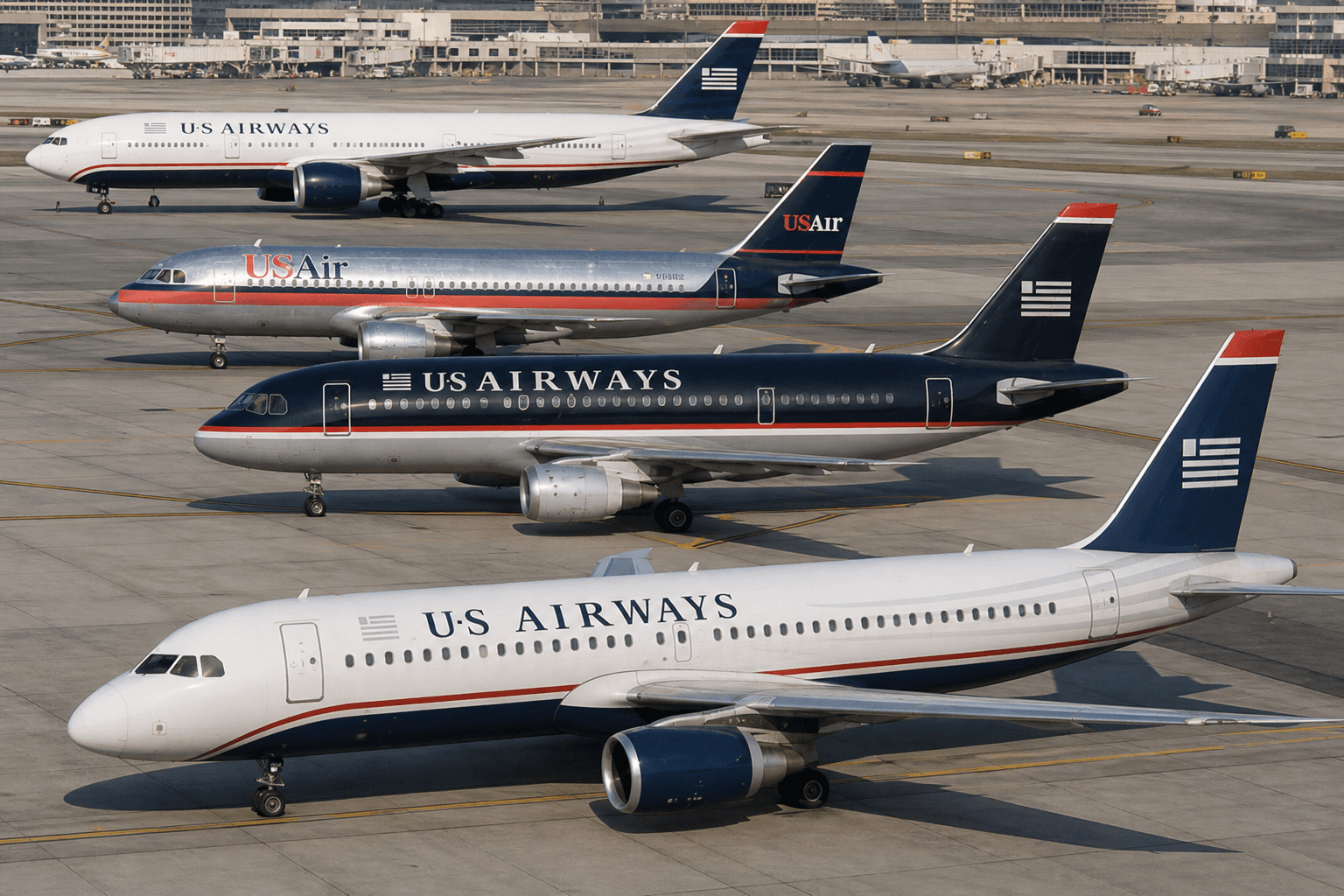
For more than half a century, USAir and its successor, US Airways, were among the best-known names in American aviation. From humble beginnings serving small communities in the northeastern United States, the airline grew into one of the country’s largest carriers before ultimately disappearing into American Airlines. Along the way, it operated an extraordinary variety of aircraft, pioneered major airline mergers and became a familiar sight at airports across North America and Europe. The Origins: Allegheny Airlines Allegheny DC-9. Photo: Dean Faulkner The story begins not with USAir, but with Allegheny Airlines. Founded in 1939 as All American Aviation, the company initially transported mail using small aircraft before expanding into passenger services after the Second World War. In 1953 it adopted the name Allegheny Airlines, reflecting its growing network across Pennsylvania, Ohio and the Mid-Atlantic states. During the 1960s and early 1970s, Allegheny became one of the United States’ “local service airlines”, connecting dozens of smaller communities with larger cities. Its fleet included Convair 440s, Martin 2-0-2s, Convair 580s and Douglas DC-9s, building a reputation for dependable regional service. Building a National Airline A Lake Central Nord 262. Photo: Michael G Smith Airline deregulation in 1978 transformed the US aviation industry and presented Allegheny with an opportunity to expand far beyond its traditional markets. The airline had already begun growing through acquisition. It absorbed Lake Central Airlines in 1968 and Mohawk Airlines in 1972, greatly expanding its route network throughout the eastern United States. Recognising that the Allegheny name no longer reflected its ambitions, the airline rebranded as USAir in 1979. The new identity signalled its intention to become a truly national carrier, with Pittsburgh emerging as its principal hub. Additional hubs developed at Philadelphia, Charlotte and Baltimore as the airline steadily expanded across the country. A Fleet Every Enthusiast Remembers Joseph Vallowe, CC BY-SA 4.0 <https://creativecommons.org/licenses/by-sa/4.0>, via Wikimedia Commons USAir became synonymous with one of the most varied fleets in North America. The Boeing 727 formed the backbone of the airline throughout the 1980s, operating everything from short commuter routes to longer domestic services. Alongside them flew large fleets of Douglas DC-9s and the Boeing 737. A classic USAir F28. Photo: Kev Cook Perhaps most distinctive were the airline’s Fokker F28 Fellowship jets. USAir became one of the world’s largest operators of the Dutch-built regional jet, using it extensively on shorter routes where larger aircraft would have been uneconomic. By the 1990s, the airline had modernised with Boeing 737 Classics, Airbus A319s, A320s and A321s, eventually becoming one of Airbus’ largest North American customers. Widebody operations also developed, with Boeing 767s and later Airbus A330s opening routes across the Atlantic to Europe. Expanding Through Mergers Piedmont operated Boeing 767-200s. Photo: Aero Icarus Like many US airlines, USAir grew significantly through acquisitions. In 1987 it purchased Pacific Southwest Airlines (PSA), famous for its smiling aircraft liveries and extensive California network. The following year it acquired Piedmont Airlines, gaining valuable hubs in Charlotte and Baltimore together with a modern fleet and an extensive route system throughout the eastern United States. These mergers transformed USAir from a predominantly northeastern airline into one of America’s largest carriers. They also brought together three of the country’s most recognisable airline liveries under a single brand. From USAir to US Airways By the mid-1990s, the airline wanted an identity that better reflected its international ambitions. In 1997, USAir officially became US Airways , accompanied by a refreshed dark blue livery and an increasing emphasis on transatlantic services from Philadelphia and Charlotte. The airline continued expanding internationally while strengthening its domestic network, eventually joining the Star Alliance in 2004 before later becoming a member of the Oneworld alliance. Difficult Years US Airways fleet. Photo: Michael Bludworth The early 2000s proved exceptionally challenging. Following the terrorist attacks of 11 September 2001, US Airways suffered a dramatic decline in passenger demand. Combined with rising fuel prices and intense competition from low-cost carriers, the airline entered Chapter 11 bankruptcy protection twice, in 2002 and again in 2004. Despite these setbacks, the airline survived through restructuring, cost-cutting and strategic changes that allowed it to continue operating. America West Changes Everything Paul Carter from Vancouver, WA, CC BY 2.0 <https://creativecommons.org/licenses/by/2.0>, via Wikimedia Commons One of the most significant moments in the airline’s history came in 2005. US Airways merged with America West Airlines, itself a successful carrier based in Phoenix. Interestingly, although the combined airline retained the better-known US Airways name, it was effectively managed by the former America West leadership. Phoenix became an important western hub alongside Philadelphia, Charlotte and Washington National, giving the airline a truly nationwide network. The Merger with American Airlines The final chapter began in 2013. US Airways merged with American Airlines to create what became the world’s largest airline at the time. Initially, both airlines continued operating separately while fleets, staff and reservation systems were integrated. The final US Airways-operated flight took place on 16 October 2015, when Flight 1939 flew from San Francisco to Philadelphia—a flight number chosen to honour the year All American Aviation had been founded. With that, the US Airways brand quietly disappeared after 36 years, although its corporate history stretched back more than seven decades. A Lasting Legacy Photo (c) American Airlines Today, USAir and US Airways live on through American Airlines. Although the name has disappeared, USAir’s influence on modern American aviation remains unmistakable. Its network, its fleet, its hubs and its people all became part of today’s American Airlines, ensuring that one of America’s most recognisable airlines continues to shape air travel long after its final flight. American Airlines also honours its memory through heritage livery jets depicting US Airways, Allegheny, America West and PSA Airlines. What are your memories of USAir or US Airways? Did you ever fly with them? Leave a comment below.
IndiGo selects Honeywell avionics and power units for 810 A320neo jets
US manufacturer Honeywell Aerospace opened the Farnborough air show on 20 July by announcing a massive component deal with Indian carrier IndiGo. The airline will equip 810 incoming Airbus A320neo-family jets with Honeywell Aerospace’s avionics and power systems. Honeywell will also support those components in the aftermarket. The agreements mark a major win for newly independent Honeywell Aerospace, which completed its separation from longtime parent Honeywell in June. “This agreement represents the largest new-aircraft-selectable equipment win in Honeywell Aerospace history, accelerating the company’s expansion,” Honeywell says. The aerospace giant will supply the weather radars, traffic collision and avoidance systems, flight management systems and 131-9A auxiliary power units found on IndiGo’s incoming aircraft. “The scale of IndiGo’s fleet expansion – and their decision to rely on Honeywell Aerospace’s advanced products – underscores the strength of our technology and demonstrates the confidence customers place in Honeywell Aerospace,” says Honeywell president of global commercial aftermarket services Anthony Florian. IndiGo chief executive designate Willie Walsh adds that the agreement will support the carrier’s ongoing “transformation into a truly global airline” and support Indigo’s “reliability, operational excellence and seamless customer experience”. IndiGo has more than 300 A320s already in service and another 70 in storage, and its 810 outstanding orders include A320neos and A321neos, Cirium fleets data shows.
The Daily Touch & Go
The day's best aviation news in your inbox. Free, no spam.