

Image: Joe Ravi · CC BY-SA 3.0 · via Wikimedia Commons
Boeing 777X's Folding Wingtips Prevent Airport Bans Like Airbus A380 Faced
Boeing engineered the 777X with folding wingtips to fit existing airport infrastructure, avoiding the operational restrictions Airbus A380 encountered from its fixed large wingspan.
The gist
The Boeing 777X uses folding wingtips to access existing gates, sidestepping the airport bans that limited the Airbus A380's routes.
Continuing coverage
All Boeing 777x →- Boeing 777-9 Program Hits 4,800 Test Hours as Seventh Plane Begins ETOPS Trials
- Emirates anticipates Boeing 777X stretch variant as it awaits delayed 777-9 delivery
- Airbus A350 Freighter Emerges as Significant Competitor to Boeing in Large Cargo Market
- Boeing 777X Delays Cost Exceed Entire Airbus A350 Development
- Limited Facilities Worldwide Certified to Service Boeing 777X GE9X Engines at Launch
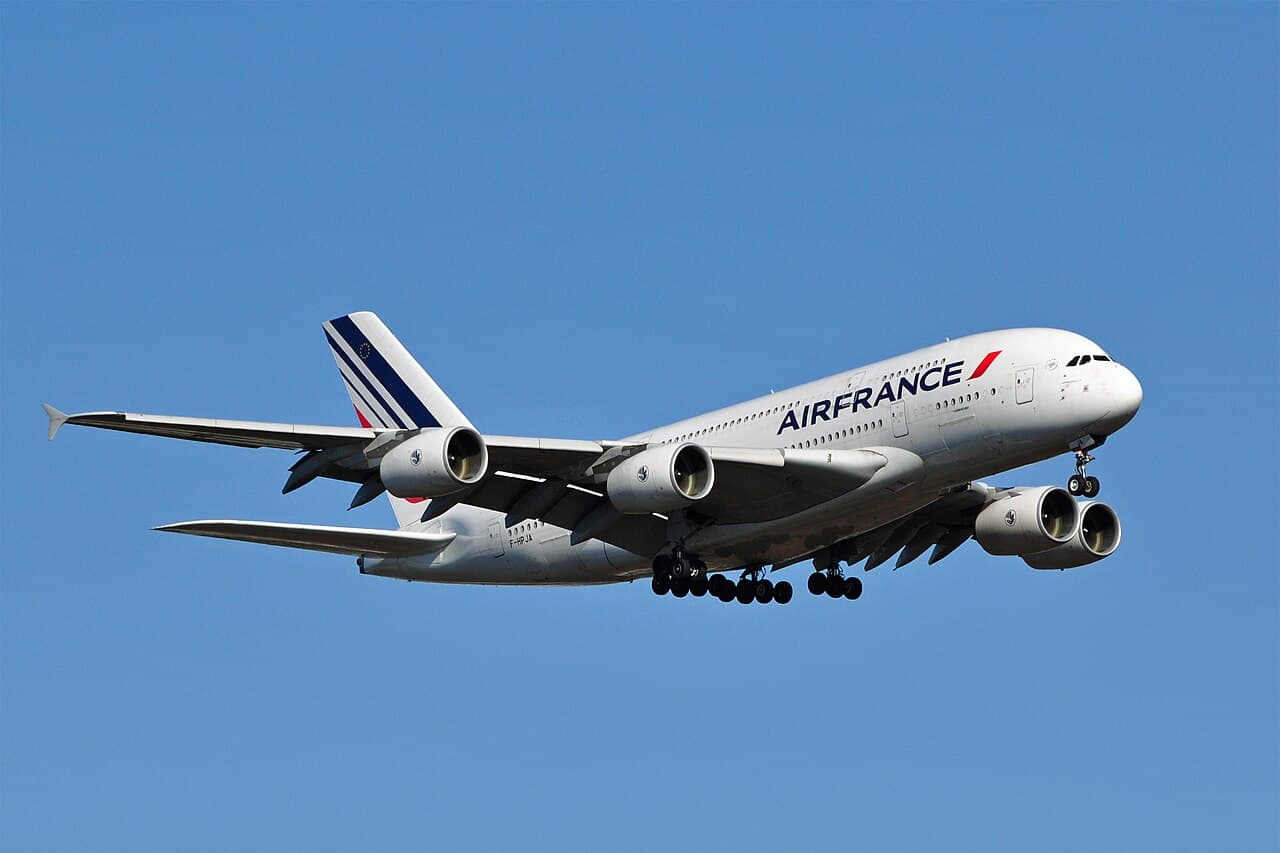
Boeing's new 777X widebody introduces innovative folding wingtips that allow it to operate at many airports without the costly infrastructure upgrades that restricted the Airbus A380. While sharing a wingspan classification with the A380 during flight, the 777X cleverly modifies its ground footprint to fit existing airport gates and taxiways.
The Airbus A380's enormous fixed wingspan of nearly 262 feet required airports to invest heavily in widened taxiways, specially designed gates, and reinforced pavement. Many secondary airports were unwilling or unable to make these modifications, leading to limited A380 service availability and operational bans at some airports.
In contrast, the Boeing 777X has a fully extended wingspan of about 235.5 feet, which places it in the same ICAO Code F category as the A380. However, Boeing equipped the 777X with folding wingtips that reduce the wingspan to roughly 212.8 feet while taxiing and parked, enabling the aircraft to use existing Code E airport gates already serving planes like the 777-300ER and Airbus A350.
The folding wingtips pivot upward approximately 90 degrees after landing, locking in place during taxi and parking. Prior to takeoff, the wingtips unfold and lock fully into position, with multiple redundant electronic and mechanical safety systems preventing takeoff if they are not correctly extended. This ensures that the folding mechanism never compromises flight safety.
This engineering solution draws inspiration from military carrier-based aircraft, which also employ folding wings to conserve space on ships. Applying the concept to a commercial airliner allows Boeing to retain long, fuel-efficient wings for flight performance while bypassing airport expansion challenges.
The 777X’s design choices reflect lessons learned from the A380 experience. During the 2000s, airports worldwide invested billions to accommodate the superjumbo, yet many chose not to upgrade, limiting A380 operations. Boeing deliberately designed the 777X to avoid forcing airports to adapt by tailoring its dimensions to fit existing infrastructure.
Airport compatibility primarily depends on an aircraft’s wingspan and landing gear dimensions, classified by ICAO codes. Code E aircraft, with wingspans up to about 213 feet, can use most large international airports. Code F planes like the A380 require more extensive airport modifications. The 777X operates in Code F in flight but effectively acts as a Code E during ground operations thanks to its folding wingtips.
By enabling the 777X to use existing gates and taxiways, airlines gain capacity benefits without needing airports to invest heavily in new infrastructure or modify terminals. This approach promises greater flexibility and broader airport accessibility for the 777X fleet compared to the Airbus A380, potentially aiding airline route planning and network expansion.
Ultimately, Boeing’s folding wingtip innovation illustrates how aircraft design can influence airport infrastructure needs and operational restrictions. The 777X offers a practical balance: aerodynamic efficiency for flight combined with ground compatibility, avoiding the operational limitations that famously curtailed the Airbus A380’s operational reach.
Frequently asked questions
- How do the Boeing 777X folding wingtips help with airport compatibility?
- The folding wingtips reduce the wingspan on the ground to fit within Code E airport gates, allowing the 777X to use existing infrastructure without requiring costly airport modifications.
- Why was the Airbus A380 restricted from operating at some airports?
- The A380’s fixed large wingspan required airports to upgrade taxiways, gates, and pavements to Code F standards, which many smaller or secondary airports could not or would not implement, limiting its operational access.
- What safety measures ensure the Boeing 777X cannot take off with folded wingtips?
- Multiple redundant mechanical and electronic systems monitor wingtip position and prevent takeoff clearance if either wingtip is not fully extended and locked into place, ensuring flight safety.
Read more
All Regulatory →
United Airlines Considers Buying Up to 20 Early Boeing 777-9 Jets
Boeing’s long-awaited 777-9 aircraft may soon find a new home with United Airlines. Industry reports suggest the U.S. carrier is in talks to acquire as many as 20 of the earliest-built 777-9 jets. ezstandalone.cmd.push(function () { ezstandalone.showAds(119); }); This potential deal could help Boeing clear early production airframes that have waited years for delivery. Why These Early 777-9s Are Still Available The 777X program, which includes the 777-9, faced significant certification delays. As a result, the first airframes rolled out years ago but remained undelivered. During this time, Boeing made numerous engineering updates and improvements. ezstandalone.cmd.push(function () { ezstandalone.showAds(127); }); These early jets now need more extensive modification work compared to newer aircraft rolling off the production line. The extra effort involves bringing them up to the latest standards before they can enter service. Launch customers for the 777-9 reportedly chose to wait for later-production examples. This shift left the early-build jets available for other interested airlines. United’s possible interest offers Boeing a practical way to place these aircraft as the program nears certification and entry into service. ezstandalone.cmd.push(function () { ezstandalone.showAds(128); }); Photo Credit: Boeing What This Means for United Airlines United Airlines already operates one of the world’s largest Boeing 777 fleets. Adding the 777-9 would strengthen its long-haul capabilities with next-generation efficiency and passenger comfort. The 777-9 is the largest variant in the 777X family. It promises better fuel efficiency, longer range, and a more spacious cabin than previous models. For United, these jets could serve high-demand international routes while lowering operating costs. ezstandalone.cmd.push(function () { ezstandalone.showAds(129); }); However, acquiring early-build aircraft comes with challenges. The required modifications may take extra time and resources. Still, securing up to 20 jets could give United a competitive edge in the widebody market without waiting for entirely new production slots. Boeing’s Path Forward with the 777X Boeing has worked hard to resolve certification issues for the 777X. The program represents a major update to the successful 777 family. With improved engines, composite wings, and modern avionics, the Boeing 777-9 aims to set new standards for twin-aisle aircraft. Placing early airframes with United would mark an important milestone. It would demonstrate progress toward final certification and help Boeing regain momentum in the widebody segment. No formal agreement has been announced yet. ezstandalone.cmd.push(function () { ezstandalone.showAds(130); }); Boeing has not confirmed any transaction with United. The reports remain speculative at this stage, but they highlight growing industry optimism about the 777-9’s future. Photo Credit: Boeing Broader Industry Impact The potential deal reflects current trends in aircraft manufacturing. Production delays often create opportunities for flexible operators to acquire aircraft at different stages of the build process. Airlines willing to invest in modifications can sometimes secure favorable terms and earlier delivery timelines. ezstandalone.cmd.push(function () { ezstandalone.showAds(131); }); For passengers, the 777-9 promises a quieter, more comfortable flying experience with larger windows and advanced cabin pressurization. United could use these features to differentiate its premium long-haul offerings. Conclusion As Boeing moves closer to certification, more clarity should emerge about the timeline for these early jets. Industry watchers will monitor developments closely, as any agreement could influence other carriers’ decisions regarding the 777X family. United Airlines has not publicly commented on the reports. The airline continues to modernize its fleet with a mix of new and used aircraft to meet growing global demand. ezstandalone.cmd.push(function () { ezstandalone.showAds(132); }); This possible acquisition of early-build 777-9s shows how delays in major programs can create unexpected opportunities. If the deal proceeds, it could benefit both United and Boeing while bringing advanced widebody aircraft into service sooner than expected.
Emirates anticipates Boeing 777X stretch variant as it awaits delayed 777-9 delivery
Dubai-based airline’s rejection of early-build airframes leaves their fate unclear. Emirates president Tim Clark believes Boeing will be tempted to explore a larger variant of the Boeing 777X – provisionally described as a '777-10' – based on performance data gathered from the prolonged development of the 777-9. Speaking during the Farnborough air show, Clark reiterated his interest in a stretched version, as the Dubai-based carrier awaits delivery of its much-delayed initial -9. "As far as the '777-10' is concerned…we do want a bigger one," he says, remarking that the capability of the 777-9 "is improving". "We already see higher take-off weights coming into the mix. We also see more thrust coming from [GE Aerospace]. "So in the end, the amount of testing they’ve been doing on this aircraft – given the time it’s taken to get out of the door – is already telling Boeing that they have the structural metrics to actually look at a stretch on this aircraft. "So I’m kind of confident that that’s the way it’ll go." He points out that the increased performance of the 777-9, and the possibility of a larger aircraft, appears to have "sparked interest…on the other side of the Atlantic", an apparent reference to Airbus's preliminary investigation of an A350 stretch beyond the -1000. Clark is hoping Emirates' first 777-9 will be delivered in the second quarter of 2027, adding that he expects Boeing will have the twinjet ready to show the carrier – with its power on, and all equipment fitted – in November this year. "And then we just wait for the certification process to complete, and its [extended twin-engined operations capability] programmed," he says. "So far, so good." But Clark states that Emirates has already informed Boeing that the carrier will not be taking any of the early-build models of the 777X initially destined for the airline, owing to the extensive rework that they would need to bring them up to the current delivery standard for the jet. Change incorporation Boeing is undertaking a process it calls "change incorporation", assessing some 30 777Xs to determine how much work is required to update them to delivery standard. This situation is a result of the 777X's long incubation period which meant early airframes, built to acquire experience and intended for airline service, have essentially become outdated. "Those airframes that were built for us…I was on board the first one, kitted out completely – except for our game-changer first-class suites," says Clark, adding that this was in 2019. "And when I got on board, the [folding wing-tips] were flapping for me…and [they were] trying to show me that it was all – not 'la la land', but they did actually work – and one thing and another. "I thought, this is great, I’m going to get this aircraft out of the door by maybe April [2020], and then, of course, it all went wrong." The pandemic disrupted the air transport system, particularly the long-haul market, for the next two years. "If we were to take those [early] aircraft in the first quarter of next year, they’ll be nearly eight years old, they’re half-life and no use to anybody," Clark states. "At the same time, we've been intimating to Boeing that's not the way they should go. "Quite honestly, if it had been me looking at these kind of things, looking at the prognosis…at some point, I would have provisioned for the write-off. And I would have charged that to my [profit-and-loss account]." Clark says there is "no point" in leaving the inventory on the balance sheet when delivery is "unlikely". "I probably would have said, 'These aren’t going anywhere'," he adds – although he acknowledges that Boeing might be able to "give them away" for a heavily-reduced price. "They have been standing on their wheels, with no engines of course, for some time. We last saw them a few years ago, parked outside Renton, all greened-up, looking very sad. "But the fact is, that’s commercial reality now. If they can, if they can get them out, that’s good to somebody who might buy them." Clark says this would mean carrying out the change incorporation work. "Whether or not that’s worth doing, whether or not you just cut them up, is up to them," he says. But he insists Emirates – which accounts for "10 or 11" of the early 777-9s – will not accept these aircraft. “We’ve already told them that," he adds. Clark says Boeing is focused on 737 Max 7 and Max 10 certification. "As soon as they've gone, their concentration is to get the [777-9] out the door," he says. "[Boeing] honestly thinks, and we believe, that with all the work that’s been done – the mods have been done, the latest mods on the engine – when it gets into the fleet, it’ll be almost a mature aeroplane. After all, it should be that, given that it’s probably the most tested aircraft in history. So we'll see."
Boeing 777X Delays Cost Exceed Entire Airbus A350 Development
Few commercial aircraft programs have experienced a certification journey as prolonged as the Boeing 777X . Originally expected to enter airline service in 2020, the latest member of the 777 family is now scheduled to arrive in 2027, representing a delay of roughly seven years.
Airbus A321XLR Gains Ground as Boeing 737 MAX 10 Faces Certification Delays
The Boeing 737 MAX 10 has an impressive and strong customer base, including United Airlines, Ryanair, American Airlines and Delta Air Lines. However, recent years have not been kind to the largest 737 MAX variant, which has suffered from a hefty backlog. It is not expected that the jet will become operational and certified until the end of this year.
The Daily Touch & Go
The day's best aviation news in your inbox. Free, no spam.