

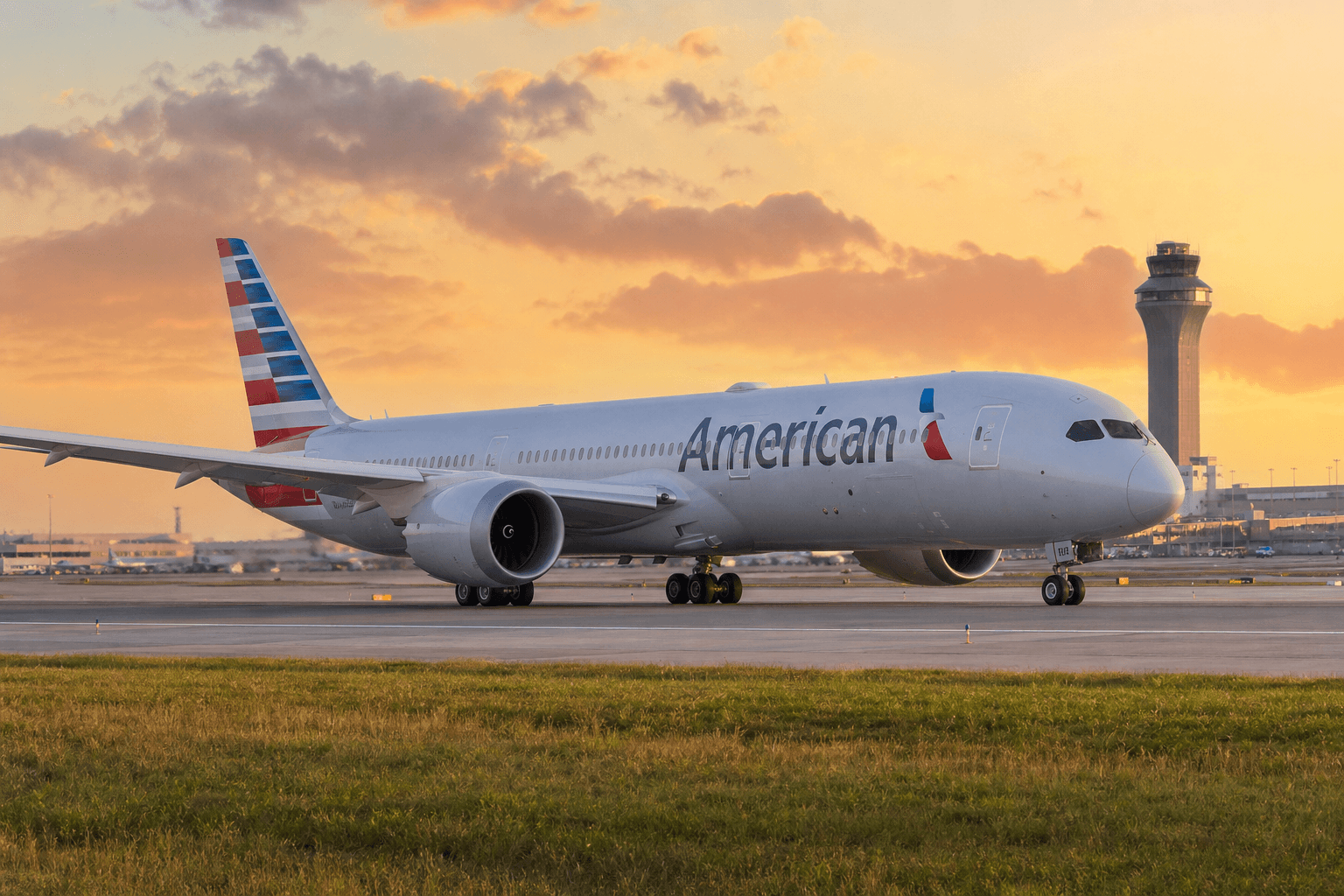
Illustration: The Touch & Go
American Airlines Struggles to Match Delta and United in Profitability Despite Market Size
American Airlines, while one of the world's largest carriers, posted a slim 0.2% net margin in 2025, significantly trailing Delta and United due to strategic missteps in fleet and sales approaches.
The gist
American Airlines posted a mere 0.2% net margin in 2025, lagging far behind Delta and United despite huge revenues and fleet size.
Continuing coverage
All Delta Air Lines →- Delta Confirms Seattle-Singapore A350 Flights Marking Asia Expansion
- Delta Air Lines Ends Narita Hub Following 2008 Northwest Merger, Shifting Asia Strategy
- Delta CEO Ed Bastian Often Chooses Economy to Hear Real Passenger Experience
- Federal Judge Approves Class Action for Delta Pilots Denied Paid Military Leave
- US Citizen Detained by ICE at Delta Gate Due to Mistaken Identity
Founded in 1930 through the merger of 80 airlines and shaped further by a 2013 merger with US Airways, American Airlines is today one of the largest global airlines, carrying over 223 million passengers in 2025. Yet, despite its scale, American suffers from one major drawback compared to its main U.S. rivals: profitability. The Dallas-based carrier recorded a record $54.6 billion revenue last year, yet its net income was a modest $111 million, translating to a narrow 0.2% net margin. In contrast, Delta Air Lines and United Airlines posted substantially higher profits and margins, with Delta earning $5 billion (7.9% margin) and United $3.4 billion (5.7% margin).
This vast profit disparity largely stems from American’s strategic choices during and after the pandemic. While Delta and United preserved much of their older widebody fleets with relatively low ownership costs, American retired older long-haul aircraft like the Boeing 757s, 767s, and Airbus A330s amid the pandemic. When demand rebounded faster than anticipated, American’s remaining long-haul capacity was insufficient to serve more than key trunk routes, limiting growth opportunities. Meanwhile, Delta and United not only resumed core routes but also expanded secondary European destinations attracting premium leisure travelers, offsetting weakened corporate demand.
Another critical strategic error was American’s 2023 push to force corporate clients to book directly via the airline by reducing indirect sales channels. This led to a diminished sales department, removal of competitive fares from third-party platforms, and restrictions on mileage accrual through indirect booking channels. The move backfired as major corporate accounts defected to competitors. By 2024, CEO Robert Isom acknowledged the misstep, admitting the airline moved too fast and its execution was poor. Restoring these corporate relationships remains a priority for regaining profitability.
To close the profitability gap, American is focusing on expanding premium offerings and rebuilding its long-haul presence. The airline’s latest Boeing 787-9 fleet exemplifies this shift, configured with fewer seats overall but significantly more lie-flat business class (increasing from 30 to 51 seats) and additional Premium Economy seats. Older aircraft, including Boeing 777-300ERs and 777-200ERs, are also being retrofitted to expand premium cabins. By the end of the decade, American aims to boost its international lie-flat seating capacity by over 50%, signaling a deliberate shift away from lower-yield economy seats toward higher-margin premium passengers.
However, premiumization extends beyond seating configurations. American must enhance the entire passenger experience to compete with carriers like Delta, which excels in customer experience, and United, which leverages a large global network combined with premium amenities. Investments in connectivity, operational reliability, and revamping the AAdvantage loyalty program are integral to attracting and retaining the high-yield corporate travelers who generate a significant share of airline profits.
Encouraging signs of recovery include American regaining its historical share of indirect bookings by late 2025, a strong rebound in managed corporate revenue with a 26% year-over-year increase in Q2 2026, and 13.4% growth in premium passenger unit revenue. The airline also reported a more than 30% rise in AAdvantage loyalty program enrollments, suggesting strengthening customer engagement after the earlier downturn caused by distribution strategy changes.
Long-haul capacity expansion, however, is not just about increasing seat count; it requires deploying aircraft and configurations that maximize premium revenue. American’s strategy with the new Boeing 787-9, which carries 41 fewer passengers than its predecessor but adds 21 business class and 11 Premium Economy seats, is a targeted approach to increase revenue potential on high-yield routes such as those to London Heathrow, Zurich, and Sydney without adding frequencies. With 30 more 787-9s expected through 2029, this premium-focused deployment aims to improve profitability on critical international markets.
Network growth is also being supported by the Airbus A321XLR, which American introduced as the first U.S. operator in December 2025. Its smaller size, with just 155 seats including 20 Flagship Suite business class seats, allows economically viable long-haul service to secondary airports. This could open new markets and feed premium demand without the high cost of larger long-haul jets, helping American diversify its international reach.
Overall, American Airlines is adopting a multipronged plan to regain lost ground by optimizing its premium product and sales strategy, though its relatively late start in these areas has allowed Delta and United to capitalize on post-pandemic market shifts. How swiftly American can translate these strategic adjustments into meaningful profit gains will determine if it can close the sizable gap with its top competitors in the coming years.
Frequently asked questions
- Why does American Airlines have lower profitability than Delta and United?
- American's lower profitability results from retiring older long-haul aircraft during the pandemic, limiting capacity recovery, and a failed 2023 effort to force corporate customers to book directly, causing account losses.
- What steps is American Airlines taking to improve its premium passenger experience?
- American is increasing lie-flat business class and premium economy seats on new and retrofitted aircraft, enhancing connectivity and reliability, and upgrading its AAdvantage loyalty program to attract premium passengers.
- How is American Airlines expanding its long-haul capacity to compete with rivals?
- American is adding more premium seats on Boeing 787-9s and 777s and introducing the Airbus A321XLR for long-haul routes to secondary markets, aiming to maximize premium revenue without simply increasing frequencies.
Read more
All Airlines →
American Airlines revamps leadership to boost lagging profits against Delta and United
American Airlines is shaking up its senior leadership as CEO Robert Isom faces growing pressure to improve the carrier's financial performance and close the gap with rivals Delta Air Lines and United Airlines. The changes broaden oversight across American's commercial and operational teams and bring former Spirit Airlines Chief Operating Officer John Bendoraitis into the company to lead technical operations. In a memo to employees, Isom acknowledged a "meaningful gap" between American's current performance and where he said the airline should be, describing the leadership changes as the first in a series of moves aimed at improving execution and strengthening the company. Isom announced that Chief Commercial Officer Nat Pieper will add marketing and branding to his responsibilities, while Chief Customer Officer Heather Garboden will take on reservations and service recovery. JC Gulbranson will add oversight of airports and planning. Garboden and Gulbranson will also join American's senior leadership team. Chief Communications Officer Ron DeFeo is stepping down. Caroline Clayton will oversee communications, while Steve Neuman will lead government affairs. Both will join the senior leadership team. The changes come as American continues to trail Delta and United on profitability. American expects roughly break-even results for 2026 as higher fuel prices weigh on earnings. Earlier this year, the airline said a sharp increase in jet fuel costs could add more than $4 billion in expenses compared with its previous assumptions. American has also been under pressure from its labor unions. The Association of Professional Flight Attendants issued a unanimous vote of no confidence in Isom in February, saying the airline had fallen behind competitors in profitability, operational performance and overall competitiveness. The union has called on Isom to step down. The Allied Pilots Association has also questioned whether American's current management can close the performance gap with Delta and United. APA President Nick Silva recently told pilots that the union had sought a meeting with American's board to discuss concerns about the company's future but was rebuffed. He said the union had since spoken with analysts, investors and other stakeholders. Despite the criticism, Isom has said American is not changing its overall strategy. He said the airline continues to focus on expanding its global network, increasing premium revenue and strengthening its AAdvantage loyalty program. American has also been investing in premium seating, lounges, onboard connectivity and changes to its hub schedules as it works to improve revenue and operational performance.
United Airlines CEO predicts just two US premium carriers amid mixed passenger experiences
United CEO Scott Kirby says there may be room for only two premium U.S. airlines, but passengers keep posting photos and complaints that make United's own case harder. Also new Priority Pass-accessible grab-and-go Atlanta "lounge," a DCA shutdown for the DC Grand Prix, Ritz-Carlton Pentagon City inspection issues, and a car hitting an aircraft at Milan Linate.
American Airlines' Sun Belt Strategy Reflects Constraints More Than Choice, Experts Say
Insiders argue American Airlines has reversed disastrous sales and distribution mistake while still running the same old strategy that left it weak in major markets. That critique is partly right, but incomplete: American's Sun Belt focus was less a fresh strategic choice than the result of years of retreat from competition, premature aircraft retirements, slot and gate constraints, and a long-running failure to value the markets that drive loyalty and credit card spend.

Frontier Airlines Expands International Routes Amid Global Challenges
Top airline news stories for August 15, 2026 (click the link for the full details): Frontier Airlines expands its international routes Economic challenges at Nepal Airlines Hawaiian Airlines prepares for Tropical Storm Lala Air Seoul prepares for its merger Capital Airlines to return to Vancouver Phoenix ATC controller notices two American flights with the same […]
The Daily Touch & Go
The day's best aviation news in your inbox. Free, no spam.