

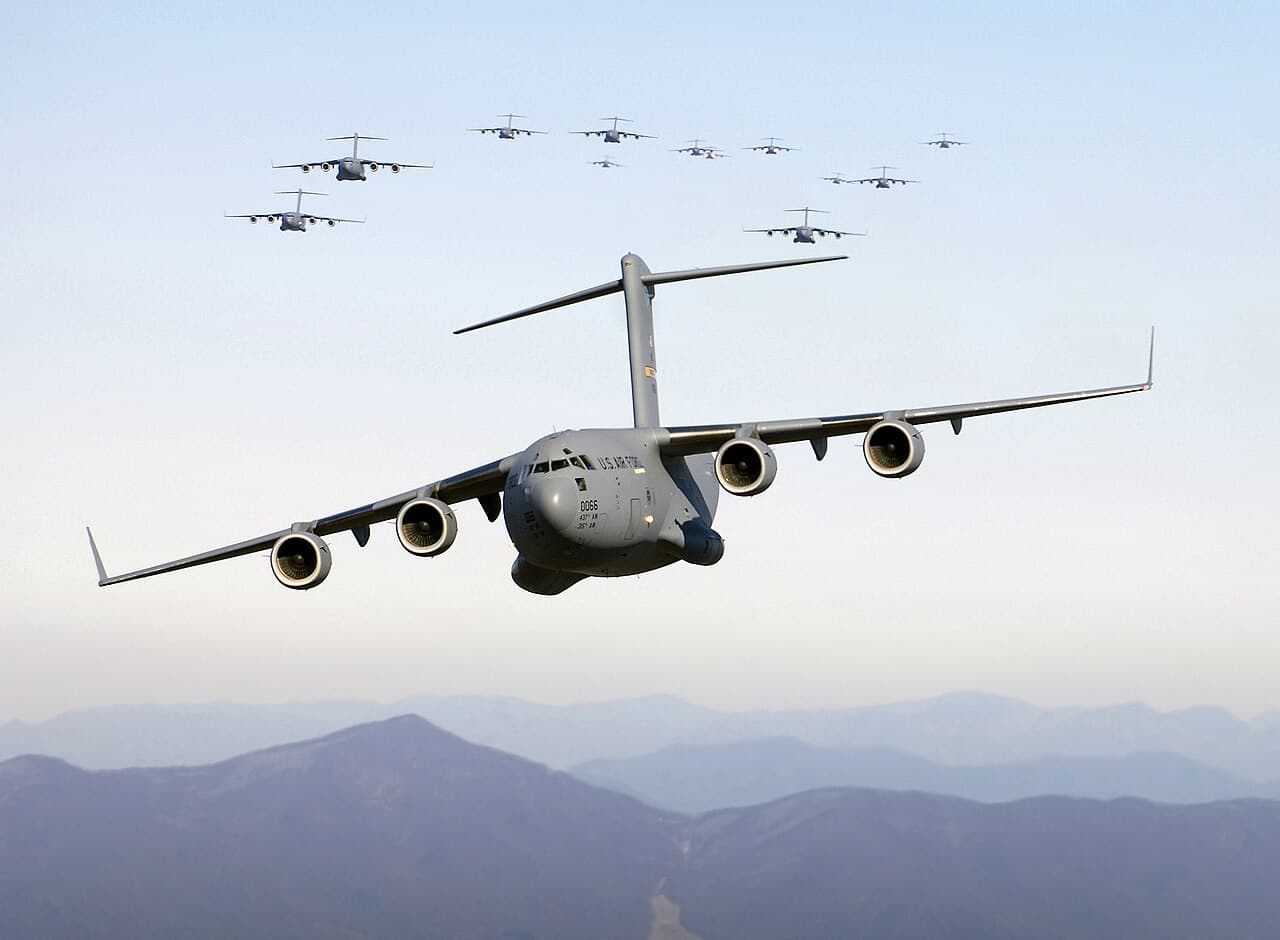
Image: Staff Sgt. Jacob N. Bailey, U.S. Air Force · Public domain · via Wikimedia Commons
Boeing's Data-Driven Upgrade Set to Extend C-17 Globemaster Service Through 2075
Boeing introduces Aircraft Data Reasoner software to boost C-17 fleet readiness and predictive maintenance, supporting US and allied operators worldwide.
The gist
Boeing's new Aircraft Data Reasoner software enhances C-17 maintenance, extending its operational life through 2075 and improving global fleet readiness.
Continuing coverage
All Boeing →- FAA Signals Imminent Certification for Boeing 737 MAX 7, MAX 10, and 777X Jets
- Boeing Forecasts Nearly $5 Trillion Market for Aviation Services and 2.4 Million Jobs by 2045
- Boeing Plans New Clean-Sheet Jet After Completing 737 MAX and 777X Certification
- Boeing predicts steady 20-year aircraft demand despite current travel slump
- Boeing dismantles never-flown 777-9 amid costly rework and program delays
The McDonnell Douglas C-17 Globemaster III, last produced in 2015, remains crucial to US Air Force (USAF) global airlift capability, with its fleet expected to operate until 2075. Boeing, having absorbed the original manufacturer, is driving a major software upgrade known as Aircraft Data Reasoner (ADR) to prolong and optimize the C-17's longevity. This technology leverages system data and forecasting algorithms to perform predictive maintenance across the 222 C-17 airframes in service with the USAF, aiming to preempt failures before they occur.
The ADR enhancement improves fleet readiness by identifying parts likely to fail, reducing excess wear, and improving supply chain management. Beyond the USAF, the upgrade benefits international C-17 operators—including Australia, Canada, the United Kingdom, India, Kuwait, Qatar, the United Arab Emirates, and NATO partners—by supporting a unified sustainment model. This global approach enables coordinated maintenance and parts sharing among the diverse operator group, maximizing mission readiness.
Central to ADR’s value is its integration with Boeing's C-17 Digital Engineering Services database, which aggregates maintenance data across the global fleet. This centralized system forecasts component failures and optimizes the Virtual Fleet Spares Pool, cutting redundant inventory and enhancing part availability. Moreover, cross-servicing agreements, such as the one since 2019 between the USAF and the Royal Australian Air Force, standardize maintenance practices to allow for inter-service cooperation on aircraft upkeep.
The operational impact of ADR is significant despite appearing modest in percentage terms. Historical data shows a 2% to 3% increase in aircraft availability—translating to thousands of additional flight hours annually and substantial cost savings from fewer parts and reduced labor. For smaller operators, like the eight-plane Australian C-17 fleet, even a few percent improvement in availability can prevent large reductions in strategic airlift capacity caused by unexpected breakdowns.
Travis Williams, Boeing’s vice president of Mobility and Surveillance Aircraft Services, emphasized that the ADR provides near-real-time insight into component health. This predictive capability not only raises mission readiness and curtails unscheduled downtime but also supports smarter decisions in parts positioning and sustainment logistics across the global fleet. As the C-17 accumulates significant operational hours, these efficiencies become increasingly critical.
The system continuously analyzes data from over 65,000 aircraft parameters using 36,000 sensor-based algorithms, successfully mitigating thousands of non-mission-capable hours and cutting down tens of thousands of maintenance hours. This proactive maintenance approach replaces blind troubleshooting with data-driven interventions, exponentially increasing aircraft availability and reducing lifecycle costs.
For Boeing, the ADR represents a strategic move to safeguard profitability under the fixed-fee sustainment contract model. Since no new C-17s are being produced, the company’s revenue depends entirely on maintaining readiness within established budgets. Unplanned mechanical failures trigger costly emergency repairs and logistics expenses that must be absorbed by Boeing, so predictive maintenance is critical to controlling costs and maintaining profit margins.
The USAF, with over 80% of the global C-17 inventory, stands to gain most from this upgrade. A 3% rise in aircraft availability equates to five to seven additional heavy-lift transports ready for missions daily, without the expense of procuring new airframes. Smaller international fleets benefit proportionally more from avoiding unplanned maintenance, preserving their limited strategic airlift resources.
The evolution of the C-17 Globemaster and Boeing’s implementation of ADR demonstrate a strategic focus on leveraging digital technology to sustain aging but essential military airlift assets. By integrating extensive sensor data and predictive algorithms, the upgrade enables the fleet to meet future mission demands efficiently, balancing operational capability with cost-effective support across a multinational operator base.
Frequently asked questions
- What is Boeing's Aircraft Data Reasoner and how does it improve the C-17 fleet?
- The Aircraft Data Reasoner is a software upgrade that uses system data and algorithms to predict component failures before they occur, enhancing maintenance planning and reducing unexpected downtime in the C-17 fleet.
- Which countries operate the C-17 and benefit from the ADR upgrade?
- Besides the US Air Force, C-17 operators benefiting from ADR include Australia, Canada, the United Kingdom, India, Kuwait, Qatar, the United Arab Emirates, and NATO, all participating in a unified sustainment model.
- How does the ADR upgrade impact Boeing financially?
- By enabling predictive maintenance, ADR helps Boeing reduce costly emergency repairs under its fixed-fee sustainment contracts, protecting profit margins by keeping maintenance predictable and efficient.
Read more
All Military/Defense →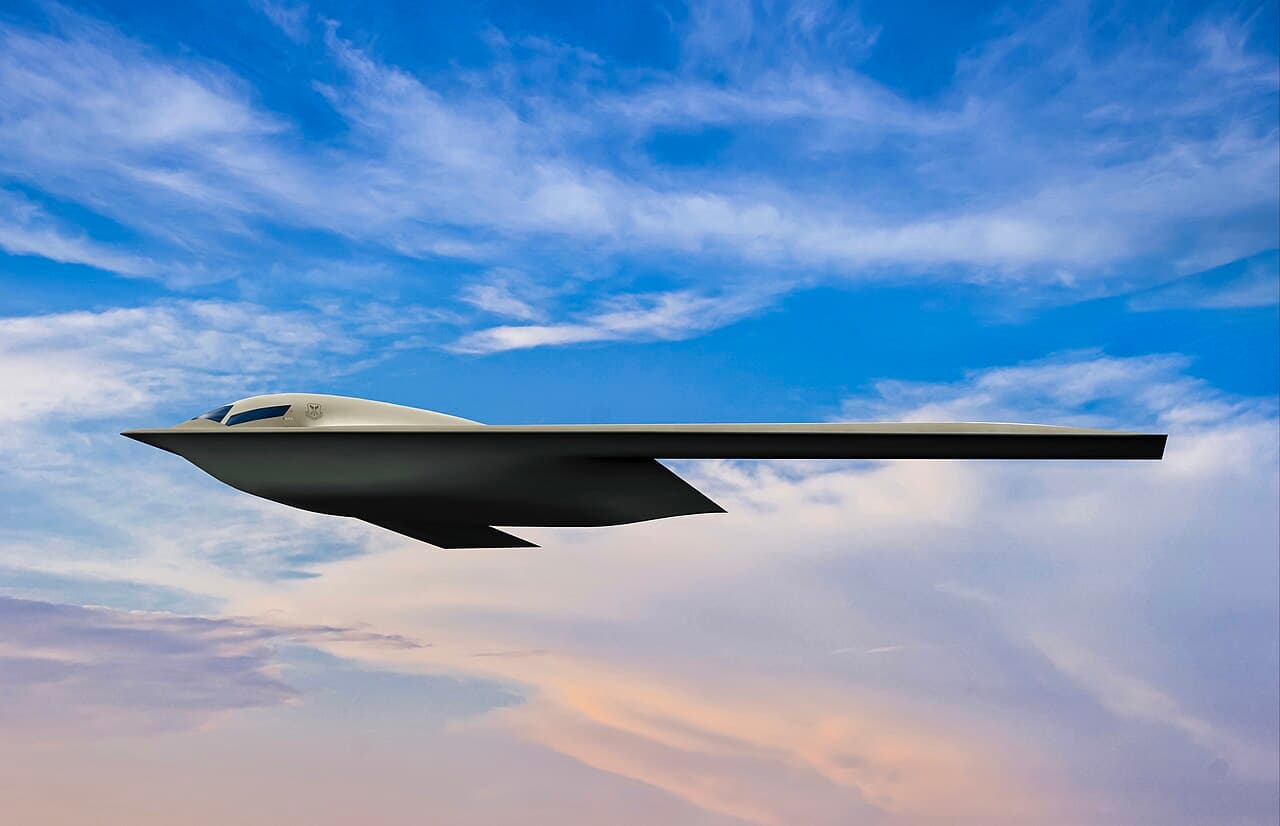
USAF to Convert B-21 Raider Test Jets Directly into Combat Bombers from 2027
The United States Air Force has a couple of test Northrop Grumman B-21 Raiders that are blurring the line between testing and fielding. The B-21 Raider is expected to enter service in 2027, making it the world's first all-new strategic bomber to enter service since the B-2 Spirit entered service in 1997. China is also working to develop its Xi'an H-20 stealthy strategic bomber, but it is unclear when it will enter service.

South Korea upgrades F-15K fleet with advanced BAE EPAWSS electronic countermeasures
The BAE-produced Eagle Passive Active Warning Survivability System is meant to help the non-stealth F-15 survive against modern air defences. South Korea will field an advanced electronic warfare system on its fleet of Boeing F-15K Slam Eagle fighters meant to protect the jets from modern ground-based air defences. BAE Systems developed the ALQ-250 Eagle Passive Active Warning Survivability System (EPAWSS), which uses electromagnetic jamming to reduce the ability of air search radars to detect and lock on to the non-stealthy F-15. The all-digital, internally carried system provides 360° threat detection and countermeasures, according to BAE. This allows pilots to operate in hostile and signal-dense electromagnetic environments. “Its advanced capabilities complement the speed, range and payload of the F-15, enhancing combat airpower and air superiority,” the company says. The EPAWSS is in active production for the US Air Force F-15 fleet, including new-build F-15EX Eagle IIs and retrofits for existing F-15E Strike Eagles. The country-specific F-15Ks operated by the Republic of Korea Air Force (ROKAF) are derived from the two-seat F-15E, with 59 jets currently in service. Boeing, which is the prime contractor for sustainment of Seoul’s Slam Eagle fleet, issued a contract to BAE on 13 July to provide the EPAWSS for the F-15Ks. "We are working closely with Boeing, the ROKAF and regional industry teams to deliver the most technically advanced [electronic warfare] system for the F-15K aircraft upgrade," says Phillip Casalegno, F-15 international programme director at BAE Systems. The countermeasures package will improve the ROKAF’s ability to counter current and future threats and ensure interoperability with US forces, BAE says. Notably, BAE has for the first time confirmed the frontline deployment of the EPAWSS. Although the company is not providing specifics, this presumably came during the campaign of heavy bombing launched by the US and Israel in late February. “The system has been employed in operational settings and is continuously improved via software and firmware updates,” BAE says of the EPAWSS. Washington deployed hundreds of fighters, bombers and mobility aircraft to the Middle East as part of that multi-week operation.

Boeing to Introduce MQ-28 Ghost Bat for UK Collaborative Combat Aircraft Program
Australian-developed CCA aimed at future operational requirement. Boeing will be promoting its MQ-28 Ghost Bat at the Farnborough air show, in anticipation of a future UK requirement for an operational collaborative combat aircraft (CCA). "We definitely see some applicability in terms of its capability, and certainly in terms of its maturity to the UK armed forces," says Thom Breckenridge, managing director of Boeing Defence UK. "BD UK could be an important partner in sustainment and potentially other pieces, when we think payload or otherwise," he said during a pre-show briefing on 13 July. The UK's recently published Defence Investment Plan (DIP) details a CCA demonstration activity which will see a UK system flown before 2030, describing such a platform as an " autonomous fighter jet ". It did not, however, provide any firm detail about a possible future acquisition. "We are very enthusiastic about the platform and the capability, and certainly see applicability for MQ-28 in the UK," Breckenridge says of the Australian-developed Ghost Bat. "The maturity of the platform relative to competitors sets it apart, in addition to the unique capability and the way it was developed," he claims. Boeing also will use the 20-24 July event to promote its T-7A Red Hawk, which is among several likely competitors for the Royal Air Force's (RAF's) future jet trainer requirement. "We think it's the best answer for the UK's JTS [jet training system] competition," says Boeing Defence UK fixed-wing director Ben Kelsey. "It brings not just an aircraft but a ground-based training system, and synthetic alongside live training, in a way that we think answers the UK's needs better than any other solution." The process of selecting a replacement for BAE Systems' Hawk T2 remains at an early stage, with the DIP outlining an initial £360 million ($482 million) through the rest of this decade towards a fleet recapitalisation that also will provide new aircraft for the RAF's Red Arrows aerobatic display team. "We are thinking about how we position that [proposal] best for the UK," Kelsey says, referring to a letter of intent signed last November under which BAE would perform final assembly of the T-7 if it is selected for RAF service. "We will be looking with interest at the RFP [request for proposals] as that evolves over the next few months," he says, with Boeing committed to "bringing as much [work] as possible into UK suppliers". Boeing Defence UK will in December mark the 30th anniversary of its formation, with the company having grown from an initial six employees to a current total of 2,000. Its personnel are located at multiple military sites, among them Lossiemouth, Waddington, Wattisham, along with Bristol and Gosport. Its main activities include delivering comprehensive support for the RAF CH-47 Chinook and British Army AH-64E Apache helicopters, and for the RAF's P-8A Poseidon maritime patrol aircraft. It also delivers pilot and maintainer training for the air force's fleet of C-17 strategic transports, using a facility in Farnborough. "We are in places where the RAF or the army are, and we are working alongside them every day," Breckenridge notes. The company is also supporting the ongoing introduction of the E-7A Wedgetail airborne early warning and control system, with the first of three 737NG-based examples having been undergoing testing since May at RAF Lossiemouth in Scotland. The RAF’s first of three E-7A Wedgetails arrived at its Lossiemouth base in May. Source: Crown Copyright "We are looking forward to seeing E-7 go through flight trials over the coming months and then get into service in due course, as well as seeing the next couple of aircraft get finished," Kelsey says. "We have got some work ahead of us with the RAF as we go through that final testing stage, but we have got a dedicated, focused team who certainly see the need to get that capability completed and handed over. "The need to get E-7 into service is clear, and we are very focussed on that. But we are very focussed also on making sure that the product is safe and to the quality level that we'd expect, so that it delivers as we know it can, as a world-beating capability."
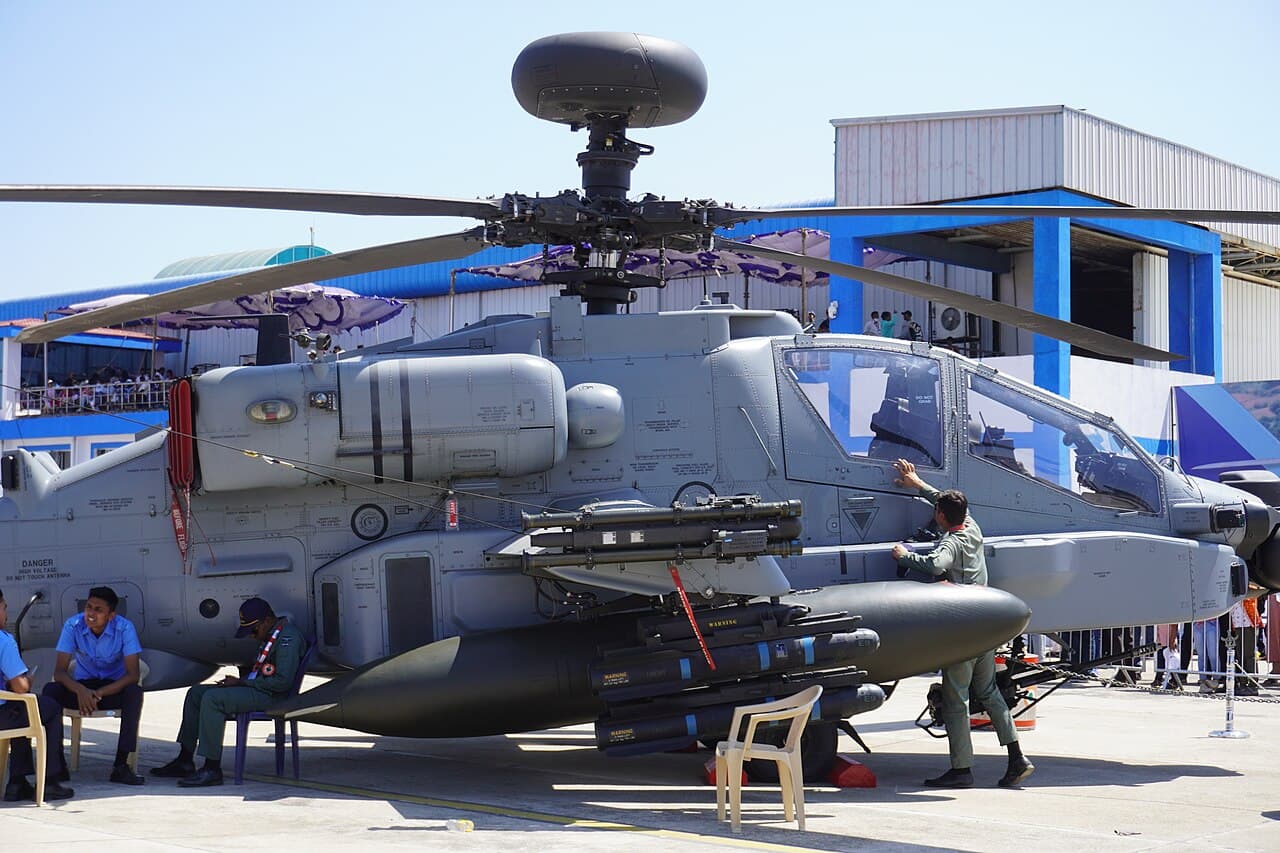
Boeing Eyes AESA Radar to Boost Apache Attack Helicopter Against Drone Threats
More capable sensor would boost detection of airborne threats. Boeing is advancing further enhancements for its AH-64E Apache to boost the platform's ability to engage non-traditional threats such as one-way attack drones. The US Army has used the attack helicopter to "great effect" in the counter-drone application recently in the Middle East, including in the Strait of Hormuz , says TJ Jamison, Boeing's director of business development for attack helicopter programmes. That has included using a new air-to-air mode with its Longbow fire-control radar to "help locate enemy drones coming in and engage and destroy them". "Adapting to change is nothing new for the Apache – it has been doing it since its inception," he notes. "The next chapter is we take lessons learned from Ukraine [and] the ongoing conflict with Iran… as we continue to modernise and adapt this aircraft to meet the changing face of warfare." He refers to a US Army trial conducted last year named Operation Flyswatter, during which the service "flew 14 small-, medium- and large-scale drones at two Apaches". The rotorcraft shot down 13 of the targets, with the remaining one having accidentally flown off the exercise area, ruling it out from being engaged. Among enhancements now being made to the type include the use of a new proximity fuze on the 30mm shells fired from its chin-mounted cannon, so that a direct hit is no longer required to bring down a drone. Meanwhile, the Apache's V6.5 software standard, which Jamison says is "in the process of finalising its certification and testing, and will be fielded soon… [with] increased range, lethality and survivability", uses an open system architecture, enabling rapid updates. "The goal is to get it as simple as a download on your iPhone," he says, while adding: "We're not quite there yet." Another option being explored by the US Army would involve the integration of a fuselage-mounted active electronically scanned array (AESA) radar. "Now you can see the next generation of drones – the very small, swarm type – all organic to the aircraft," Jamison says of the possible addition. "There are a number of OEMs that have an AESA capability currently that we are looking at for potential integration into Apache as we continue down that army modernisation path," he says. However, the service has made no decision yet about funding any such update. Noting that the Apache's original Longbow radar detection capability gave "an 8km [4.3nm] range", necessitating the sensor to be installed on top of the rotor mast, he says: "As you get out to the 50, 60, 70km range, hiding it behind a hill or a tree or a building is not quite as critical as it was when we had that shorter range." Boeing also sees an opportunity to potentially use directed energy, microwave or electronic warfare capabilities to counter the drone threat in the future.
The Daily Touch & Go
The day's best aviation news in your inbox. Free, no spam.